That is a question that always answers itself

Let me give you some Jeep perspective. Coil sprung Jeeps, with the now exception of the Unlimited, come with a short arm five link suspension. When highly lifted the control arms become very angled, which causes all kinds of problems on and offroad. A very common solution is the radius arm y-link.
The reason for this is the Jeep axles already have upper arm mounts, so it is a very simple redesign - you just need new "frame" mounts for the longer radius arms. Due to bushing size, you can get a ton of flex with just a johnny joint at the frame and rubber at the axle.
The problem with this approach is you are trading one set of problems for another. The long radius arms solve for the angle problem, but they introduce the unloading issue common to radius arm suspensions on steep climbs and create a substantial reduction in clearance due to arm mounting that is now behind the front tire and a hang up point.
80's have these issues out of the box, so most 80 owners don't have a sense of what it is like to not be constantly slamming around on suspension links and their low hanging mounts. Non-TJ Jeep owners have taken to radius arm mounts inside the subframe rails, limiting straps, and ultimately designs such as four linking to what I personally consider no real success other than "why not?".
I've watched people try it both ways, and the most successful approaches where there is a desire to retain the underlying vehicle design (you aren't going "Shortbus") always find creative ways to optimize the factory design.
An example I like to use in the XJ world is this rig. Instead of going long arm up front the owner raised the lower arm mounts to axle level and raised everything else up on a custom Ford Dana 44 front end, using a mid-arm 3-link. This suspension, outside of the 3-link that simply removes one upper arm, seeks to mimic the factory design while accounting for 7" of lift and maximizing clearance in every possible way.
In the rear, which on the XJ is a leaf suspension, there are still leaf springs. The pack is a longer boneyard Dodge spring with some leafs added with a relocated subframe mount on 2" blocks with a traction bar. A flat leaf spring can flex very well, and again, the underlying suspension design is not altered.
Both ends use the full travel of a 12" shock, and this rig is a suitable highway vehicle as well as one that runs trails like the Hammers. Notice how little damage for a rig that sees extremely difficult trails - means it isn't flopping all the time, so the platform is working extremely well, was extremely simple, and outside of the axle upgrades common to virtually any serious Jeep build, very inexpensive.
I like the comparison to the 80 because in both cases a lot of performance comes from keeping one end of the suspension focused on stability - it's just opposite ends between the two vehicles. XJ's are much easier to lift to 6" than say ZJ's/WJ's because of the rear leaf/front coil design - I think the 80 can be run on 6" of lift for the exact same reason and would personally be very wary of freeing up both ends to a point of unrestricted motion.
The other approach involves things like four linking, and those owners have spent a fortune and unimaginable amounts of time trying to dial in a suspension that doesn't fundamentally do anything more than the example above except have weird quirks in certain situations and a bunch of asking new questions to your "why not?" answers on forums like Pirate.
If you are not going to get rid of the 80's radius arms, you will not have solved for the bigger complications of those arms (suspension dynamics on steep ledge climbs and clearance), but you may unbalance the vehicle.
It is unsexy to take the simple approach. If you plan to keep the radius arms, simply beefing up the axle mounts and going "poor man's" 3-link will give a necessary increase in front flex without introducing any other unknown variables. If you add to this a well designed limited strap to keep the front end from dropping out and unloading, you will have a solution that a) minimizes cost and complexity, b) does not introduce unknown variables, and c) recognizes and leverages Toyota's intentional design to keep the front end stable on a rig as large and heavy as an 80.
Now, I still think you should do it, because I love to see the answers to "why not?"

I'd love to muck around with an 80, although I'd do a mid-arm 3 link front and a rear leaf spring suspension. Of course, my "why nots" are easy: money, time, and I already have a rig that does everything I need it to do with no additional modification.




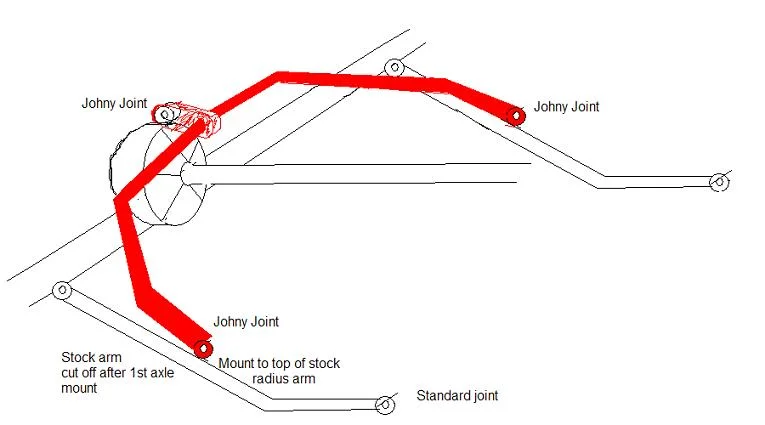


 its always good to think outside the box!


