

Teq pto winch

This site may earn a commission from merchant affiliate
links, including eBay, Amazon, Skimlinks, and others.

@MDH33

For the following PTO case:
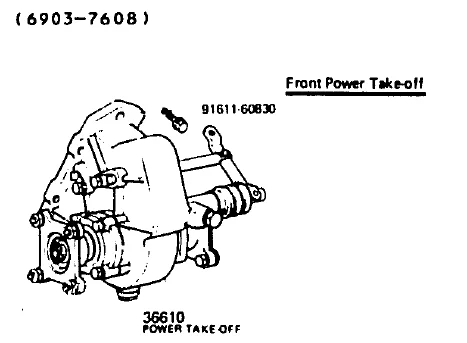
1648517247191.png


The part no. for both of the seals, likely on the 'endangered species list', is 90311-35004. List price of $26.23 each, suggests to me they're not too many left.

Part no. for both of the gaskets located between the bearing retainers and the case (held in place by the four bolts) is 36631-60010, List price of $1.72 each.

Bearings are NLA. Gasket between PTO case and TCase is NLA.

​

 
@MDH33

For the following PTO case:
View attachment 2965325

The part no. for both of the seals, likely on the 'endangered species list', is 90311-35004. List price of $26.23 each, suggests to me they're not too many left.

Part no. for both of the gaskets located between the bearing retainers and the case (held in place by the four bolts) is 36631-60010, List price of $1.72 each.

Bearings are NLA. Gasket between PTO case and TCase is NLA.

​


Good stuff. Fwiw we stock the 35004 seal (Cruiser Outfitters Part# PTO35004), the PTO box gaskets (PTO60010 & PTO36726) and the gasket between the tcase and PTO case/box. The gaskets are aftermarket (Japanese) as I recall. I'm pretty sure I found a Japanese alternative for the bearings. I'll update in a few days.
 
Good stuff. Fwiw we stock the 35004 seal, the PTO box gaskets and the gasket between the tcase and PTO case/box. The gaskets are aftermarket (Japanese) as I recall. I'm pretty sure I found a Japanese alternative for the bearings. I'll update in a few days.


Figure someone hadto made the gasket for between the transfer case and PTO since every transfer case has that one. I just purchased some seals and bearings for the later split case PTO. I was in the process and working on converting a single direction to two direction when a other one fell in to my lap.this was a few year ago but since I torn a single direction split case and two direction one piece may finish the projection some day.
 
One issue to point out regarding one direction (newer) PTO WINCHES, not PTO drives., is that PTO worm shaft is an opposite hand thread than the older two direction units. People have learned this after the fact when they hook up an OLDER winch to a one direction DRIVE and find they have one speed winding in and three or four speeds winding out. One guy even wound his cable so it played out the bottom of the winch drum in order to get more speeds of winding in.
 
Last edited:
One issue to point out regarding one direction (newer) PTO WINCHES, not PTO drives., is that PTO worm shaft is an opposite hand thread than the older two direction units. People have learned this after the fact when they hook up an OLDER winch to a one direction DRIVE and find they have one speed winding in and three or four speeds winding out. One guy even wound his cable so it played out the bottom of the winch drum in order to get more speeds of winding in.

Great intel. Any idea when that changed?
 
Great intel. Any idea when that changed?

Not sure there is a set date but most seem to be around 11/84 when the 70 series started. On the two direction in the 40 series there are two versions. 8/80-9/82 and 10/82 plus. Main difference is the shift lever moved to the front side which would assume it was part of the H55F five speed that changed. The crossmember and transmission hump pretty much across the entire 40 series line at the same time.
 
Not sure there is a set date but most seem to be around 11/84 when the 70 series started. On the two direction in the 40 series there are two versions. 8/80-9/82 and 10/82 plus. Main difference is the shift lever moved to the front side which would assume it was part of the H55F five speed that changed. The crossmember and transmission hump pretty much across the entire 40 series line at the same time.

:cool:

OK, I need to level up on the differences. I've got a handful of older 1-pc t-case stuff, one on my 87 HJ61 and one on my 91 HZJ77 as well as a variety at the LCHM I can go crawl around. I'd love to get to know all the differences and variations.
 
FJ25 PTO bolted to the side of the transmission. 61 to mid 63 has an early version of the transfer case type. Mid 63 to 7/80 was the most common one piece transfer case. 8/80-9/82 was the first version of the two direction split case PTO. 10/82 on 40 series used another two direction. When the 60 series switched to the single direction haven't quite figured out. Pretty the single was only one offered in the 70 with the split transfer case. My single direction split case is current torn down. Have loose mid 63+ one piece and both versions of the two direction split case. The FJ25 and 61 to mid 63 are installed in cruisers.
IMG_20191229_172509044.webp
 
@cruiseroutfit


Here is a writeup from a French website which speaks to PTO winch evolution:


ADAPTATION OF A 1st GENERATION POWER TAKE OFF
How to install a PTO on TOYOTA series 4, 6, 7
By Bruno Mellier​

Some TOYOTA 4, 6, 7 series vehicles are fitted as standard with a power take-off mounted on the transfer case which usually allows a mechanical winch to be operated, via a transmission shaft placed along of the chassis.
For vehicles that are not equipped, it is possible to adapt power take-offs from other vehicles.
Before mounting anything, it is necessary to identify the different existing models.
The power take-offs mounted on transfer cases before 1981 have 3 internal sprockets with 1 front output and 1 rear output. The 3 pinions make it possible to control 2 directions of rotation by moving the sliding pinion mounted on the secondary output shaft. The disadvantage of this principle is that the primary pinion is in constant mesh with the transfer box pinion. The control lever placed in the passenger compartment has 3 positions: neutral in the central position, winding and unwinding in the forward and reverse position
taken_force29.jpg​
taken_force26.jpg​
taken_force27.jpg​
From 1981, new transfer box casings appeared on the 4 and 6 series, the power take-offs remained identical in operating principle, but the casing changed slightly in shape, which made it impossible to fit the old PFs on the new ones. transfer boxes.
taken_force30.jpg​
taken_force28.jpg​
Some time later the 5-speed gearboxes were fitted to certain vehicles, the rear PF outlets disappeared, while the control on the housing moved from the rear to the front because the PF was found closer to the chassis crossmember on the models short.
take_force22.jpg​
At the end of 1984, the PF changed its principle and the central pinion disappeared. The primary pinion becomes a sliding gear, thus avoiding having to turn it constantly. unfortunately the final output of the PF loses a direction of rotation, while the control lever retains only 2 positions: neutral or engaged, it is then necessary to play with the reverse gear of the gearbox to unwind the winch cable


As you mentioned earlier they neglected to say the worm gear reversed in the winch with the single direction. Cable in on the two direction is thru the small idler gear. That went away on the single direction PTO. The gear to gear was reverse in the two direction and only way it works on the later one which is why all forward gears will cable out.
 
Back
Top Bottom