

Since most of us didn't purchase our rigs new, how do we know for certain that we are suffering from "sag" or otherwise plastic deformation of our original leaf spring pack? Are there a set of reference dimensions we can use to evaluate if our truck is "sagging"? I ask because its easy to want to buy an OME kit, but its not so easy to earn $2000. I really need to justify the expense mathematically.
Navigation
Install the app
How to install the app on iOS
Follow along with the video below to see how to install our site as a web app on your home screen.
Note: This feature may not be available in some browsers.
More options
Style variation
You are using an out of date browser. It may not display this or other websites correctly.
You should upgrade or use an alternative browser.
You should upgrade or use an alternative browser.
Suspension Sag Diagnosis
- Thread starter Braden620
- Start date
This site may earn a commission from merchant affiliate
links, including eBay, Amazon, Skimlinks, and others.


- Thread starter
- #3
I have no metric to judge by. I found one of my leaf bushings in the driveway, but other than bushing degradation I have nothing to measure.Is there something about your current suspension is not doing for you? What are you trying to correct or believe isn't right?
My shocks are the original 1975 tokico units with 158,000 mi on them. They don't appear to be leaking but that's probably because there isn't anything left to leak.
I can almost say I have rear sag but then again, nothing to measure by to say for certian. Did I mention I like having numbers? I like calculated decisions. Guesswork is hugely inefficient.
So you have spring bushings that are rotted and shocks that need to be replaced. Are you planning to put larger wheels and/or tires that will run into clearance issues? New springs may be required then. Or are you wanting to improve ride quality?
If spring bushings are falling out you can't measure sag until they are replaced first. Even then all vehicles will sag with age but unless the sag is causing issues why worry about it.
If spring bushings are falling out you can't measure sag until they are replaced first. Even then all vehicles will sag with age but unless the sag is causing issues why worry about it.
- Thread starter
- #5
You misunderstand. Outside of all modifications, interpretations, or expectations. What are the OEM toyota specifications for MEASURING plastic deformation of the original leaf springs? And what is this tolerance?


Measure from a fixed point on both sides of the chassis to the ground.
Measure a spot up front, and a spot in the back.
If the measurements are the same (side to side), then you don’t have the dreaded “Cruiser Lean”.
I think you are overthinking this....
Rocky
Measure a spot up front, and a spot in the back.
If the measurements are the same (side to side), then you don’t have the dreaded “Cruiser Lean”.
I think you are overthinking this....
Rocky
- Thread starter
- #7
Not worried about lean, lean can be determined with the eye. Sag, or the permanent deformation from the original state can only be properly measured having some sort of original dimension to compare against.Measure from a fixed point on both sides of the chassis to the ground.
Measure a spot up front, and a spot in the back.
If the measurements are the same (side to side), then you don’t have the dreaded “Cruiser Lean”.

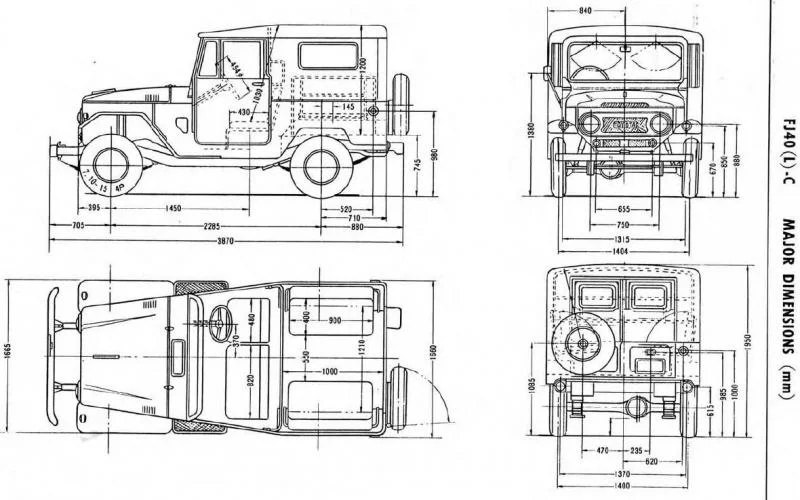
This might be as good as it gets. Looks like the horizontal center line of rear crossmember is about 615mm, center of the headlights is 880mm. You'll have to adjust for your tire/wheel size vs. OEM, but this is how an OEM FJ40 measures up.
FWIW, Cruiser lean is a thing
FWIW, Cruiser lean is a thing
- Thread starter
- #9
@B y r o n I completely disagree with your statement regarding the sag not causing any issues. Any amount of sag putting the dampener outside of its static threshold would cause accelerated wear and premature failure of the dampener. Dampeners work as a function of length, and changing the operating limits of these lengths affects the dynamics of the system.
- Thread starter
- #10
Oh thank God, finally some engineering documentation. Metric too! Will measure tomorrow to get an idea of the status of my springs. Gotta find a nice level spot to get that normal force parallel with gravity.This might be as good as it gets. Looks like the horizontal center line of rear crossmember is about 615mm, center of the headlights is 880mm. You'll have to adjust for your tire/wheel size vs. OEM, but this is how an OEM FJ40 measures up.
FWIW, Cruiser lean is a thing
View attachment 2538895
I am aware of cruiser lean. It is a byproduct of the suspension design. This is why if you use the OME Dakar springs, you should use the "+" or "0" marked leafs on drivers side and the "0" or "-" on the passenger side, respectively.
Last edited:

Those dimensions posted by Dick @reddingcruiser, which are out of the Toyota Land Cruiser FSM and is a good thing for any cruiser owner to have, are also affected by frame twist and body mount aging, not just spring sag. I’ve never seen the actual spring specs for cruisers, maybe a good spring shop can hunt them down for you. Most likely you would have to pull the springs to get to the level of detail it appears you’re seeking.
- Thread starter
- #12
Like a lot of engineering problems, some assumptions must be made. For instance if the stock body mounts are normally 6.5 mm installed and compressed, we might assume they are now 3/4 of this, we would include this difference in our measurements. Or maybe the truck has seen little off road use or hard riving and we assume the condition of the body mounts is insignificant. You make assumptions like this so that you can look specifically at the piece of information needed. Pulling the springs would result in nothing, as there have been no free spring dimensions given. The only reference we have is with the springs installed and the truck on level ground. I have never laid eyes on any spring shop, but I imagine some specifications do exists, as Dakar, Pro Comp, and others manufacture springs for this application.Those dimensions posted by Dick @reddingcruiser, which are out of the Toyota Land Cruiser FSM and is a good thing for any cruiser owner to have, are also affected by frame twist and body mount aging, not just spring sag. I’ve never seen the actual spring specs for cruisers, maybe a good spring shop can hunt them down for you. Most likely you would have to pull the springs to get to the level of detail it appears you’re seeking.

Two things that I've observed. On real rust buckets, the leafs will bellow-out, no longer making a tight sandwich. Also, I had a pair of springs which both had one leaf broken.

I don't care about measurements. If they are original it's pretty much guaranteed they're sagging. Just took mine off recently and they were busted

I'd probably buy from you the one with the straight leaves, and broken pin.I don't care about measurements. If they are original it's pretty much guaranteed they're sagging. Just took mine off recently and they were busted
View attachment 2539228
I'd probably buy from you the one with the straight leaves, and broken pin.
If you were closer i'd say come get them, going to the dump soon
Unfortunately, used ones are the only source, aside from custom Alcan, for non-lifted options.
- Thread starter
- #18
Might have some extras laying around.Unfortunately, used ones are the only source, aside from custom Alcan, for non-lifted options.

Your 40 is older than mine (79) and just for reference, this is what my 50mm Dobinsons springs looked like by comparison. The first picture are the front.

