Rank Amateur Painting HJ60: ISO Advisors

This site may earn a commission from merchant affiliate
links, including eBay, Amazon, Skimlinks, and others.

Thanks for the advice, Heirloom. I've got a couple custom hotrod shops here in town I'm going to check out next week. Good luck on the teaching job. If Texas is anything like WA, it's a bit of a rough time to be an educator. I'll check out that link. My husband has a welder, and I've used it a couple of times, but I'm by no means good at it (makes me jump every time I strike an arc!). I'd kind of like to get better at it but I'd really hate to screw my truck up with my learning curve.
 
Any local metal working shop will sell off scraps for you to practice on. I bought some 18 gauge metal scraps and practiced welding them together and grinding smooth. I also bought a copper backing plate from Eastwood and it has saved my arse from blowing holes straight through. Good luck!

Sent from my iPhone using IH8MUD
 
Progress Report

I pulled my rear slider windows out today. They came out really easily, like, I'm surprised that they didn't fall out on the road when I hit a bump easily. I think they've been out before and the PO put them back in with some goopy black adhesive that is now all over my hands.

Also, I bought a cheapo wire-feed welder. YOLO. If it all goes to heck, I'll claim that OZZY made me do it. What size wire do people use for welding panels?
IMG_2225.webp
 
Good to see you are diving into this yourself. Hopefully, you are a good swimmer. Tell us a little about the welder you bought, and I can offer a little advice on how to set it up. What make/model do you have?

If your welder is compatible with shielding gas (MIG a.k.a. GMAW), I recommend ER70S-6 wire in 0.023" or 0.024" diameter.

If your welder is not compatible with a shielding gas tank (FCAW), I recommend E71T-11 flux-cored wire in 0.030" diameter.

Whichever wire you get, make sure you also buy the appropriate welding electrode tip that matches both the welder gun threads and the wire diameter. Knowing what model you have is important for me to be able to offer more specific advice.
 
Looks like it is set up for flux-core and you can add a shielding gas setup to it? For sheetmetal, you typically want shielding gas over flux-core.
 
Yes. It's set up for flux core arc welding right now and I'm trying to get it set up for MIG. What gas mix ratio and flow rate do you recommend? I've got a bunch of co2 parts and pieces for my beer making operation, but no argon...
 
I use 25% CO2 and 75% Argon for shielding gas. If you already have standard industrial high-pressure industrial tanks, take an empty to the local welding supply and exchange your empty for a tank that is pre-filled with the right gas mix. If your tanks are not similar to the tanks used in welding, I recommend finding a tank designed for that purpose and getting the right gas mix. Some welding gas suppliers have special gas mixes for MIG and steel, which are basically slight manipulations of the CO2/AR ratio.

For sheet metal, I just max-out the flow rate on my regulator. In my experience, it works well. Expect to refill your tank more often if you follow my advice here.

Check your welder owner's manual to verify the electrode polarity settings when you switch to MIG. You will probably have to move a couple wires inside the welder case when you switch.

I use ER70S-6 wire size 0.023" with a matching size tip. The electrode tips you can buy at HF are going to be compatible with the machine you bought at HF. You may want to step up to a reputable brand for your wire, though. Your local welding supply store won't steer you wrong.
 
Thanks again for the info, Heirloom and everyone else. I feel like I'm asking a bunch of kindergarten level questions, but your answers are helping the job progress. The welding shop was closed yesterday, so I just messed around with flux core welding on a door panel I picked up from the junk yard. It's really thin (must be from a Jeep), and I know all about burning through now. I think my wire feed rate was way to slow, so I'll mess around with that while I'm making a patch work quilt of the scrap panel. The annoying thing was, after I studied about it and practiced for 1/2 hour, my 12 YO wanted to try and did as well as I did on her first shot.

image-2211929787.webp

My kid, schooling me.
image-2211929787.webp
 
Fear not. Burn-through is a part of learning to weld thin materials.

Experiment with these techniques: Vary your tip angle between 90* and 45*. The more vertical you get, the hotter the puddle is. Vary the distance between the tip and your work surface. The closer you are, the hotter. Vary your movement patterns: Straight lines, tiny circles, spirals, zig-zags, and wavy lines. Try to push the puddle, pull the puddle, and hover over the puddle. Try every combination you can come up with and see what works for you.

Make sure that you are also practicing how to watch what is going on. The light from the arc can be distracting. Make sure you are looking at the puddle of molten material and watching how it reacts to your movement.

The best thing you could have done was to find a piece of scrap to practice on. Keep up the progress.
 
I'm interested to see how this turns out for you. I have started removing pieces on my rig in preparation for stopping the rust that has started.
 
looks like you are taking the bull by the horns! glad to see you still have the diesel and that you are giving it some new life.

the black butyl all over your hands is fine and shows that its doing the job at staying flexible for your rear windows.

as far as the patches go do some quick searches on youtube on welding or patching panels. lots of great info. key is take it slow, dont overheat or blow through the sheet metal.

you can acheive this by two things, smaller wire and slower feed.

like posted above cut back the rusted areas to give yourself some thicker material, easier to weld square edges anyways, and to mitigate any rust that may still be learking near the edges.

also if you have a local mill end store or major fabric store you can pick up replacement headliner material for reasonable cost.

please keep us posted!

good luck

clint
 
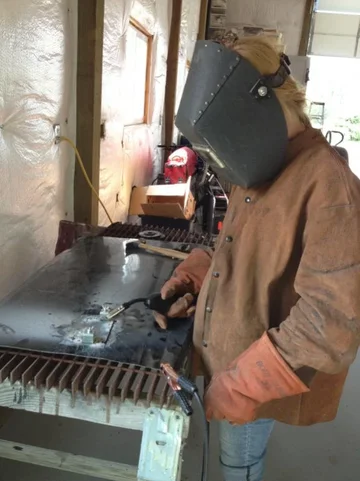
I got back in the shop to practice welding today after a (too) long break. I had to put the cruiser back together to take my kids' steers to the fair with it. Then I had to go back to work. Working for a living is really inconvenient. Anyway, I'm set up for MIG welding, and although it's still brutal, my welding is getting better. I'm a bit of a ways from being confident enough to do it on anything but scrap metal though.
image-1908727165.webp
 
Well, I knew nothing would get done after school started. But I spent the winter screwing up scrap metal with my welder and learned a thing or two. Then I decided to pull the seats and floor mats out to avoid lighting them on fire, and I found a hole in the floor. So I cut it out, shaped a new piece of sheet metal and tacked it in there.

image-3922686429.webp


image-73628417.webp


image-2509338500.webp
 
My plan is to roll bed liner on the whole interior of the tub as long as I have it all emptied out. I want a surface that's not too hard to keep clean and that will come close to matching the OEM color. I've read a bunch of reviews of the different products and I'm leaning toward Monster Liner, but I'm very interested in everyone's opinions and advice about that decision.

Also, apologies for the double post of the previous photos on an old thread. I couldn't figure out how to delete the other one. The Interwebs are so hard!
 
Back
Top Bottom