


Navigation
Install the app
How to install the app on iOS
Follow along with the video below to see how to install our site as a web app on your home screen.
Note: This feature may not be available in some browsers.
More options
Style variation
You are using an out of date browser. It may not display this or other websites correctly.
You should upgrade or use an alternative browser.
You should upgrade or use an alternative browser.
Introduction and Suspension Help
- Thread starter John Alderman
- Start date
-
- Tags
- shackles suspension
This site may earn a commission from merchant affiliate
links, including eBay, Amazon, Skimlinks, and others.

Someone put a shackle reversal kit on the front and moved the axle forward...
Sarge
Sarge
- Thread starter
- #3
Thanks Sarge. Pretty much what I'd suspected after reading up. Now I have to figure out if I should correct and do a proper lift or work with what's there. no idea what an undertaking that could be. Not a ton of shops in Central Florida deal in these rigs.Someone put a shackle reversal kit on the front and moved the axle forward...
Sarge

Anyone that is mechanically competent can undo the shackle reversal and return it to stock. After seeing some of the pontoon swamp buggies in FL, there has to be someone that can weld and follow directions near you.
Ruffstuff or 4 plus(mud vendor)carry all the hangers for the front.
Post some pics of the rear suspension so you can find out if it has been messed with too.
Welcome to the 40 sickness, these things have a way of multiplying.
Ruffstuff or 4 plus(mud vendor)carry all the hangers for the front.
Post some pics of the rear suspension so you can find out if it has been messed with too.
Welcome to the 40 sickness, these things have a way of multiplying.


- Thread starter
- #6
I'd prefer for the axle to be in its proper place but I guess I could easily lengthen the shackles in the back. This is how they look currentlyWhy do you want to remove the Shackle Reversal? IF you want to level it out, adjust the shackle length in the front or rear.


You have longer than stock anti-inversion shackles on the front and rear currently. The front spring may have been reversed to move the axle forward as well. (the spring center pin which locates the axle is offset on Fj40 springs) The shackle inversion lifts the front end about 2 inches +/- from stock height and the rear is often lifted with extended shackles to level the truck. It would be simplest to replace the front shackles with stock length units to lower the front end. This will change you caster angle in the front as well-probably for the better.
HTH
Will
HTH
Will

The front springs HAVE been flipped. IIRC, that was part of the shackle reversal kit instructions (it's been a long time since I used this "kit"). The military wrap belongs on the fixed end of the springs, which would be towards the rear on an OEM setup. The front axle does look a tad forward. I agree shorter shackles up front could level it out. However, if you were a 'crawler', shorter shackles will bring the fender closer to the tire and eventually they might meet  .
.
.
- Joined
- Jul 8, 2004
- Threads
- 111
- Messages
- 1,357
It also looks like those brackets were placed 2-3 inches past the frame?
You could drill new holes in the front shackles to set the height where you want it. 

When I first purchased my 40 I wanted to remove the shackle reversal system and go back to the OEM setup, however, I did my due diligence and discovered having reverse shackles on the front suspension was going to give me an improved ride so I kept it and now I've come to appreciate the technology and it's many benefits and smoother ride.
This was originally written for Jeeps but spring and shackle geometry is the same for the Toyota Land Cruisers.
Shackle Reversal Pros and Cons
Shackle reversal is one of the most misunderstood FJ40 suspension modifications. Most people do not really understand the advantages and disadvantages of shackle reversal. The pros and cons of shackle reversal should be understood before you spend your hard earned money on a kit.
Handling
The purpose of a shackle reversal is to allow the tire move backwards easily when it hits a bump to smooth out the ride. That is the theory at least, but it is important to understand how the axle moves with various spring combinations in order to really understand the handling advantages and disadvantages.
Axle Movement With Flat Springs
When measuring spring length, one normally measures spring eye to spring eye. Obviously, springs do not shrink and grow, but the distance between the eyes changes when they flex. Flat springs are at their maximum length at rest and any flex decreases the distance between the eyes.
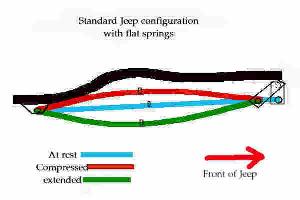
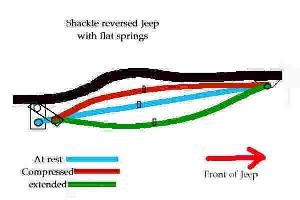
With flat arch springs on a 40 with the conventional setup the tire already goes backwards as it goes up, in fact it also goes backwards as it goes down. This is because the spring is it's longest when it is flat and curving it either way shortens the spring and draws the tire towards the fixed end. This can be demonstrated on any stock 40 by noting the angle of the shackle relative to the frame when it is sitting on flat ground, and then again when one tire has been run up a ramp. On the ramp the bottom end of both front shackles will be more towards the rear than when on flat ground because one spring will be arched positively and one negatively.
Axle Movement With Arched Springs
With heavily arched springs such as used in normal 2.5" spring under axle lift kits and the conventional fixed spring hanger at the rear the front tire will come forwards when it rises to go over a bump. This is because the spring is moving towards being flat, rather than away from being flat.
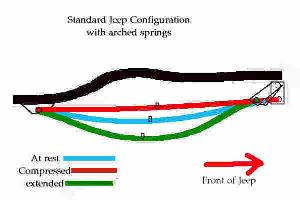
As the spring moves towards being flat the arch decreases and the length of the spring increases, pushing the tire slightly forwards.
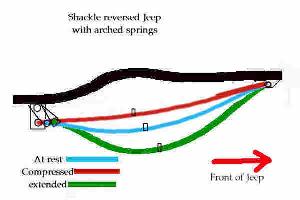
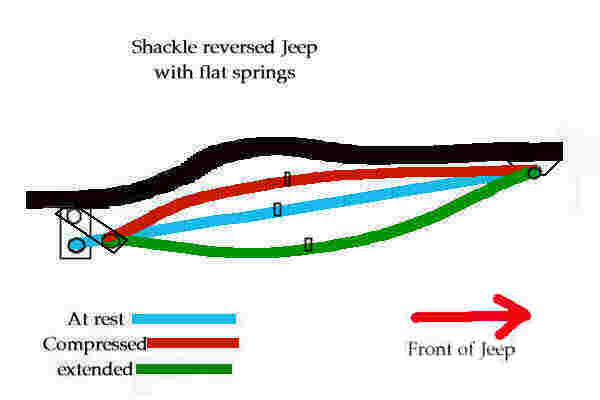
A shackle reversal puts the fixed end of the spring at the front, which makes the tire go rearwards on compression instead of forwards. This is very desirable for handling reasons. This is why shackle reversals are popular with after market lift springs on FJ40s.
Bump Steer
Besides allowing for smoother motion over bumps, a shackle reversal reduces bump steer. This seems a bit hard to imagine at first, but if you look at the arc that the axle travels in with a shackle reversal, you will notice that caster increases as the axle compresses. The increase in caster makes the Jeep track better reducing wander on bumpy roads.
Nose Dive
A 40 with a shackle reversal and arched springs will suffer from more front end dive during braking than a non reversed FJ40. The reason is similar to the reason for the improved highway ride. When the brakes are applied the tire is effectively pulled hard to the rear of the Jeep by the braking force. On a 40 with arched springs and a shackle reversal the rearward pull will cause the springs to flatten out or compress. The compression from the tire pulling back combined with the forwards weight transfer that normally happens during braking cause the nose of the FJ40 to drop more than a non shackle reversed FJ40.
With arched springs and no shackle reversal the force of the tire being pulled towards the rear of the FJ40 causes the spring to arch more. The spring arching and the natural forwards weight transfer somewhat cancel each other out and front end dive is limited.
The Driveshaft Problem
Another disadvantage of shackle reversal is the need for a drive shaft with more travel. A long travel drive shaft is required because the tire is going forwards as it goes down and backwards as it goes up. The downward and forward movements add together meaning a drive shaft used with shackle reversal must compress and extend more than a shackle forward driveshaft.
 If the drive shaft problem is not dealt with, parts can be broken. A drive shaft that is too short will fall apart when droop is maximized. A drive shaft that is too long can be punched through a transfer case. Long travel drive shafts can be expensive and long travel drive shafts wear quicker than short travel drive shafts.
With no shackle reversal and arched springs the tire goes forwards as it goes up and rearwards as it goes down. The forwards and upward motions partially cancel each other resulting in less of a length change on the driveshaft. The same cancellation effect happens as the tire goes rearwards and down. The result is a fairly normal amount of length change on the driveshaft that the stock slip joint can usually handle.
Tire Clearance
A FJ40 with shackle reversal can have the tire move back more than it would with the shackle forward. Clearance for tires should be checked with a shackle reversal to make sure body damage does not occur if a tire comes into contact with a fender.
Bull Dozing
A shackle reversal should not change the approach angle, but it can be built so it slides over obstacles better. With the shackles forward, if you hit a rock dead on, there is a possibility of bending the spring and the shackle will not slide easily over the rock. With a shackle reversal, the front mount can be ramped so the spring pushes over the rock.
Bending Springs
An FJ40 with a shackle reversal will be less likely to bend a spring if the spring hits an obstacle. The likelihood of bending a spring while backing up will be increased with a shackle reversal, but most of the time people are driving in the forward direction.
Tire Contact Pressure
An FJ40 with the shackle forward will load the spring and tire when the 40 is driven into an obstacle. The spring and axle do not move back, so traction is increased. With the shackle reversed, contact pressure will be increase any time the front axle is pushed forward. Here shackle reversal might have a slight advantage when climbing steep hills where the axle wants to move forward. Generally traction is not a problem when you come straight on an obstacle in a flat area.
Conclusion
Both methods have their pluses and minuses. It boils down more to what the rig's purpose is - and personal preferences. If the FJ40 is going to be a daily driver as well as weekend trail warrior, forward shackles may be the way to go. If the rig is primary a trail toy and sees more street miles on a trailer than with its tires on the tarmac, then the rear shackles may be more advantageous.
This was originally written for Jeeps but spring and shackle geometry is the same for the Toyota Land Cruisers.
Shackle Reversal Pros and Cons
Shackle reversal is one of the most misunderstood FJ40 suspension modifications. Most people do not really understand the advantages and disadvantages of shackle reversal. The pros and cons of shackle reversal should be understood before you spend your hard earned money on a kit.
Handling
The purpose of a shackle reversal is to allow the tire move backwards easily when it hits a bump to smooth out the ride. That is the theory at least, but it is important to understand how the axle moves with various spring combinations in order to really understand the handling advantages and disadvantages.
Axle Movement With Flat Springs
When measuring spring length, one normally measures spring eye to spring eye. Obviously, springs do not shrink and grow, but the distance between the eyes changes when they flex. Flat springs are at their maximum length at rest and any flex decreases the distance between the eyes.
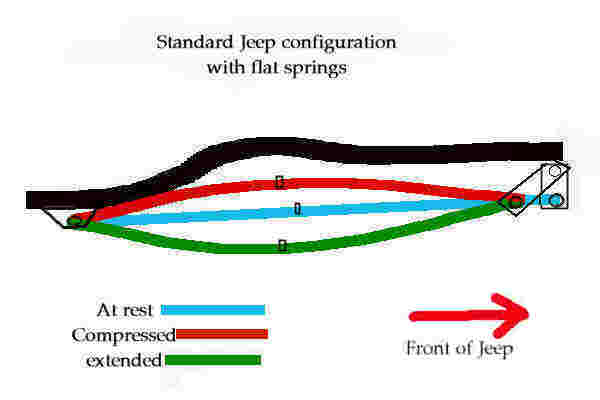
With flat arch springs on a 40 with the conventional setup the tire already goes backwards as it goes up, in fact it also goes backwards as it goes down. This is because the spring is it's longest when it is flat and curving it either way shortens the spring and draws the tire towards the fixed end. This can be demonstrated on any stock 40 by noting the angle of the shackle relative to the frame when it is sitting on flat ground, and then again when one tire has been run up a ramp. On the ramp the bottom end of both front shackles will be more towards the rear than when on flat ground because one spring will be arched positively and one negatively.
Axle Movement With Arched Springs
With heavily arched springs such as used in normal 2.5" spring under axle lift kits and the conventional fixed spring hanger at the rear the front tire will come forwards when it rises to go over a bump. This is because the spring is moving towards being flat, rather than away from being flat.

As the spring moves towards being flat the arch decreases and the length of the spring increases, pushing the tire slightly forwards.
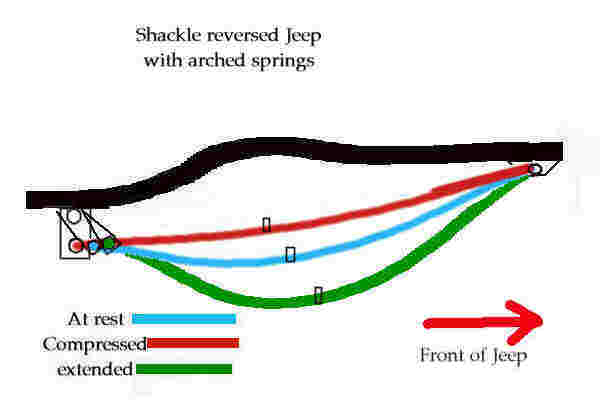
A shackle reversal puts the fixed end of the spring at the front, which makes the tire go rearwards on compression instead of forwards. This is very desirable for handling reasons. This is why shackle reversals are popular with after market lift springs on FJ40s.
Bump Steer
Besides allowing for smoother motion over bumps, a shackle reversal reduces bump steer. This seems a bit hard to imagine at first, but if you look at the arc that the axle travels in with a shackle reversal, you will notice that caster increases as the axle compresses. The increase in caster makes the Jeep track better reducing wander on bumpy roads.
Nose Dive
A 40 with a shackle reversal and arched springs will suffer from more front end dive during braking than a non reversed FJ40. The reason is similar to the reason for the improved highway ride. When the brakes are applied the tire is effectively pulled hard to the rear of the Jeep by the braking force. On a 40 with arched springs and a shackle reversal the rearward pull will cause the springs to flatten out or compress. The compression from the tire pulling back combined with the forwards weight transfer that normally happens during braking cause the nose of the FJ40 to drop more than a non shackle reversed FJ40.
With arched springs and no shackle reversal the force of the tire being pulled towards the rear of the FJ40 causes the spring to arch more. The spring arching and the natural forwards weight transfer somewhat cancel each other out and front end dive is limited.
The Driveshaft Problem
Another disadvantage of shackle reversal is the need for a drive shaft with more travel. A long travel drive shaft is required because the tire is going forwards as it goes down and backwards as it goes up. The downward and forward movements add together meaning a drive shaft used with shackle reversal must compress and extend more than a shackle forward driveshaft.
With no shackle reversal and arched springs the tire goes forwards as it goes up and rearwards as it goes down. The forwards and upward motions partially cancel each other resulting in less of a length change on the driveshaft. The same cancellation effect happens as the tire goes rearwards and down. The result is a fairly normal amount of length change on the driveshaft that the stock slip joint can usually handle.
Tire Clearance
A FJ40 with shackle reversal can have the tire move back more than it would with the shackle forward. Clearance for tires should be checked with a shackle reversal to make sure body damage does not occur if a tire comes into contact with a fender.
Bull Dozing
A shackle reversal should not change the approach angle, but it can be built so it slides over obstacles better. With the shackles forward, if you hit a rock dead on, there is a possibility of bending the spring and the shackle will not slide easily over the rock. With a shackle reversal, the front mount can be ramped so the spring pushes over the rock.
Bending Springs
An FJ40 with a shackle reversal will be less likely to bend a spring if the spring hits an obstacle. The likelihood of bending a spring while backing up will be increased with a shackle reversal, but most of the time people are driving in the forward direction.
Tire Contact Pressure
An FJ40 with the shackle forward will load the spring and tire when the 40 is driven into an obstacle. The spring and axle do not move back, so traction is increased. With the shackle reversed, contact pressure will be increase any time the front axle is pushed forward. Here shackle reversal might have a slight advantage when climbing steep hills where the axle wants to move forward. Generally traction is not a problem when you come straight on an obstacle in a flat area.
Conclusion
Both methods have their pluses and minuses. It boils down more to what the rig's purpose is - and personal preferences. If the FJ40 is going to be a daily driver as well as weekend trail warrior, forward shackles may be the way to go. If the rig is primary a trail toy and sees more street miles on a trailer than with its tires on the tarmac, then the rear shackles may be more advantageous.
- Joined
- Jul 8, 2004
- Threads
- 111
- Messages
- 1,357
The axle has been moved so far forward though...just my opinion, it looks a little awkward. And based on what I think the owner is going for, is really not needed. I could be wrong though. But in this instance I would seriously consider at least correcting the placement of those front hangers.
More pictures of how those hangers were attached would be helpful, I think.
More pictures of how those hangers were attached would be helpful, I think.
His front spring hanger appears to be welded too low thus increasing lift, also the front shackles are too big also contributing to the lift. This suspension is not properly balanced front to rear, but there's hope with some modifications. The springs appear to be original Toyota so the rears could be flattened out.
Also with such a radical lift up front the drive line angles are off and will needs shims to correct it.

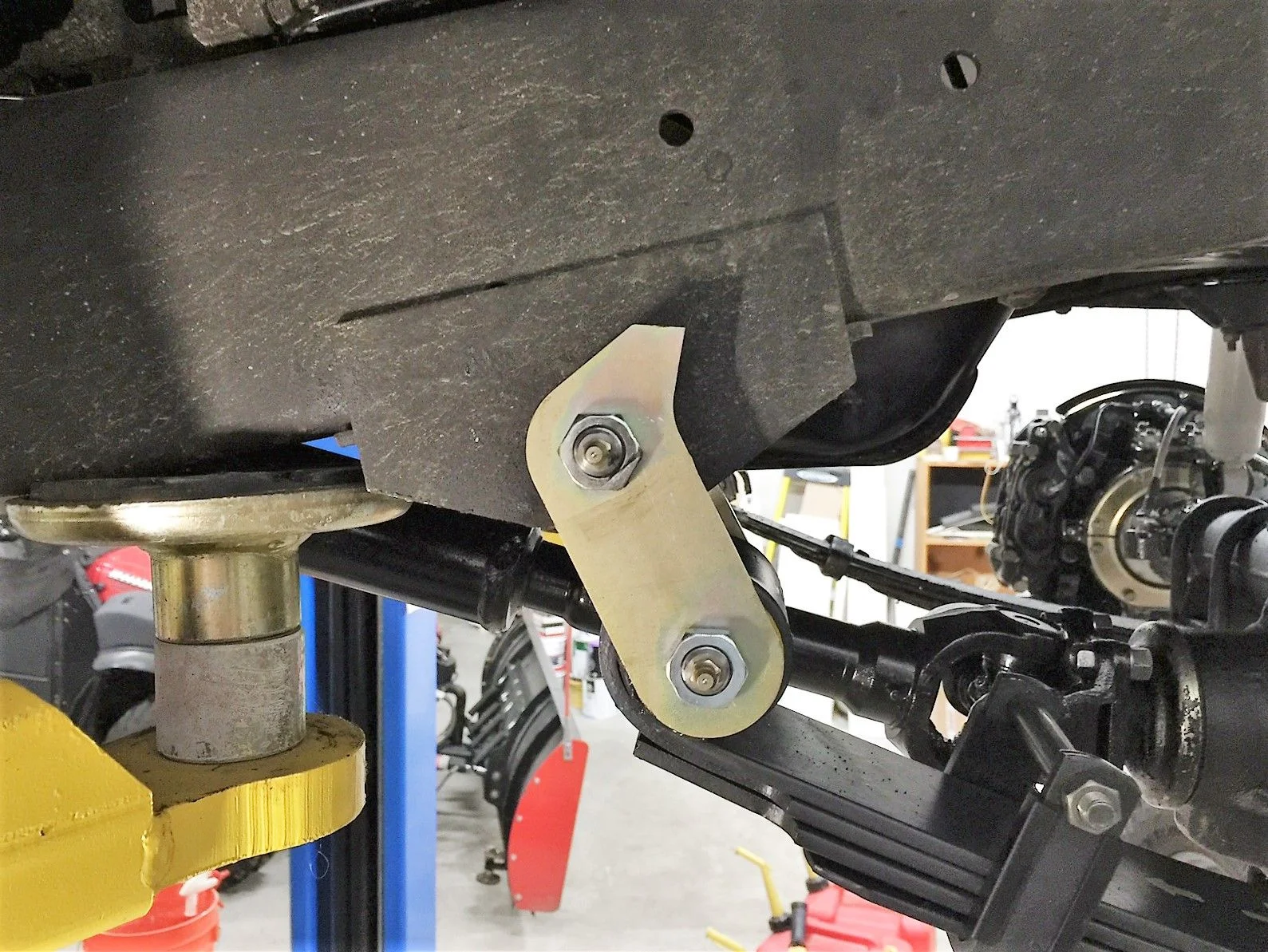
This is what my hangers and shackles look like (for reference)
Also with such a radical lift up front the drive line angles are off and will needs shims to correct it.
This is what my hangers and shackles look like (for reference)
Very NICE, Mike!
Are you sure that's not a Toyota Dealer photo from 1978???
Are you sure that's not a Toyota Dealer photo from 1978???
Here's my rig with shackle reversal and a 2.5 inch lift with OME Old Man Emu springs and shackles and 31 inch tires
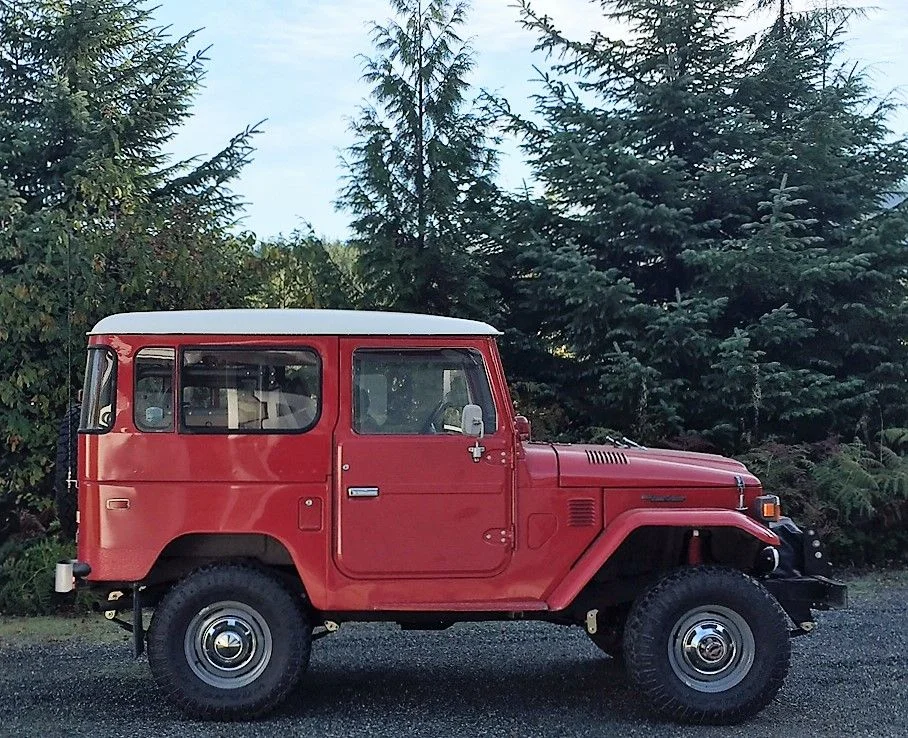

Mike, this may have been covered in your own thread, but after you installed your shackle reverse, did you test drive to determine whether you needed shims?
Very NICE, Mike!
Are you sure that's not a Toyota Dealer photo from 1978???
Thanks Dick!
I did borrow some of their pics, and subsequently changed the background for copy right infringement purposes!

Mike, this may have been covered in your own thread, but after you installed your shackle reverse, did you test drive to determine whether you needed shims?
Hey Bud!
I did cover it in my thread, but I had to use 2.5mm shims on front axle and 3mm shims in the rear axle.
Good to know.  or job?
or job?