Flux capacitor?

This site may earn a commission from merchant affiliate
links, including eBay, Amazon, Skimlinks, and others.

Joined
Apr 21, 2005
Threads
113
Messages
25,629
So I picked up some early 40 parts a couple days a go and one of the items I got was a generator. The voltage regulator attached at the end of the wiring harness may or may not be stock. But what is wired to the generator isn't. So what is this? If it a flux capacitor I'm heading back in time with a old cruiser and buying as many early original parts as I can get in it and still get up to speed to make it back.:rolleyes:
IMG_1087.webp
 
That's cool... Take me with you... I don't have any money to buy anything with you.. But... I'd just like to check it out :)

Looks like an old noise suppressor... He probably had an old school CB hooked up in that truck as well
 
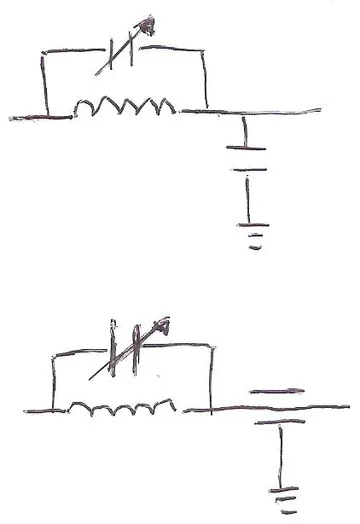
What you see is an adjustable noise suppressor filter/network.
A coil and capacitor in series and a adjustable capacitor AKA "trimmer" parallel to the coil.
That way you can filter out a frequency range that interferes with your radio / CB / electronic equipment.

Rudi
 
That's cool... Take me with you... I don't have any money to buy anything with you.. But... I'd just like to check it out :)

Looks like an old noise suppressor... He probably had an old school CB hooked up in that truck as well


Sounds about right for the round capacitor thing. It's that darn goofy coil in ciruit that's weird. Don't remember seeing anything like that before.

As for heading back not thinking new dated money will do any good. I would still be in jail today for counterfeiting. Ugly tellers and debit card won't be happening. Fugure have to bring stuff I hock at a pawn shop:meh:
 
What you see is an adjustable noise suppressor filter/network.
A coil and capacitor in series and a adjustable capacitor AKA "trimmer" parallel to the coil.
That way you can filter out a frequency range that interferes with your radio / CB / electronic equipment.

Rudi

Thanks Rudi. Now the question is currently setup correctly to filter the noise I need filter or is it easier to just use modern spark plugs?

The generator could use new bearings and figure I would replace the brushes while I'm at it.
 
LC filter

Here is the diagram. The top pic shows a regular LC filter.
The coil filters out the low frequencies and the capacitor filters out the higher frequencies. The "varicap" or "trimmer" is adjustable to make it a frequency specific filter.

In the lower pic you see a special capacitor where the housing is ground. Same diagram, different model capacitor.

LC filter.webp

Rudi
LC filter.webp
 
We're talking different things here.
1. The thing in your pic is a generator and not an alternator.
A generator makes AC and needs a (external) rectifier. This was combined in the voltage regulator. Because a generator produces AC through the wiring to the rectifier you have a kind of antenna that transmits unwanted noise in the air.

2. An alternator makes DC. Actually it's a generator (which makes AC) with build in rectifier diodes. Here the old school Voltage Regulator with the contact points is the source of unwanted noise. At these VR's you see the extra blue wire with the bullet connector. This connection is for a capacitor to ground to filter out the noise.

3.Next is the dizzy with points. Also a noise producer. These old school dizzy's have a capacitor mounted on the side.

4. The spark plug cables.... also a source of unwanted noise. Here the solution is to use the special cables as Pearly mentioned.

So on that generator you have a frequency specific filter. I doubt it's OEM.

Clear as MUD.......?

Rudi
 
We're talking different things here.
1. The thing in your pic is a generator and not an alternator.
A generator makes AC and needs a (external) rectifier. This was combined in the voltage regulator. Because a generator produces AC through the wiring to the rectifier you have a kind of antenna that transmits unwanted noise in the air.
Clear as MUD.......?

Rudi

Huh?
Generators put out DC current and don't need a rectifier, although there is some ripple and RF noise from the switching and arcing at the armature brushes.

As the name implies, alternators put out AC current.

You can estimate the operating frequency of the coil from its dimensions and number of turns here:
http://www.rac.ca/tca/RF_Coil_Design.html

It looks like it would be in the 100 MHz range.
 
We're talking different things here.
1. The thing in your pic is a generator and not an alternator.
A generator makes AC and needs a (external) rectifier. This was combined in the voltage regulator. Because a generator produces AC through the wiring to the rectifier you have a kind of antenna that transmits unwanted noise in the air.

2. An alternator makes DC. Actually it's a generator (which makes AC) with build in rectifier diodes. Here the old school Voltage Regulator with the contact points is the source of unwanted noise. At these VR's you see the extra blue wire with the bullet connector. This connection is for a capacitor to ground to filter out the noise.
Rudi
Wikipedia says no. http://en.wikipedia.org/wiki/Electric_generator
 
Sorry, sorry, sorry

I knew it, I knew it! :bang: After posting I walked the dog and while doing that I was thinking..... something is wrong. When I came back here the both of you had already replied so I couldn't edit my posting any more. :o

Error....BIG ERROR on my side. Both of you are right. The error is caused by using different words for the same thing. My native language is Dutch and in Holland they are called Dynamo no matter if it's AC or DC. The power for the electric grid (AC) is made by Generators in my language. It's the same as fender/mudguard, hood/bonnet and so on in American English and British English.

Anyway, sorry for the confusion. It shows that we have some very knowledgeable and alert people here on MUD.

Rudi

P.s. I still don't know why I called it a (AC) Generator, because it's useless to put a AC filter on a AC power source.
 
Last edited:
I have seen that type filter on vehicles that run mobile ham equipment, though they are usually in a box to protect them...

Rudi for your sin you must say 10 hail Cruisers.... :idea:
 
I have seen that type filter on vehicles that run mobile ham equipment, though they are usually in a box to protect them...

Rudi for your sin you must say 10 hail Cruisers.... :idea:

Mea culpa, mea culpa, mea ultima culpa. X10 :crybaby:

Rudi
 
I'm going to have to disagree with the masses and say that it IS a flux capicitor. Now let's see if we can hit 88 mph. :cool:
 
I agree, it's a flux capacitor on the bottom side is a sticker like this.....
S_S_flux-capacitor.webp

Rudi
S_S_flux-capacitor.webp
 
Back
Top Bottom