Equipment you carry daily?

This site may earn a commission from merchant affiliate
links, including eBay, Amazon, Skimlinks, and others.

Bogo,

Very informative and technical- I like it! How about a "how to" or some pictures from your lab on these shields?

I understand all that and I understand the magnetic strip is not involved in this at all. I've made my own low frequency passive RFID tag readers from TI modules*. When I tested out how to block them, I found out that it was much more effective to keep the RFID tag in the "dark" so it never powered up. To do that I found out I had to magnetically shield it. A well formed aluminum foil shield could keep the tag's transmissions from being read, but it couldn't stop it from powering up. Cut a small hole in that foil shield and I could read the tag. Sure the read distance was lowered, but it was still readable. When I tried the two transformer plates, I stopped being able to read the tag. When I stuck a small antenna loop from a RFID reader set to passive mode in the sandwich I couldn't get a read when the other reader was trying to read it. The nice thing about the transformer plates is I didn't need them to have 100% coverage like the aluminum foil needed. They only needed to cover a slightly larger area than where the antenna on the card was.

* 10 years ago cattle RFID tag readers were $1,500 minimum for a dumb one with no display. TI RFID modules from DigiKey could be had for $75 each. All you needed to add to the module was a serial port level translator chip, antenna, and power supply. Then a PDA with a custom application on it could talk to it.

BTW, many car keys now have RFID tags in them.
 
Bogo,

Very informative and technical- I like it! How about a "how to" or some pictures from your lab on these shields?
I did all that experimenting years ago. The pieces of transformer plates I use are around 0.032" thick and I have them cut to the size of a credit card. They came from a dead transformer that was around 20kVA. The rest of its' plates have long been fully recycled into other projects. The only large dead transformers I have left are 2 12kVA units. Unfortunately the plates in them are narrower than a credit card. They are scheduled to become part of a coil gun.:hillbilly:
 
Bogo-

Off topic, but do you work for the power company?
No, I'm a farmer, and back then I was a software engineer. I just had many friends in the electronics industry who were very good scroungers. The transformers we got were all s****ped ones and we got them for hauling them away. With a few trips, me and a couple friends hauled away a few tons of large open frame transformers. Much copper saw it's second life as bronze in sculptures. The metal plates mostly went into a guy's maglev model railroad.:hillbilly: There were a few other projects they went into. For helping haul I grabbed some of them for myself.

:hillbilly: I was envious as I didn't have the space at the time for a project like the maglev. It was an 0 gauge scale system to go with his existing 0 gauge garden railway.
 
I understand all that and I understand the magnetic strip is not involved in this at all. I've made my own low frequency passive RFID tag readers from TI modules*. When I tested out how to block them, I found out that it was much more effective to keep the RFID tag in the "dark" so it never powered up. To do that I found out I had to magnetically shield it. A well formed aluminum foil shield could keep the tag's transmissions from being read, but it couldn't stop it from powering up. Cut a small hole in that foil shield and I could read the tag. Sure the read distance was lowered, but it was still readable. When I tried the two transformer plates, I stopped being able to read the tag. When I stuck a small antenna loop from a RFID reader set to passive mode in the sandwich I couldn't get a read when the other reader was trying to read it. The nice thing about the transformer plates is I didn't need them to have 100% coverage like the aluminum foil needed. They only needed to cover a slightly larger area than where the antenna on the card was.

* 10 years ago cattle RFID tag readers were $1,500 minimum for a dumb one with no display. TI RFID modules from DigiKey could be had for $75 each. All you needed to add to the module was a serial port level translator chip, antenna, and power supply. Then a PDA with a custom application on it could talk to it.

BTW, many car keys now have RFID tags in them.
That's interesting, based on my experiences I wouldn't have expected that. Since the goal is to block data transmission from the RfID chip I wonder if the ferrous metal is really necessary? I guess a lot would depend on the power level of the signal used to query the card. In my work we typically deal with power levels from -2dBm to around +20dBm so that would be about 0.6 mW to around .1W. I guess if you were using 27 - 30 dBm (~.5W - 1W) it would change things.

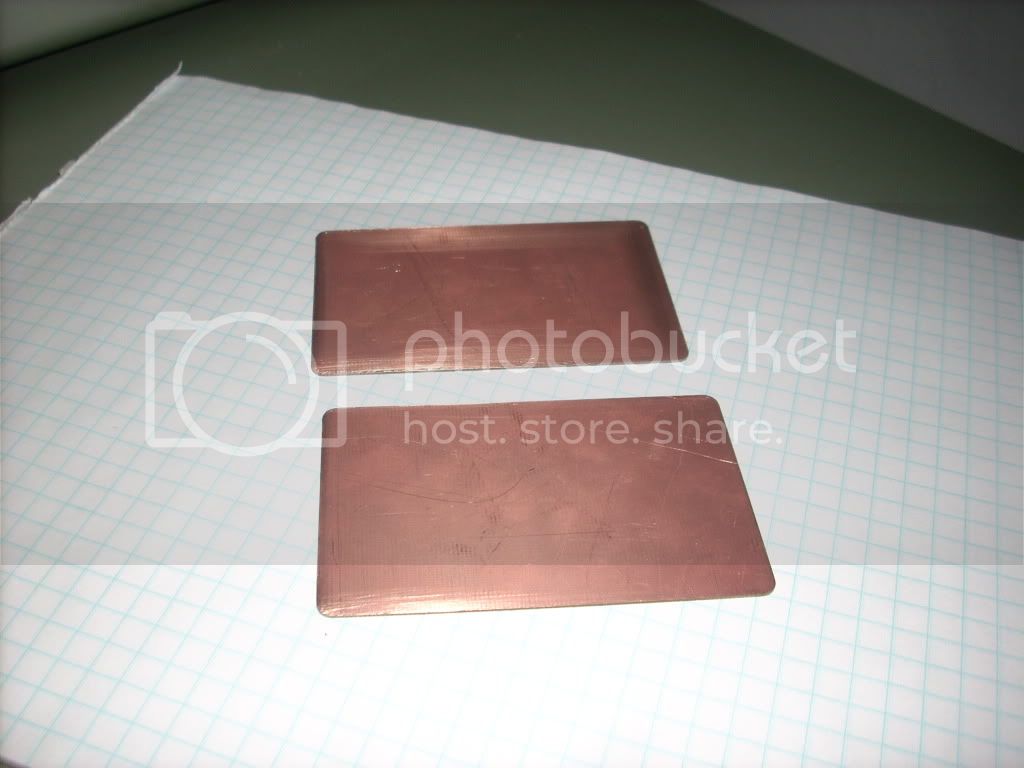
I cut a couple of pieces of Copper clad in the PCB prototype lab yesterday just for grins
DSCN2486.jpg


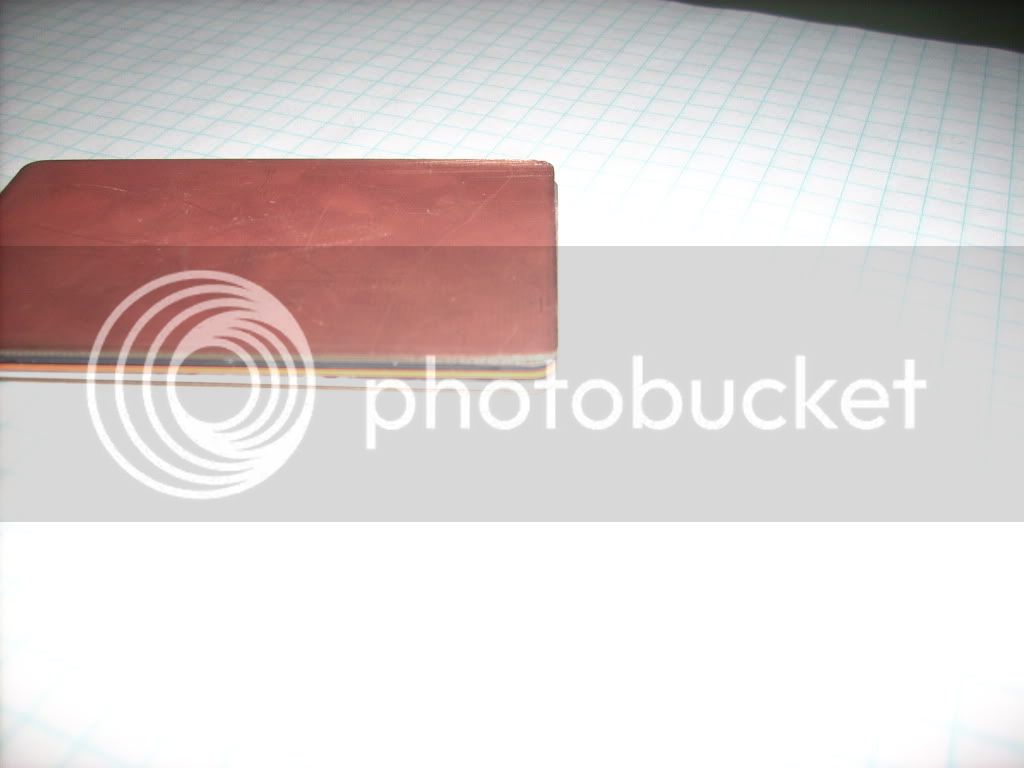
Stacked up with three credit cards.
DSCN2487.jpg


If I had any cards with RfID chips I could test them out.:grinpimp:
I'm thinking about this now so that when I am forced to use RfID card I'm prepared. We already had skimmers get our account and PIN from a Gas pump ATM, they withdrew almost $1000 form our account before the bank shut the card off. I don't want to go through a repeat of that.
 
Dan,

Like the spy shots from the lab, any idea of how you will bring the two pieces together to form a card holder? I am envisioning a pig skin wallet with "TEQ" brand into it? ;)
 
Josh...you have TEQ burned on brain!

That said I like the wallet idea....
 
Any thoughts on a lighter for daily carry- outside of smoking? I had mentioned the piece of flint that I carry, and incorporated the "hack blade" which was detailed earlier in the thread to help produce a spark (among other uses). I picked up a relic zippo 1941 lighter and really like it. What are you guys doing?

Van
 
I've got an original WWII zippo too. Love it, but it has no place in a survival kit. Zippos aren't waterproof and if/when the wadding inside gets soaked, you are s*** out of luck. You have to remove the wadding and the wick, dry them and reassemble. Oh yeah, then you have to refill it - providing you have fuel with you. Also, the fuel evaporates over time even if sealed in a kit. Been there, done that and learned the hard way during a jungle trek. Two weeks using a magnesium block striker to light a pocket rocket and hexy stove for meals is never fun.

My own PSK contains three fire-making tools. 1. USAF Mag block; 2. Credit card sized plastic fresnel lens magnifier (which also increases the utility of a little LED light); 3. Garden variety mini-Bic lighter.

I don't believe the Bic can be beaten for reliable fire making in the bush. Sealed unit, cheap, lightweight, rugged, waterproof... well, easy to dry out. The only problem is if you have to travel on military aircraft. If you don't then it's perfect.

Some guys swear by refillable piezoelectric ignition jet flame lighters, but I've never looked past the Bic, so I wouldn't know.
 
I would have to concur with the BIC for all the reasoned you mentioned. I'll keep the WWII zippo for nostalgia and do a little more research on the piezo. Anyone else have some tried wisdom to share?
 
cant beat a mini-bic lighter that is a super bright color on cheapness and being effective.
Zippos are cool, especially the older model, but have to be refilled too frequently to really be useful.
A few companies do make a torch/piezoelectric lighter insert that fits into the zippo case and is pretty cool. That way you can always keep a can or butane in the truck for a quick refill.
 
Last time I got a mini bic it didn't have the child safety. Have they changed that?

I have a couple of regular Bic lighters scattered among different kits and vehicles. I like the safety because it stops the lighter from accidental discharge if it gets mashed against something else in a kit or tool box.
 
I picked up a SOG Micron 2.0 and a Streamlight Nano today at Sportsmans Warehouse. The SOG is pretty dam cool I forgot I had it in my pocket until I emptied them tonight. The Nana is also neat, I'll have to see how long the batteries last before I pass final judgment on it.
 
Dan,

That is a great looking knife with some good specs to boot! The streamlight would be a welcomed addition to my key chain.....
 
Back
Top Bottom