

Aluminum Radiators & Electrolysis

This site may earn a commission from merchant affiliate
links, including eBay, Amazon, Skimlinks, and others.

Joined
Sep 18, 2010
Threads
6
Messages
139
Location
Kelowna, B.C. Canada
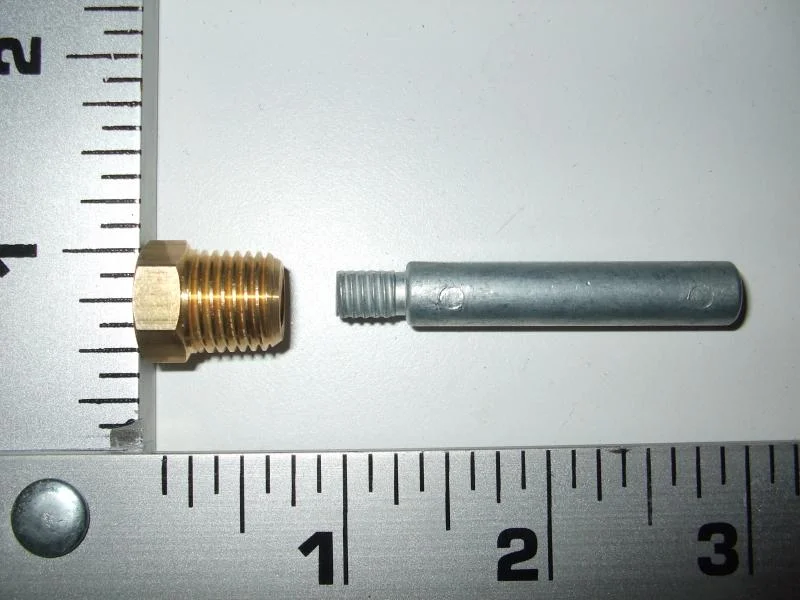
I searched 'Mud before just posting a question, and found an old thread in 40 tech. I added to it in search of more info but would like to hear from more members. I am installing a new aluminum rad because the first Flexalite one didn't last a year in my non daily driver '40. With all of the net research I have done it came to my attention that electrolysis is a big concern when running an aluminum rad to cool an iron block/heads ( my intake is aluminum). With the info I have found online I do believe electrolysis was one of the main factors in the first rad's failure, combined with harsh driving conditions ( frame flex, and all-around gettting pounded on ). Also through this research I have come accross a sacrificial anode intended for automotive applications. Flexalite Part # 32060. A two inch piece of zinc that threads into a 1/4" NPT plug. See pic. I am now almost complete installing a new Becool aluminum rad. The engineering of the rad mounts has been reworked so as to preserve its life, including rubber isolation. Now, I am led to believe the location of said anode is irrelevant as long as it is submerged in the coolant. So if I locate it in one of the unused ports on my intake manifold it should serve its purpose and protect the intake manifold as well as the rad ? Furthermore, what are you running for coolant? Are you using Distilled water? Other additives? An anode? And any other tricks, procedures, or info you have to share would be appreciated. I know refilling/purging a coolant system isn't rocket science, but you never know what kind of tricks guy's (and gals) have come across. Thanks in advance.
Attached Images
attachment.php
 
Last edited:
Electrolysis is a big deal. My second aluminum radiator is leaking and I need a new one again. They both have leaked in the upper corners. I think rust and sludge collect there. Regular flushing may help too.

I like the idea of a sacrificial anode, they get used in a variety of industries.
 
Thats were my first aluminum rad began to leak as well, the top inlet side. I am going to run this aluminum rad, but if it fails down the road, I am going back to conventional brass/copper whatever they are. Nat, how long did the rads last in your 'Cruiser?
 
Just found this thread and Im going through the same issues.. my rad has developed a leak 3 times now on the upper corner on the pass side...

Huroneymoose how did that Flexalite part worked for yah ??????

Im already going to start looking at replacing my $500 crappy rad for a copper/brass one or even a stock one...
 
FJfodee... I run a vortec with alum heads and used the Dexcool 50/50 mix.
I did stop at napa and asked about the NAPA Kool but they said it should only be used on Diesel apps...
The rad shop that did the repair did suggest I use the wetter water stuff which I just started using...
I still got to see if my volt meter reads any current going through my cooling system...
Thanks for the input tho' !!
 
This topic really grabbed my attention. I'm a corrosion engineer and design cathodic protection (anode) systems to protect natural gas pipelines. The application is different but the fundamentals remain the same.

A few questions:

Is this happening more often on cars with automatic transmissions?

Is it happening more often on cars with radiators that are not electrically isolated from the steel chassis of the vehicle? (is the aluminum radiator in direct contact with the chassis, or is it isolated through rubber mounts with no aluminum to steel contact)?
 
Splangy..... I have an auto.. I dont know about the rest...
My rad is isolated the best I could do and have it attached to the frame but have rubber mounts between the rad and frame and rad and bolt... but I think I still have some what of a contact between the rad and frame...

I read on the net that you should have no contact (ground) on the rad and use the voltmeter to see if you have any kind of current running through your cooling system.......If yah do then you need to isolate the rad mo' better :hillbilly:

I also read other peeps post that contradict what other have said....
So, your input on this would be much much appriciated
 
I don't know if this is correct or not, but I bought a aluminium radiator from Man-a-fre some time ago (which is really a Ron Davis model), in the instructions as I recall they said to insulate the radaitor well at teh mount points to avoid vibration issues (rubber washers or material)...then as I recall it also said to make sure to have a ground from the radiator body to the truck frame? I don't recall reading any adivic on coolant type.

My radiator developed a small leak at the lower driver's side portion of the core where it joins the lower tank. I don't know the reason for that, I swapped in my spare 4 core brass type radiator since then. The man-a-free radiators are pretty $$, even more so than when I bought mine.

A great question I have is.... Who repairs aluminium radiators? For me, I'm looking for someone in the SouthEast..
 
Why the big draw to aluminum radiators? They are cheaper and easier to produce than brass/copper ones is why the MFGers went to them.

So why does everybody in the offroad and hotrod industry think getting a aluminum radiator is the cool thing to do?

They dont cool as well as a brass copper.

They dont last as long as a brass copper.

They are not as easily repaired as a brass copper.

But they are cheaper. Is that the only reason you guys got one is cuz its cheaper?
 
Splangy..... I have an auto.. I dont know about the rest...
My rad is isolated the best I could do and have it attached to the frame but have rubber mounts between the rad and frame and rad and bolt... but I think I still have some what of a contact between the rad and frame...

I read on the net that you should have no contact (ground) on the rad and use the voltmeter to see if you have any kind of current running through your cooling system.......If yah do then you need to isolate the rad mo' better :hillbilly:

I also read other peeps post that contradict what other have said....
So, your input on this would be much much appriciated

I've read some of those online threads and the people that claim that grounding your radiator to the chassis to lower the voltage between the two are quite misguided. It will lower the voltage potential between the two parts (obviously, since you are lowering the electrical resistance between the two to zero!) Measuring voltage potential between the two parts does not tell you if you have current leaving the aluminum (corrosion) and into the electrolyte (coolant) and completing the circruit onto the iron/steel block/chassis.

I don't know if this is correct or not, but I bought a aluminium radiator from Man-a-fre some time ago (which is really a Ron Davis model), in the instructions as I recall they said to insulate the radaitor well at teh mount points to avoid vibration issues (rubber washers or material)...then as I recall it also said to make sure to have a ground from the radiator body to the truck frame? I don't recall reading any adivic on coolant type.

My radiator developed a small leak at the lower driver's side portion of the core where it joins the lower tank. I don't know the reason for that, I swapped in my spare 4 core brass type radiator since then. The man-a-free radiators are pretty $$, even more so than when I bought mine.

A great question I have is.... Who repairs aluminium radiators? For me, I'm looking for someone in the SouthEast..

Excessive engine/wheeling vibration can pose serious problems to aluminum radiators. Considering where yours failed, it sounds like vibration may have weakened the rad to the point of failure. Internal corrosion from contaminated/old coolant probably also played a factor.

One of the most important things you can do to preserve an aluminum radiator is to change the coolant every couple of years, and only use distilled water. Check the pH level of your coolant using pool test strips. It should be pretty high. If it's neutral or lower, I would replace the coolant.

There may be other factors at play here, but I specialize in the protection of pipelines, not radiators!

Also, keep in mind that you should have some success with those anodes, but most of the aluminum protection will occur near the zinc anode. If the anode is installed at the bottom petcock, the top of the radiator may receive little to no protection at all.
 
Last edited:
Elbert.. find a hot rod shop.. they might be able to turn yah into the right direction......

Chop shop... I did it cause I honestly thought it would be an upgrade.. (maybe it is but the constant developing leaks make it a down grade)
If I had research it properly then I think I would of stay away from them from the get-go.
Im actually looking at getting a copper/brass one back into my engine bay...
I dont know how much the copper/brass rads go for.. but at $550 from Off Road Downey I didnt think mine was cheap....more like a rip-off.

Spangly, good to know on the grounding issue....
I did read that having a hi pH level is a good thing.. and I will be doing this too... Also several places stated having an additive would help with this.....

although not a solution.. I will be trying the anode...but will eventually put back a brass copper rad in the engine bay....

Good info to have guys
 
Yeah...I know about the vibration issues and had the radiator well insulated ..maybe I could have done a beter job (I used what they reccomended though). I only used distilled water and the radiator shows no signs of sludge or other breakdown of the coolant. I don't feel that the custom radiator made spefically for the fj60 should only last a year or so.

And the answer on dollars...aluminium custom radiators are not cheaper than the brass OEM version.

I'm running an aftermarkte 4 core brass type..becuase I have one and I can get it fixed or get another one fairly easy.
 
This is kind of a drag for me as I (currently building) have put an al. rad. in my rig, thinking it would be a NICE UPGRADE like Manu.
Not gonna change it NOW. Ill run it till it dies, but....to prevent that, you add in one of the electrode jobbers, change the fluid, using distilled water?
As it is, I isolated the hell out of it with Rubber mounts...under the mount, and around the rad. itself as protection FROM THE MOUNT.

I wasnt aware that they even made copper/ brass core rad. for the vortec configuration.

Great info gents!
 
my brass 4 core is just a replacment radiator for the OEM. I had the water necks on the radiator modifed to suite my setup. 5.7 vortec has standard configuration like all the 5.7 engines...the change I think you are referring to with the vortec is the 5.3 and 6.0 engines where water necks on the radiator are generally on the passenger side (both of them).
 
Chicago, you could def modify your stock rad to a vortec needs....
My question now would be what is the best way to accomplish hi pH levels?
Besides changing fluids at shorter intervals..... Perhaps not a 50/50 mix but rather a 25/75 mix?
Obviously, this would depend on where yah live.....or modified as temps change during the year....

Anyone?
 
Back
Top Bottom