

3B Rebuild and Performance Notes

This site may earn a commission from merchant affiliate
links, including eBay, Amazon, Skimlinks, and others.

That is a neat article. Coating the pre cup itself has shown to reduce the power output and increase egts. I talked with a fellow at passanger performance specifically about this and he repeated that he had back to back dynos that proves a noticable drop in power with corisponding increases in egts. I guess the pre cup needs to shed its heat into the fuel mix and directly affects is burn rate or ignition delay or something like that. Insulating the roof of the chamber would be great, but most available ceramics are pretty thin and would not make a massive difference, although would help some. That article talked about an inscert to sheild the chamber and create an insulation barrier... that would be great. It would have to be very tuff to survive in there though. Its a nasty little chamber. I was going to get mine plasma sprayed at a helecopter place where my friend works, but he got fired so no such luck. I was going to add a few mm of ceramics instead of the 5 thou for air brush spray on stuff.

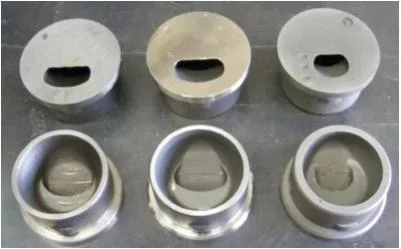
I did port my last cups to reduce outflow pumping losses and help a heavier air fuel mix escape for more power. This was based on the GM IDI diamond cup. EDIT: Here is a pic of the diamond in the middle and the origional on the right. The left one is an aftermarket cup that I forget the name, but it also was used on higher hp version of the same engines. All were used on the gm 6.5 I believe, but with different power ratings.
gm diamond cup left big improvement.webp

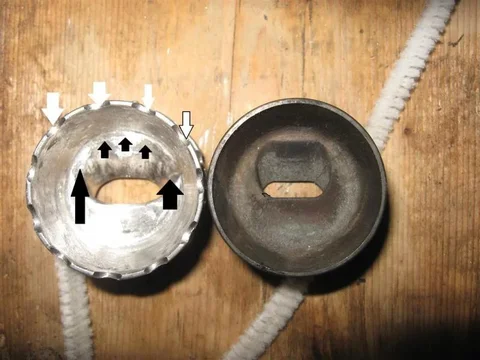
Here is my cup inside. I blended and widened the opening (black arrows) to lower pumping losses as well as removed all the ceramic coating inside. I also removed material from all of the contact surfaces (white arrows) in order to reduce the thermal transfer of heat from the cup to the head.
scallop 2 (Medium).webp

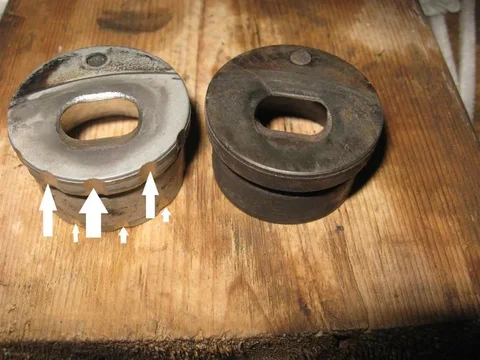
Here is the face. Cermics were left intact and the piston opening was not altered much. I did debate drilling a pattern of holes on the block part of the cup to further reduce contact with the cup and the gasket. I decided not to as the gasket is stainless and the face is ceramic coated. One of the drawbacks I read about with the GM IDI cups that were ported (diy ported) was that they ran dirty, even at idle. The thought was that the opening was altered enough so that the air/fuel stream was not properly directed onto the piston allowing it to be deflected upwards properly. It was instead landing on the outer flat edges of the piston and hindering further air fuel mixing and gave it a crappy burn. Mine should keep it centered... hopefully. Many of the diy ported cups had drastically enlarged openings on the piston side. I purposfully tried to avoid that.

My thought was to:
Reatain as much heat in the cup to shed into the air/fuel stream.

Reduce thermal losses into the head.

Allow for a larger air fuel mix to escape from the chamber as fast as possible without altering the incylinder burn dynamics.
cups scallop (Medium).webp

gm diamond cup left big improvement.webp


scallop 2 (Medium).webp


cups scallop (Medium).webp
 
Last edited:
Am I missing somethieng here?

Roller lifters for a 4K reving engine is not reality, design was for high rpm engines.


We are talking about a 2200rpm engine all day.:meh::meh:
 
Am I missing somethieng here?

Roller lifters for a 4K reving engine is not reality, design was for high rpm engines.

We are talking about a 2200rpm engine all day.:meh::meh:

The idea was that reducing mechanical resistance means more power made with less work done. And yes we are done with that idea.....for now.
I asked the mods to change the thread title.
 
In this picture, the middle precup is the stock genuine 6.5 GM diamond stamp precup. The right one is an earlier model part, and the left is a knockoff aftermarket part...from the info i read, on a different site with that exact pic. But technicals aside...

Your precups look exactly like mine on the inside and out ~give or take. Except of course the divots(white arrows) which seem like they would make a difference. I didnt really change the shape too much, pretty much rounded everything smooth and took some material out of the inside...

I wonder if using ceramics on the outside of the precup walls, inside the upper chamber, and the face of the head and the face of the piston would work well.? Keeping the heat in the cup and out of the head and piston.
Like you said, very interesting about the back to back dyno stuff. Seems you cant believe everything you read. But, the post did say a bit about retarding the timing after such mods, is needed to see the full benefit.. since, like you say, an incomplete burn, due to the changing of the heat properties in the combustion process, timing is most likely affected. Would probably run like ass if not tuned correctly.

ForumRunner_20131204_235636.webp
 
Last edited:
Ahh sorry about the miss information on the Gm cups there. I stand corrected. My cups are coated on the exterior walls that apear to contact the head, but actually dont. The outer flat cylinder aspect of the cups are slightly narrower than the rest of the cup and dont actually contact the head. I did leave the ceramics on there as I too thought it would lower the conduction there. I focused on the points that I was certain contacted.

I also found an interesting opinion on that Gm cup thread discussing the pistin side of the cup and porting it to lower pumping lossses. Some felt that alowing more air into the chamber could have a negative affect on thermal transfer as the air fuel mix would have grreater opertunity to burn and loose energy in there. Its a good argument, and after reading about how the fuel stream interacts with the piston I choose to leave mine alone in that regard.

One thing ive pondered is the glow plug relationship to the fuel mix ignition at operating temp and the heat the plug sheds into the head. I have to asume the glow plug aids in the air/fuel ignition, but often thought that insulating the plug from the head could also lower pumping losses. After looking at the plugs, I have no clue how that could be done though.

Passanger performance has been working on getting power out of diesel VWs for a long time. I talked alot with him about head porting and valve work and in cylinder swirl and cups and pretty much everything we want to do, except they have done it to little IDI engines 20 yrs ago. Sadly, they moved on the the DI engies out of frustration. Alot of it had to do wth the poor design of the 1.6 head. It just flows really poorly no matter what you do. The 1.9s and newer are just better platforms to start with.
 
Last edited:
Hey no worries on the info. Internet "facts" can be questionable at times. I think when I do my new head later on, ill coat the face of the cylinder head c.chamber, face and outsides of the precup, and try to get a thick coating on the upper chamber of the head.
I cant recall exactly how the glow plug protrudes in relation to the injector, but isnt it above the nozzle tip? I would think that it would have little effect on the swirl. However, on cold starts, insulating the non threaded portion of the hole would ensure maximum transfer if heat into the cup as it would have nowhere to transfer but down into the cup.
I also read that removing a very small amount of material from the upper chamber or the walls of the precup was a good way to lower compression a small amount, instead of dishing the piston. However if dishing the piston, it was recommended to dish directly in the center of the swirl flow(whether thats the physical piston center or not im not 100% on) to promote proper combustion., instead of just carving out a symetrical portion and callin it good.
 
Im asking ARP if they can put together a head stud kit for me,(and others if needed)
I need some measurements from anyone who has a head and block apart....
Diameter of bolt head contact area.
Cylinder head thickness at bolt hole.
Bolt hole diameter.
Head gasket thickness.
Total depth of hole in block.
Threaded length of hole in block.
Top of block to top of threads in block.

They gave me a form to fill out with all the measurements. Im curious to see if they can do it for a reasonable price.

The tricky stud would be that front one under the rocker shaft, making sure it doesnt protrude too far up...
 
Last edited:
I did this a few years ago. It was not too hard to cut down the studs. If you do make sure you cut the bottom off and not the tops as you dont want to burr the threads and wreck the nut as you put it on. It was a fun project. Ignore the gasket leaking stuff as it was a cracked head giving me the grief, not the gasket. The retorquing was real however and I cant explain it other than it needed it mutiple times until it leveld off. Great stuff to work with. For a stock pump I have to say that I actually dont think you need it, but they cant hurt.

https://forum.ih8mud.com/diesel-tech-24-volts-systems/488209-3b-arp-studs-vendors.html
 
ARP number 207-4202 kits x 2

I ended up cutting down 5 bolts all together to get under the rocker arms. Bolts wre originally 146mm and I cut 8mm off, or 6 threads which brought it down to 138mm. That let the nut grab all the stud threads and left none protruding out the top. The studs are mucho hard and I went through a haksaw blade every 2 studs. Was slow going. I didnt zip them as I wanted to avoid lots of heat.

I also used the permatex copper spray on the last head I did and it really smooths out the machining. You only use very thin coats.
 
Awesome thread gerg!
Man the search function sucks lol.
What kit did you end up using? The mits starion? Edit. Damn youre quick! Thanks bud. Bout 110$ per kit online. Ill check with lordco tommorow with my discount...

I always decided against retorquing, as I heard sometimes it causes HGs to blow prematurely. But ill be checking mine next valve adjustment for sure....I have the toyota MLS under my head., no bubbles so far....
 
Last edited:
So retorquing is a mixed game. When I did it with a fiber gasket I kind of crushed the gasket so much it allowed the cylinder liner to contact the head itself. The gasket absolutely crushed to nothing. It left a definate ring on the head from the cylinder contating it. Fast forward to the MLs gasket and they are non compressible....so no problems with crushing it, but I did need to retorque my ARPs pretty much 6 times before I was satisfied with them. The first retorque took about 1/8 a throw which blew me away. They must have been really loose. So my first thoguth was that im a complete moron and did something wrong... which I have been known to do...but 6 times is a bit excessive. I basically did it weekly till It clicked without any movement on my wrench. That is completley contrary to ARPs info. Did I use too much lube? That was my only thought. Can you use too much lube? It was the super duper ARP crazy good moly torque stuff they recomend. Many years later and that gasket is solid with no leaks.
 
I used ARP head studs on a few Toyota gas motors. Fantastic quality fastener so defiantly worth wile. On my built 7M I used a cometic gasket and did not re torque never had an issue. On my 2JZ I used the OEM metal gasket and re torqued 2 times. Was not planing on it but in tuning at 27psi and 100% load it burped some coolant out. I went through and like Greg found that I got a surprising amount of extra torque out of the studs. So i drove it for another 1000kms and did it again got minimal out of it the last time. I would have checked again but that motor requires removal of the t belt and cams to check and i did not possess the energy to do it a 3rd time.

I use ARP moly thread lube on all my inner engine fasteners that call for lube. On my 4BD that was head bolts (stock) and mains.
 
Im using stock bolts with ARP lube with an MLS gaket on this latest motor and am quite interested in seeing how the retorqing goes.

All this talk about ceramic coating pre chambers and stuff has me wondering if I shouldnt yank the head off this engine and get it done. I already have it assembled though and wonder if the gasket will be screwed if I take it off. I did spray both sides with copper spray. Any advice Jereme? Will the nitrile peel or the gaket not seal next time? Hard to say I guess. I really want to get the thing back on the road. This 1fzfe milage is putting me in the poor house. This thing is worse than my old FJ40 with a 2 barrel holley.
 
So its pretty toasty up there I hear. Its below zero in the valley so the rest of BC must be getting ready to cut their Tauntaun open and hunker down. Night Luke.

Not so warm here either. Hovering around -10 in the mornings. Not fun for working on vehicles outside....

All this talk is making me want to get going on this project as well.
Should get my block in about a month, and slowly start tearing into it.
 
Last edited:
Im using stock bolts with ARP lube with an MLS gaket on this latest motor and am quite interested in seeing how the retorqing goes. All this talk about ceramic coating pre chambers and stuff has me wondering if I shouldnt yank the head off this engine and get it done. I already have it assembled though and wonder if the gasket will be screwed if I take it off. I did spray both sides with copper spray. Any advice Jereme? Will the nitrile peel or the gaket not seal next time? Hard to say I guess. I really want to get the thing back on the road. This 1fzfe milage is putting me in the poor house. This thing is worse than my old FJ40 with a 2 barrel holley.

I would not take the head off with out expecting to take the nitrile coating off. The nitrile tends to stick to the more pores head and block. The spray copper works great I use it on all my head gaskets.
 
X2 on not re-using a HG. I know theyre like 150$ for a genuine, but better than having a problem later......
Ill be utilizing the copper spray when I do mine. I always wondered about a coating while installing a new HG. Funny how a lot of manuafacturers say NO! But the info and experience here points to it being acceptable.
I never had my head or block resurfaced prior to installation, but i did make sure it was squeaky clean and free of debris. No problems yet. Next time will be a tad more thorough. :D

Gerg,
Did you apply a small amount of torque to the studs themselves when you installed them? Did you happen to check the stud for looseness?(would be kind of hard with the head installed on a running motor, i know) I know ARP says finger tight, but their reasoning for that is for the stud to stretch only in a longitudinal plane, instead of rotational twisting/stretching as well. However, I think a snugly torqued stud(10-15ft/lbs or even less) would help with the loosening and re-torquing issues.
Do the studs in that kit have the allen head in the top? Seems its a lot of trouble to put that in just to have them installed finger tight..
Not saying you installed improperly or anything, but lots of stud applications suggest a small amount of torque applied to the stud on installation. Maybe head studs are different, Just thinking out loud....

Found this on a Honda forum..

"This information is from Al at arp, older guys, knows his stuff.

He says for head studs:
1. hand tighten in to block.
2. use the moly lube on the top threads and washers.
3. torque in 2-3 steps. Not 10-12 pound increments like is posted all over the internet.
-for example the torque spec is 60 ft lbs. Tighten them all first to say 5-10 ft lbs, then ideally...go right to 60, but if you physically can't do 30-60.

I broke mine doing it in 10lbs increments. 12-22-32-42-54-68

he said you do not get accurate torque readings doing it this way, and if the studs will take it you can torque them down that way and not have the same clamping force as a straight 5-60 ft lbs straight torque in one step.

Alot of the people torquing them down in steps to 75-80 ft lbs he said your asking for trouble..and not sealing any more or putting any more clamping force that way."
 
Last edited:
Also seen a few posts quoting ARP as saying to thread them in snug with an allen wrench(or double nuts) and 1/4 turn past that. Ambiguous info all over the place....
I think I'd feel better with the studs tighter than finger tight though and a lot of folks seem to go the 1/4 turn past snug and no issues.
 
Oh good point on the studs, I torqued my studs to about 15ft/lbs and I had ARB thread lube on the stud threads into to block.

I also torque mine to 30ish ft/lbs and then straight to the torque desired. So two sequences usually just follow the FSM with head torque sequence. Never heard of doing 10ft/lbs increments?
 
yea I didnt see the point in such small increments, unless your cyl. head is made from china alloys or tinfoil...
I did mine to around 25-30Ft/lbs and straight to 90. and then checked them all to 90 again, the head BOLTS that is. I went with 90ft/lbs to make a nice round number. I used a analogue wrench and its hard to see 87...
 
Last edited:
Back
Top Bottom