When introducing boost into an engine, it's very common to de-stroke to lower compression. Boost is compression, so you gain it right back, but with more control.
De-stroked engines can rev higher (less side loads on cylinder walls and less inertial mass). You give up low-end torque with a shorter stroke, but the higher rpm ability can result in better peak horsepower. This is a testament to the block and crankshaft journal strength of the 1FZ. Best of all - they probably don't have a PHH.
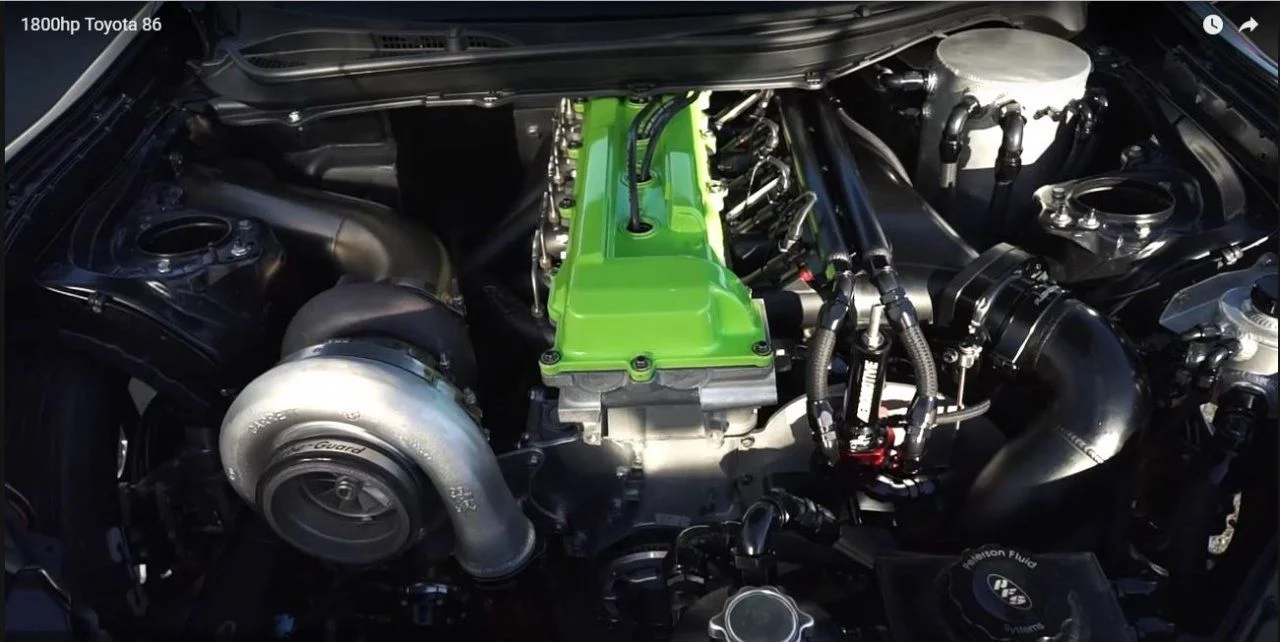
lol, imagine changing the phh with the motor shoved under the cowl like that. Cool car, I've seen it around the interwebs before (I believe it's in one of Ryan's threads )
Not correct, lowering the stroke has nothing to do with compression. You can have a short stroke and high compression. What you gain with a shorter stroke is the piston has a lower piston speed, hence less g's and you can rev higher. example
105mm stroke engine at 7000rpms = 4,822ft/min
80mm stroke at 9000rpms = 4,724ft/min
When introducing boost into an engine, it's very common to de-stroke to lower compression. Boost is compression, so you gain it right back, but with more control.
Not correct, lowering the stroke has nothing to do with compression. You can have a short stroke and high compression. What you gain with a shorter stroke is the piston has a lower piston speed, hence less g's and you can rev higher. example
105mm stroke engine at 7000rpms = 4,822ft/min
80mm stroke at 9000rpms = 4,724ft/min
Compression is a total calculation of swept area, volume of air introduced into the cylinder, and ultimate volime of squish area at top dead center. Combo of the three
Compression is a total calculation of swept area, volume of air introduced into the cylinder, and ultimate volime of squish area at top dead center. Combo of the three
Piston shape, combustion chamber shape all factor in to compression ratio. For instance, honda B16A has a shorter stroke than honda B18B, yet a much higher compression ratio. Both engines have similar architecture. In the case of this 1fz drag racer, you can bet they are not using the stock pistons or head for that matter. They likely achieved their desired compression ratio via piston selection. Reducing the stroke was more likely an attempt to squeeze out more top end power (less stress on rotating assembly at higher engine speeds).
:edit: but in theory, you are correct, if everything else is left the same but the stroke is reduced, compression ratio would be reduced. But in practice, nobody makes a custom stroker (or de-stroker) crankshaft and uses stock connecting rods and pistons with it
Because when you decrease stroke length you increase rod length, which also gives you a better rod length to stroke ratio. Many consider around 1.75:1 to be ideal. You are not simply decreasing the stroke length and leaving the same piston and rod. If you did that your piston would be a good 15mm below the deck at TDC, you would have a combustion ratio of 4.55:1
F1 engines, limited to 2.4 litres, have a ton of bore compared to stroke to rev high "and quickly" to 20,000 rpm. Part of the reason the ford 289 did so well road racing, and the 302 chevy held (and may still hold, not sure) the stock small block e.t. in NHRA for so long. Quick to max revs/ max hp






 )


