Slider Opinions?

This site may earn a commission from merchant affiliate
links, including eBay, Amazon, Skimlinks, and others.

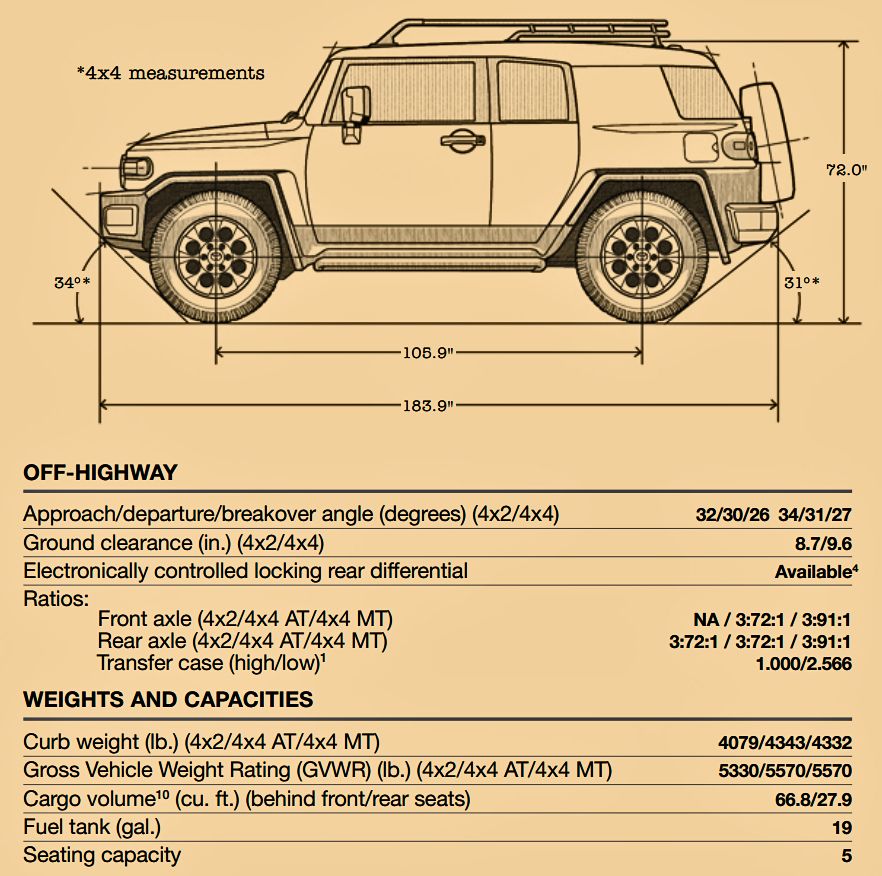
I would have to stress that your FJ probably doesn't weigh 6200lbs.
It did, Cat scale put it at 6,440 when loaded for offroad trips

1.75" tube is good, but I had to go .150 DOM.

Here is a crossmember of 1.75" .125 HREW that the sliders were made out of also. Thinking back on it, are Slee's DOM?
P2120026.webp
 
6,440?! I think that exceeds the FJ's GVWR by like 1,000lbs right?
 
It did, Cat scale put it at 6,440 when loaded for offroad trips

1.75" tube is good, but I had to go .150 DOM.

Here is a crossmember of 1.75" .125 HREW that the sliders were made out of also. Thinking back on it, are Slee's DOM?
View attachment 1375976

According to wiki that means your FJ weighed about 2,200 to 2,300 pounds more than stock - that seems like quite a lot of added weight!

Toyota FJ Cruiser - Wikipedia
 
Someone asked about the mounting brackets of the WKO sliders. Here's a shot of mine before instal:
IMG_0888_zpsdwxazqor.jpg


I went with the DOM tubing and am very pleased with their quality and strength.
 
So if you don't have sliders, what do you have. The stock steps? Does everyone have steps (I am not familiar with models before 2016). I have to believe that Slee's sliders are stronger than the stock steps on my 2016.

As an interesting comparison, my prior vehicle was a Land Rover LR4. It did not come with any steps or bars or sliders. They were optional for the 2014 and I did not want that option as they would get destroyed off road. BUT, starting in 2015 Land Rover required every LR4 sold to have the steps - and these steps were significantly reinforced. The argument made by Land Rover is that this was for safety - apparently they were required by the safety police to have these steps. You weren't "allowed" to remove them. So the safety police clearly believed/determined that there was some safety benefit to having a rigid piece of steel at that location on the vehicle body.
 
So if you don't have sliders, what do you have. The stock steps? Does everyone have steps (I am not familiar with models before 2016). I have to believe that Slee's sliders are stronger than the stock steps on my 2016.

As an interesting comparison, my prior vehicle was a Land Rover LR4. It did not come with any steps or bars or sliders. They were optional for the 2014 and I did not want that option as they would get destroyed off road. BUT, starting in 2015 Land Rover required every LR4 sold to have the steps - and these steps were significantly reinforced. The argument made by Land Rover is that this was for safety - apparently they were required by the safety police to have these steps. You weren't "allowed" to remove them. So the safety police clearly believed/determined that there was some safety benefit to having a rigid piece of steel at that location on the vehicle body.

All of the 200's come with the OEM installed aluminum steps that are as flimsy as an aluminum pie tin. They would not provide any protection from rocks, or other off road debris nor would they provide any protection from a side impact, even at 2-3 mph. I doubt they would even protect your vehicle from someone parking too close and whipping their door open.
 
So if you don't have sliders, what do you have. The stock steps? Does everyone have steps (I am not familiar with models before 2016). I have to believe that Slee's sliders are stronger than the stock steps on my 2016.

As an interesting comparison, my prior vehicle was a Land Rover LR4. It did not come with any steps or bars or sliders. They were optional for the 2014 and I did not want that option as they would get destroyed off road. BUT, starting in 2015 Land Rover required every LR4 sold to have the steps - and these steps were significantly reinforced. The argument made by Land Rover is that this was for safety - apparently they were required by the safety police to have these steps. You weren't "allowed" to remove them. So the safety police clearly believed/determined that there was some safety benefit to having a rigid piece of steel at that location on the vehicle body.
Safety Police?

I am cynical, skeptical and sarcastic (at times)......sounds like NHTSA mandated installation and lawyer inspired CYA dealer-speak/BS language preventing dealer removal, but I wasn't there.....
 
Last edited:
WKO mentions that they can do slight mods to the design - anyone know if that allows for a wider step, etc? What can they change?
 
WKO mentions that they can do slight mods to the design - anyone know if that allows for a wider step, etc? What can they change?
See my response on page 1. You can also select the type of top cover you want. Exposed, half exposed or fully covered. They also offer dom or regular tubing. If you do any off roading pay for the dom.
 
My rig is also on his 200 home page. Stock form back in the day....
 
I have the WKO sliders and I'm very very happy with them. Very high quality and heavy! I got the DOM version and instead of the 2x2 main rail I went with the 2x3 so they stick out an inch further and couldn't be happier
 
Other than actually being crushed or impaled what causes injury is high G forces being transmitted to the occupants. Spreading force reduction over time (delta-v) is what reduces bodily injury. This is why if you crash a smart car in to a wall at 70mph the car (and thus occupant) may not be crushed due to amazing structural strength engineering but you are still dead inside. This is also why race cars aren't built like tanks and instead spectacularly disintegrate in crashes.

It seems to me that a crash in to the side of a vehicle with sliders (especially if they are super beefy) will do nothing but increase the G forces transmitted to the occupants through the slider directly in to the frame. You want the vehicle to progressively crush through the B pillar, sill, and doors before transmitting those forces to the occupants. Sliders may bypass enough of those crumple zones to increase G forces to the occupants.

Of course my logic above doesn't address the points that have already been made about preventing intrusion which sliders may help with. Although intrusion may be a possibility, high G forces are a definite threat.
 
I was originally sharing Markuson's theory about it offering some protection. But I never truly understood crumple zone technology. I do miss the good old days when my BMW/Mercedes would hit a honda and not leave a scratch on my car since it was a big heavy german tank.
 
Other than actually being crushed or impaled what causes injury is high G forces being transmitted to the occupants. Spreading force reduction over time (delta-v) is what reduces bodily injury. This is why if you crash a smart car in to a wall at 70mph the car (and thus occupant) may not be crushed due to amazing structural strength engineering but you are still dead inside. This is also why race cars aren't built like tanks and instead spectacularly disintegrate in crashes.

It seems to me that a crash in to the side of a vehicle with sliders (especially if they are super beefy) will do nothing but increase the G forces transmitted to the occupants through the slider directly in to the frame. You want the vehicle to progressively crush through the B pillar, sill, and doors before transmitting those forces to the occupants. Sliders may bypass enough of those crumple zones to increase G forces to the occupants.

Of course my logic above doesn't address the points that have already been made about preventing intrusion which sliders may help with. Although intrusion may be a possibility, high G forces are a definite threat.
A benefit of this conversation/thread is consideration of the topic with input from folks more knowledgable about physics and engineering than me, so pls correct me if I get this wrong....

To this uninformed participant, it seems like the intruding mass has three basic routes - into your vehicle, over or under - like the deer in your grille or bull bar. You want Bambi in your grille/bar, under the bar or onto your hood (perhaps through your windscreen or over your roof)?

In a side impact, I would think that the size and design of the intruder would play a large part - small/low sedan vs. lifted Ram pick up - first could "go low" under your rig, while that latter could end up in the greenhouse of your rig.

Back to crush zone and air bags....lots of air bags. :)
 
Air bags are definitely awesome. They do a great job of reducing delta-v and thus G forces on the occupants. Only down side to air bags is they only fire once which provides injury reduction from the initial impact (which is usually the largest risk). However, there is also secondary impact risks to the occupants from vehicle roll over or collisions in to other structures post initial impact.

What we need is something like this:

:)
 
Air bags are definitely awesome. They do a great job of reducing delta-v and thus G forces on the occupants. Only down side to air bags is they only fire once which provides injury reduction from the initial impact (which is usually the largest risk). However, there is also secondary impact risks to the occupants from vehicle roll over or collisions in to other structures post initial impact.

What we need is something like this:

:)

Don't forget to include a side order of Sandra Bullock Ver. 1.0
 
To paraphrase Mark Watney from "The Martian" - you guys are really sciencing the sh$t out of this. And that is awesome! Love threads like this.

So, to sum it all up.

- rock/tree stump protection on the trail: yes
- parking lot door ding protection: mostly yes (not all door curves created equally)
- horrible car accident: don't expect a "I can't believe they walked away" as a result of sliders only - seems like a reasonable expectation

Not trying to cast any bias or speculation into any prior postings, each experience is different and that is what makes this whole discussion incredible. I bought my sliders for rock protection - any other benefit is pure gravy. And, other than cost, I can't think of any negatives?

And, securefoam looks awesome!
 
Buyer expectations are largely driven by peer BS and marketing BS. One thing I like about @woody World is the BS is higher quality and much more usable :)

I don't think any of our slider vendor friends would allow their products to be sold as risk remediation in a significant side impact collision.

On the marketing front, I have owned a number of all wheel Subarus since buying a new one in December 1974 (yes, very early). Totaled it in a head on collision four days later (no, not my fault) and walked away. Funny thing is Subaru didn't market them as safe, just able to handle inclement weather and light offroading. I survived without injury because the front end "failed" by wrapping around the engine, absorbing most of the energy produced by the Ford Mustang that blew the traffic signal.

Fast forward a few years and Subaru is selling their crash ratings and safety proposition with "They lived" ad campaign. That's all good except for my buddy who lost his wife in a Subaru. He is not a fan of that TV ad...

My point is that a good vendor doesn't oversell the buyer and a good buyer doesn't oversell himself.
 
My pea-brain thoughts:

G-forces kill. No doubt about that. But in a T-bone...intrusion into the cabin kills too. Crumple zones work great on a frontal impact, because you have an entire engine and several feet to crumple. But front crashes also tend to be head-on--often doubling the impact, where a side impact is less. If you hit a car head-on, you both benefit from your combined crumple zones. But in a side impact, your door doesn't really have a crumple zone. As others have maintained...your slider WILL be crushed...that means it is doing what it can to form at least some level of "crumple" where there is otherwise none.

So I would just suggest that if a slider can begin reducing the impact to the door before the door is reached a split second later...to whatever degree it can by beginning the other vehicle's crumple at least somewhat before it hits your door...you've reduced the door impact by the amount of energy required to smash through or around the slider. G-forces may well kill you...but intrusion definitely can too.

By sending more force to the heaviest parter of the LC (frame), rather than ONLY your door, you start the other car's crumple sooner and at your strongest point. It isn't as if you're being hit by a steel block where ALL the g-force is absorbed by you. You're being hit by a crumple zoned mass that you want to crumple as much as possible on its way to intrusion into your own cabin. That crumple process will begin either before it gets to your door...or after it hits your door. I would prefer that my LC's frame absorbs as much as possible--even if just a bit--before it reaches my door.

Watchu think? :)
 
Last edited:
Back
Top Bottom