Residual Valve - discs all around

This site may earn a commission from merchant affiliate
links, including eBay, Amazon, Skimlinks, and others.

Joined
May 11, 2007
Threads
123
Messages
900
I have read and did my research on residual values and have a simple question.

I have purchased the Marlin FJ60 Aisin Master cylinder for my FJ 40 - all wheel discs. The Marlin ad states "Features 1" piston and residual valves for both front and rear. Works with both drum and disc brakes."

Now based upon my reading, drums require a residual valve with 10-12lbs of pressure and discs require a residual valve 2lbs of pressure.

So how could one master cylinder work for both without some sort of modification.

Am I not understanding something.

here is the link
Marlin Crawler
mastercyl_500.webp
 
That is a non ABS M/C from an 80. I have a buddy that is running that same one on his 40. It's better than the stock but the back brakes still lock up a little when he gets on the brakes hard.
 
I don't see what your question is.

Do you have 4 wheel disks??

the master is not a 60 master, as stated above, it is an 80 master.

2 lb residuals in both ends..

Also, you most likley will need a proportioning valve. for the rear circuit.
 
I think his question is how the 80 master sold by Marlin with the 2lb valves can ALSO work for drum brake systems without changing the valves to 10-12 lb valves?
 
I think his question is how the 80 master sold by Marlin with the 2lb valves can ALSO work for drum brake systems without changing the valves to 10-12 lb valves?

Thats how I read it.
 
clarification

Yes - I am wondering how one master cylinder could be used in both applications be that disc or drums.

Didn't know what problems I might face, but it looks like people are using them for trucks with front and rear discs without issue (my set up). Thanks for the clarification on the FJ80 and the suggestion on the proportioning valve.
 
Evidently Marlin offers a Master Cylinder with 1" piston, not sure what vehicle application it was designed for, or how it would be an upgrade for those who already have a 1" piston. We offer a Master Cylinder with 1.125" piston, same as 1998-newer Landcruiser. Ours was used on 1 ton non-USA Toyota trucks. It solves the soft pedal/pump-up scenario, and the vehicle it was designed for has front disc, rear drums. It requires an external Residual Valve for the rear brakes, so you can use 2 lbs. for rear disc or 10 lbs. for rear drum.
 
residual valve

The Brake Man.com - ValveTechI

I did some searching and found this --good read on the prob

It seems you can change the valves from the reading?

unless it is an adjustable valve I dont see how it could work for either disc or drum--you sure it wasnt saying disc and drum combo?

or it could just be messing up

or are you sure your brake lines arent running through an old externally mounted residual valve so you are getting both acting on the system?
 
It seems you can change the valves from the reading?

Yup. They should be marked somehow too. I looked at the one I removed from my front (disc) circuit. It has either a 0 or a 6 on it; hard to tell. As shipped from Toyota it caused my disc brakes to hang up and overheat. Without it my brakes work great.
 
If you probe the outlets on that master, I bet you will find there are no residual valves installed in it. As the article you referenced states, they are not used in disc brake systems as long as the master is mounted above the calipers.

I can't tell you why the seller is telling you a disk brake master is fine and dandy on a drum brake axel, it is not.
 
And the term "residual valve" is really a complete "misnomer" for the type of valve that I have in my Toyota mastercylinder.

My "residual valves" are completely incapable of leaving any "residual pressure" in my brake lines! (I wish I knew what they are REALLY there for!)

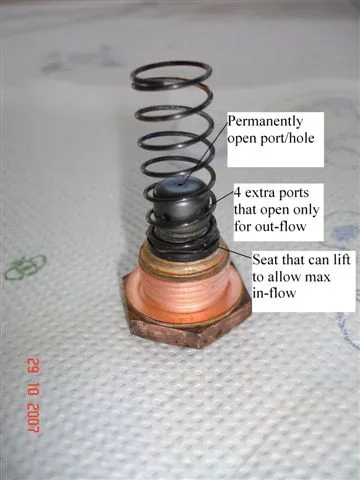
Here's a photo of my "residual valve". (One sits in each outlet.):

residual4.webp

The holes in the centre of the caps are "permanently open thru-holes" which ensure that no residual pressure can ever be left in either of my brake lines (front or rear).
residual4.webp
 
residual pressure

I read some general info on brake systems and some say that some residual pressure is available as long as the M/C is mounted high

I've looked for a cutaway of that valve and cant find one but I remember the post on this---bugs me now, I'll have to pull one out and have it xrayed or cut it open one of these days.

:):)

on aircraft emergency brakes we have a brake pressure dissipation valve that has a small metered hole in it to bleed residual pressure off, it is held open by a spring and when brake pressure is applied the pressure acts on the rest of the surface and drives it on a seat shutting the hole---this would have to work kinda in reverse of that so with no pressure it would close the hole via a spring maybe? Dont know cause if I remember right you were able to blow through it and that dont seem right?
what about where it is installed---anything there?
Gonna have to find an answer now---thanks a lot!!!! ha ha!
 
Last edited:
I read some general info on brake systems and some say that some residual pressure is available as long as the M/C is mounted high

True. The fluid provides its own pressure because of its weight.

But in my opinion there seems to be a lot of nonsense written in technical publications on this subject. - I can't see why "residual pressure" is needed to prevent the shoes in our cruisers from moving too far away from their drums (drum brakes) because that job is accomplished very well by the "adjusters".

.....if I remember right you were able to blow through it and that dont seem right?.......

I should have taken a photo looking straight through the whole assembly at a bright light. That would have shown exactly what I mean. Looking from the brake line end you would then have been able to see the hole through the cap.

And nothing is able to block those cap-holes. The ends of my mastercylinder ports (into which the "residual valve assemblies" fit) are far enough back to accomodate those springs so nothing there can block the holes.

Personally - I suspect these valves in my vehicle have something to do with creating the right "fluid flow pattern".

Hitting the brakes, and the fluid gets pushed out - with very little restriction - towards the wheel cylinders. Then take your foot off and the shoe-springs GRADUALLY push the pistons back in - with this return fluid movenment being slowed by the cap orifices. At the same time of course, the pistons in the mastercylinder have moved back - probably creating suction there. ..............

So if you ever need to "pump your brakes" in an emergency (due to a brake fault), the master will suck fresh fluid from the reservoir on a "pedal-upstroke" in preference to sucking the old fluid back in (from the brake lines) that it pumped out on the previous "pedal downstroke". If you see what I mean.

PS. I raised this "pet theory" of mine about a year ago here. (It still plays on my mind!)
 
I have front disc brakes the wilwood conversion on this '71 and stock drums on the rear with a stock 40 master + booster. now would it be best for me to buy an inline prop. valve towards rear or get this suitable master from an 80? later in mind to do GM rear disc .
 
Master cylinder, prop valve, and residual valves

I would think it would be best to have a MC from a disc/drum set up. The difference is that disc brakes take a larger flow or volume of fluid and less pressure than Drum brakes.

Then the appropriate residual valve pressures again due to design 2 lbs for disc and 10 lbs for drum and finally a prop valve to get the braking force balance between front and rear.

Considering some of the problems posted I am convinced it would be best to buy aftermarket adjustable residual and prop valves to fine tune the brakes the way you need em.

Also off roaders may want to proport the brakes differently where It may be an advantage to have the rears locked up early.

Recently I saw a show that explained that the Aussies have done some work to ABS to allow the rear tires to lock up in gravel and reduced stopping time by 20 percent as the tires dig in a little.

Hope that helps
 
The front disc brakes are dragging

I pulled off the tires and the front disc brakes are dragging. I can turn hub, but it does drag. I am thinking this is the master cylinder as the The Brake Man.com - ValveTechI article describes my symptoms.

I guess I am going to have to call Marlin and see what they can tell me. I hate digging in to this thing again. I just finished re-doing all the break lines and upgrading the brake booster.

Is there is not , it looks like a call to Downey to see if thier Master Cylinder will do the trick.
 
I have a '40 with discs front and rear and recently added the Marlin 80 master cylinder. Within a few miles of the house the rear brakes start dragging--a lot! If I crack the rear brake line at the master cylinder and release pressure to the rear the dragging stops.

A friend that is a Toyota tech told me that the master cylinder Marlin sells is a for 94 and newer 80s that had discs in front and drum rears and needed residual pressure. the 95 and newer master cylinders do not have the rear residual pressure. I will be given Marlin a call...
 
Back
Top Bottom