My Caster readings...4" lift

This site may earn a commission from merchant affiliate
links, including eBay, Amazon, Skimlinks, and others.

Ok, the mystery begins...lol

just got back from a different allignment shop:

to show past readings:

A: Lifted no caster correction
Left tire: -2.3 Right tire: -2.8 on one page, Left -2.2 Right -2.9 the other page..:confused:

Different allignment shop
B: Caster Arms on
Left Tire: 4.4 Right Tire: 4.0


Ok so now I'm confused....:confused: I did notice after the arms the vehicle pulls to right more, which both allignment shops noted...but I didn't notice until putting the arms on.

At these readings, it appears the arms corrected at 6.7 degrees? And how did the caster switch on which side was off? (nevermind...I'm a negatvie number idiot) ....

help wanted...
 
Last edited by a moderator:
Nice work FJBEN! This is probably the first time that somebody has followed up with an ending reading. Me stating that the arms corrected 10* was from a conversation with Christo, but depending on the tech setting up the truck and using a different machine as well it looks like you are fine.

Seems Slee's arms correct for 7*, there abouts.
 
sleeoffroad said:
From the above you would think that it correct 7 degrees, but we actually took a arm and drew it out, overlayed that with the stock arm dimensions and it is 11 degrees change in caster.

I need to simplify the drawing and post it.

Ben, do you have the measurements of how much lift you gained?


here's some more info. Last year it was alligned and here were the readings:

Bone stock 80:
Caster
L: 3.0 R: 2.7

Hub to bottom of flare
F: 19" R: 19.5"

Lifted no caster:
Caster
L: -2.3 R: -2.8 change of about ~5ish

Hub to bottom of flare
F: 24" R: 24 3/4"

Lifted w/arms:
Caster
L: 4.4 R: 4 change of around ~7ish

Hub to bottom of flare
F: 24 1/4" R: 24 1/4"


I know the suspension was sagging as our 97 sits 1" higher stock. So it appears around 5" of actual lift from the time right before lift install and after. The rear prolly changed as is broke in more and then I put a full sized 35" trxxus on there. The front raised up slightly because the spring "straigtened" out with the caster correction taking some of the bow out of the spring.

i'll try to book time in the original allignment shop to get current readings again.
 
Last edited by a moderator:
FJBen said:
Ok so now I'm confused....:confused: I did notice after the arms the vehicle pulls to right more, which both allignment shops noted...but I didn't notice until putting the arms on.

So you are saying with proper toe and no camber issues that you are getting a pull to the right?

Did the alignment shop give any indication why?

Maybe the lack of panhard correction?

Nay
 
I can't remember the cross caster error limit but you are at .4~.5 and I think that is a little high.

The more common reason for this is that the toe is set improperly. It should be 0 so the stops on one side doesn't influence the other when doing the sweeps.

Another possibility is something with in the wheels, such as a loose or worn bearing either in the wheel itself or possibly in the knuckle.

I'd jack up the truck and with help of someone else with a good long bar for prying, really work over those wheels to try and find some looseness. A 5 or 6 foot bar works good for this, just be sure the truck is secure and safe because someone needs to lay next to it to feel for movement.
 
Oh sorry, didn't explain that better. The toe is actually off on it according to both shops, which is why it pulls...not sure why it pulls more now, rather than before...

Can only imagine it has to do with the caster being changed.

I got around 5 degrees of caster change for 5" of lift which does follow the thought school of 1 degree of caster change per inch of lift.

Now how the arms measure out to 11* then only change 7* I don't know. there must be some X-factor we aren't taking into account.
 
FJBen said:
Now how the arms measure out to 11* then only change 7* I don't know. there must be some X-factor we aren't taking into account.

If Slee posts the dwgs of the stock vs. Slee - I'll see if I can find the x factor. It may be as simple as the shops doing your caster measures are wrong - though it's unlikely both would measure incorrectly the same ammount.
 
Walking Eagle said:
If Slee posts the dwgs of the stock vs. Slee - I'll see if I can find the x factor. It may be as simple as the shops doing your caster measures are wrong - though it's unlikely both would measure incorrectly the same ammount.

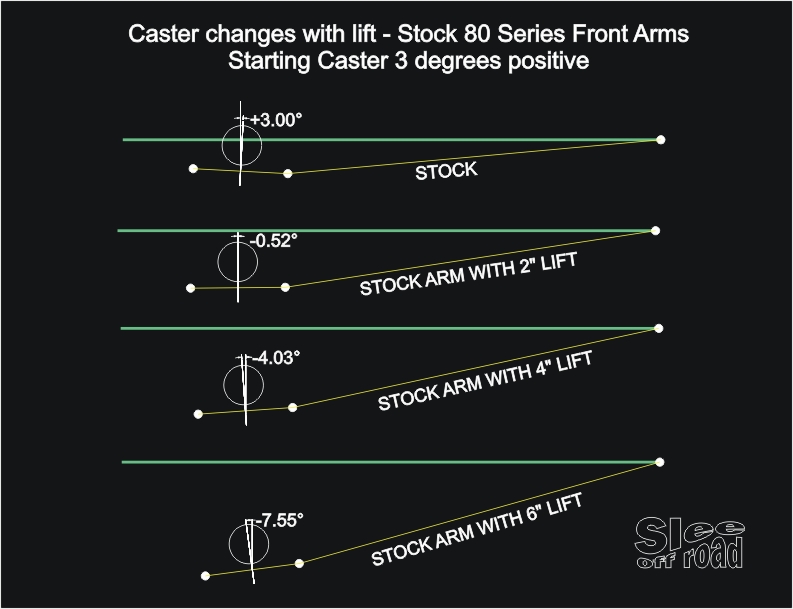
Heith, this is the one drawing.
caster_with_lift.jpg


From this you can see that the that the caster changes about 1.75 degrees per inch of lift. Not with Ben's setup, that means when he got 5.25" of lift, he should have shown about 9 degress of caster changes, but it measured out to 5 degrees. I can not explain that.
 
How were these numbers generated?
 
landtank said:
correcting the caster, especially going from negative to positive greatly alters the forces being applied to the axle. This is especially true on the trunion bearings. How old are those things?


That change was only about a 3 week period. That couldn't have caused that much disaster could it have?

The axle service is due...was done around 50K ago...so definitely time.
 
FJBen said:
That change was only about a 3 week period. That couldn't have caused that much disaster could it have?

The axle service is due...was done around 50K ago...so definitely time.

I think he's refuring to them taking a set at the origonal caster, and if they're setting at a different caster now, they're not 'in the groove'. I think, maybe, that could be what he means.
 
Walking Eagle said:
I think he's refuring to them taking a set at the origonal caster, and if they're setting at a different caster now, they're not 'in the groove'. I think, maybe, that could be what he means.


Could that account for that much a difference tho? seems like 4-5 degrees would be high? and now they are back t o1 degree higher than the initial settings?

Please excuse my retardedness on this subject lol
 
FJBen said:
Could that account for that much a difference tho? seems like 4-5 degrees would be high? and now they are back t o1 degree higher than the initial settings?

Please excuse my retardedness on this subject lol

I have no idea :) I just know that if things are worn in and seated in one direction, and you change that direction, it can cause some issues. Sort of like U-joints. If you take two identical u-joints, and run one at 10 deg. for 100,000 miles, and the other at 15 deg for 100,000 miles, then switch them. They both may fail. Like with alot of lifts, at 10 deg, the u joint is fine, and would probably last another 50,000 miles, but change it to operating at 15 deg, and it vibrates like mad. Any part that wears, will wear according to it's operating conditions, and if the conditions change, they can fail. Remember the little old ladies car that she only drove to church on sunday's at 30 mph? It'll last another 30 years, as long as you don't take it out on the interstate and drive it 80mph. I think that's the theory landtank is going after. I'm sure he'll speak up if it's otherwise :)

It's hard to dig into Slee's dwg without knowing the distances between the mounting points, the angle between the line from the two axle points, and the line from the rear point to the mount, and the axle position above the axle mount points. I'm sure Slee left out this information understandibly on purpose. One of these day's I'm going to have to break down and take some serious measurements of the stock arms.
 
I did not add the arms dimensions, however that drawing is to scale. I know the numbers are right. What I do not understand is why the caster measurements from the alignment racks are not the same.

Also, if you draw out the 2 degree caster bushings from OME and you check the angle that they rotate the axle, then the change is 3.3 degress.

When we first came out with the 1 degree per 1" rule of thumb for cater changes, we did exactly what Ben did and measured the same truck pre and post lifts. We also did a lot of different lifts and I kept records of the changes in lift height and caster changes.

When we designed our arms, we did not design them based on a degree change, we designed them to put the axle at 3 degrees when it was moved 6" away from the stock location, ie, drop the axle side bushing holes 6" down.
 
I'll take some of the blame for the confusion on this subject.

When I finalized my lift I concentrated on the geometry of the front suspension. As Christo has drawn out, geometrically the caster should change at 1.75*/1" of lift. However that would have to include that the rear of the vehicle is raised the same as the front. Remember that caster is measured against an aboslute verticle plane, so if the truck is not raised absolutely vertical then the formular will not work.

I also had my issues with the techs on the alignment rack. They adjusted my toe but left the clamp out of position so it would contact the arms during the caster sweep giving a false reading.

Back to the pull, if you are 50k into an axle rebuild I'd do that before anything else.
 
Back
Top Bottom