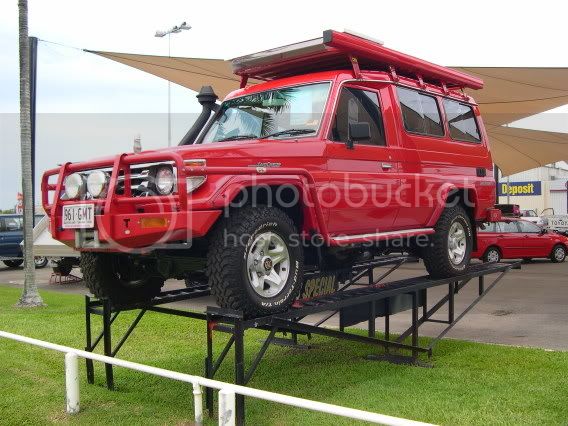
Long distance expedition cruiser 80vs100

This site may earn a commission from merchant affiliate
links, including eBay, Amazon, Skimlinks, and others.

I own a 100 now and have owned 2 80's in the past.

I love the 100 and it has taken me to some pretty cool places - for a 4 day trip to Death Valley last March - food, supplies, water, spare parts, tools, roof top tent and fuel - the truck weight was 7180 pounds!

Have you worked on the IFS? There are lots of moving parts - to get to the CV's if it breaks - hub has to come off - bearings - rotors & calipers - upper & lower A-arm ball joints has to come off - need a big hammer to get the CV's off the third member. You will need special tools for the ball joints - if the CV boot rips or cracks - you will also need a special tool for the clamps that keeps the grease from leaking.

The rear axle on the 100 is a semi-floater.

The 80 series front end - no special tools needed - a lot less moving parts - the rear axle is a full floater.

Being in the US - I would use the 100 for day to day, long trips, expedition trips - parts can be available readily and cdan is easy to get a hold off :grinpimp: but outside of the US, I would use the 80 - less moving parts in the front end - they have sold far more 80 series than the 100 series so parts can be easily obtained - even used parts.

I guess I have worked on the front end of the 100 many times - I have cracked the CV and had to replace it - in my garage, wouldn't want do it in the dirt somewhere where it might afffect someone else's vacation since they don't want to leave me there on the side of the road by myself. I've also broken birfields on the 80 - take the driveshaft out, remove broken birfield - lock the center diff and your on your way home. The 100 - you break a CV - unless you have another one with you, your options are very limited - you can take off the CV - be hard to plug that hole you left where the CV was and prevent gear oil from spilling out after you take the driveshaft off and push the center diff lock to get home or to a shop.

But I love the 100, lots of power, smooth, heated seats ... :D

just my 2 cents ...


now that's a good lucid technically-specific point well-made...!
 
Have you worked on the IFS? There are lots of moving parts - to get to the CV's if it breaks - hub has to come off - bearings - rotors & calipers - upper & lower A-arm ball joints has to come off - need a big hammer to get the CV's off the third member. You will need special tools for the ball joints - if the CV boot rips or cracks - you will also need a special tool for the clamps that keeps the grease from leaking.

Sure, you need more tools, but it is still field servicable, it just takes more time.

The rear axle on the 100 is a semi-floater.

Has anyone broke one yet?

The 80 series front end - no special tools needed - a lot less moving parts - the rear axle is a full floater.

The rear axle is not a full floater on 95-97 FZJ80's, right? They are semi-floaters too.

The 100 - you break a CV - unless you have another one with you, your options are very limited - you can take off the CV - be hard to plug that hole you left where the CV was and prevent gear oil from spilling out after you take the driveshaft off and push the center diff lock to get home or to a shop.

Remove front driveshaft and lock the center diff?


Anyone taking a long expo type trip should have spare parts and applicable tools for field service. You just need a few more items with these newer vehicles.
 
Sure, you need more tools, but it is still field servicable, it just takes more time.

Yes, that is the whole point. You can make a 100 fly to the moon too, if you had enough time...


The rear axle is not a full floater on 95-97 FZJ80's, right? They are semi-floaters too.

Full Floaters front & rear on 94-97. I think it was just the very early ones that are semi.

Anyone taking a long expo type trip should have spare parts and applicable tools for field service. You just need a few more items with these newer vehicles.

I believe that is the whole point Mando is making. Yes, you can bring more parts. Yes, you can spend more time repairing things. Yes, things are more likely to need repair- But maybe that is not the best use of time and resources in this case.

Remember that he loves his 100 (so do I :D) but he is being objective and truthful based on real-world experience.
 
indeed, full floaters on late 80s... I like that.

cal, if you break a CV etc, may not be possible to leave all the remains in place and just remove the DS, I would think - depending on the state of affairs?
 
Sure, you need more tools, but it is still field servicable, it just takes more time.

But the point it, why should you have to bother? Just go the 80 and avoid all of that.

Has anyone broke one yet?

Sorry dude, but that's a cop out. That's like me saying "I've never been in an accident, so why bother wearing my seatbelt?" The point it, if it does break, you're screwed because nothing holds the wheel onto the axle tube. That's assuming you don't flip the truck when the broken axle stub and wheel go spinning off your vehicle and you suddenly find yourself on three wheels at 100 kph. With a full-floater, you just pull over to the side of the road, pull out the broken bits, bolt the hub back on, remove the appropriate driveshaft, lock the center diff, and keep on truckin'.

People like Schotts will say that the rear semi axle shafts are thicker and stronger in the 100 than the full-floaters in the 80. But what they conveniently forget to mention is that semi shafts HAVE to be, because the full weight of the truck is resting on those shafts. The elegance of the full-floater design is that the shafts don't take that weight, but the bearings do (which is what they are designed for). So there is no need for them to be thicker. Better engineering for the intended purpose.

The rear axle is not a full floater on 95-97 FZJ80's, right? They are semi-floaters too.

Rear full-floater was an option included with ABS and four-wheel disk brakes, but since I've never seen a 95-97 without, I'd say it's pretty much on every 95-97 out there.

Remove front driveshaft and lock the center diff?

Amando would be better able to speak to this, but I think you'd have to first remove the axle shafts, which then exposes a hole in the CV boots, which then allows grease to escape the hub and other contaminants to get in. This would eventually destroy your hub and maybe lock up that front wheel(s). It's not a closed CV design like the 80 (and every other Cruiser). Having never been inside a 100 front hub, not sure if there are other concerns.

Anyone taking a long expo type trip should have spare parts and applicable tools for field service. You just need a few more items with these newer vehicles.

Weight and space are always the killers on expeditions. They not only affect the agility of the vehicle, but wear more heavily on the drivetrain and cause breakage. Whatever you can shave off is good...

My $0.02,
 
Are you building this for the "dream" of worldwide expedition or are you really going to be able to pack up and take your Cruiser out of the USA.

Man, I would buy one in South America.

Henry C went to Panama and they have the full catalog there. You can order a Land Cruiser there with ANY option available in the world.

That is what I would do for sure. GO spec out a brand new 78 series and see the planet.
 
Are you building this for the "dream" of worldwide expedition or are you really going to be able to pack up and take your Cruiser out of the USA.

Man, I would buy one in South America.

Henry C went to Panama and they have the full catalog there. You can order a Land Cruiser there with ANY option available in the world.

That is what I would do for sure. GO spec out a brand new 78 series and see the planet.


I really plan to built a capable cruiser which I can take out of USA. Probably will start wil central and South America than some other part of the world. It would be much more expensive to buy a new one and complicated to bring and keep it in US when I am not travelling. But can you bring a new one back to US if you buy one in Panama? The 80 should be more comfortable than 78 right?
 
But can you bring a new one back to US if you buy one in Panama? The 80 should be more comfortable than 78 right?


No (legally), and yes.
 
But can you bring a new one back to US if you buy one in Panama? The 80 should be more comfortable than 78 right?
AFAIK, there is no legal way to permanently register a 78 series into the US. You might be able to bring it in for a year at a time but that's about it. The 80 is definitely more comfortable than the 78 series. The 78 series headlights are like driving with flashlights. The "mighty" 4.2 Turbo Diesel accelerates like a snail. The steering is vague. There are very few luxury features though power steering is standard and AC optional. Remember manual side view mirrors?

That being said, the 78 series is the Land Cruiser I desire most... but maybe that is just because I can't get one.
 
No the 78 will not be as comfortable as the 80. The 75 series which I think they still sell on SA is a 2dr version with the FZE and the same 80 series suspension, but it is not big enough.

What amount of trans-american travel are you going to be able to do?

Do you realize that most of my South American friends that know the SA and CA culture would not try to attempt to drive from the USA to SA? That is some dangerous territory. Have you looked into it?
 
78 is available with the direct-injection version of the 1FZ-FE: sweet. Same drivetrain as the 80 (auto or 5-speed manual). Front and rear axles same as the 80, except the rear uses leaf springs for their load carrying capability. Same available electric lockers at each end. Almost an ideal truck for long-distance expedition use, whether with the gasser or the oiler.

Did I mention the interior is basically the same as the old 60 Series?
 
Some third world places only have diesel once you are out of the capitols and some of this is poor quality and sold from drums. have you considered a troop carrier for the extra load carrying and room.With extra water and fuel tanks. cheers.
rainforrest256-1.jpg
 
The "mighty" 4.2 Turbo Diesel accelerates like a snail.

That's true. But if you buy an 78 or a 105, things seven get worse: they have the "mighty" 4.2 normally aspirated diesel (130HP).
All turbos in those cars are aftermarket or transplants.
If you want to buy a tractor - tractor is what you get ;)

But I still like a 105 - the only problem is, that it's impossible to buy a second hand heavy duty car in decent condition and I can't afford a new one.

Regards
Samo
 
People like Schotts will say that the rear semi axle shafts are thicker and stronger in the 100 than the full-floaters in the 80. But what they conveniently forget to mention is that semi shafts HAVE to be, because the full weight of the truck is resting on those shafts. The elegance of the full-floater design is that the shafts don't take that weight, but the bearings do (which is what they are designed for). So there is no need for them to be thicker. Better engineering for the intended purpose.

Pointing out that they beefed up the rear axle shafts doesn't say that the 100 SF is better than the 80 FF. It just states that they beefed it up. They probably did it to avoid breakage so your scenario isn't likely happen. No doubt the 100's rear axle is stronger than an 80s. If they do break though the FF has the advantage of course. That's all.

I don't think even the Aussies have been busting 100 rear axles. Super high speed bumby rough roads? ??? I don't recall any. Could be wrong though. :confused:
 
There are many assumptions being made. If he wants a US legal vehicle then he is stuck with a FZJ80 or UZJ100 (most likely). If he's going to buy on overseas then off course his options are much broader. Not only that, but we have no idea what his budget is either.

All thing being equal, such as mileage and mechanical condition, I too would choose an FZJ80 over the UZJ100. Yes, parts would be harder to source for the UZJ100 overseas than the FZJ80. Yes, the front suspension on the 80 is easier to work on. Don't mind me if I play devils advocate however and don't jump on your bandwagon without discussion. Frankly, I wouldn't hesitate to drive either type of vehicle around the world.

And don't tell me the reliability question regarding the semi-float axle is "irrelevant" or a "cop out". I'm wanting to hear ANY real information from our friends in AU or elsewhere who have beaten theirs up and had it fail on them. SF axle may or may not be a deal breaker but I'm not about to declare it so just yet.
 
Just for the record its the '91-92 FJ80s that have the semi-floater in the rear. And being a former 60 owner I don't recall the SF in the 60 or the FJ80 breaking all that often if ever either... but i'm sure there are people with WAY more experience than me that can speak more intelligently on that subject. just my $.02
 
Is it really important, that an overlanding wehicle have a SF or FF?
I would prefer that the car is new - the newer the car, the less chances are it will fail. Noone will convince me, that an over 10 years old car can be as reliable as a new one. With an old car you can expect all kinds of trouble that you get becouse all the components of this car are old. And if you completely rebuild the car, you will know how to repair it (which is good), but again: it won't be as reliable as factory built cars.
On old toyotas you can expect many things to fail: brakes, clutches, gearboxes (especially on a 75), bearings (on all 4.2 liter diesel engines before LC100, LC105, LC78 and LC79),...

It's true, that the cohoice of new cars in the US is limited, but in Germany you can buy a new 105 for EUR 33990 (I think this one doesn't have lockers, and being a UN version, it doesnt have any luxury either - like for instance separate seats in the front (it has air condition - a cheap version ;) ). If you want all the luxury and the lockers, the price is 42000 EUR. Those are all individual imports. Toyota doesn't sell those cars in Europe.
And how come it is not possible to import a single car into the states? How is Podvin than able to register his "prototypes"?

Regards
Samo
 
Pointing out that they beefed up the rear axle shafts doesn't say that the 100 SF is better than the 80 FF. It just states that they beefed it up. They probably did it to avoid breakage so your scenario isn't likely happen. No doubt the 100's rear axle is stronger than an 80s. If they do break though the FF has the advantage of course. That's all.


Except that you always list it as an "advantage" of the 100 over the 80. But in actuality, it's not an advantage, just a way to compensate for the inherently weaker design.

Also, shaft breakage isn't necessarily the concern, but also remember a few other things about this design. The axles use bushings, not bearings. If one goes, you are toast, unless you happen to be carrying a hydraulic press in your toolkit. Whereas on a full-floater with bearings, it's a simple job to swap in new bearings and races with hand tools. Also, C-clips can be a problem, though I seem to remember that the 100 uses a clip-less design like a Hilux. Can anyone confirm?

Again, don't go telling me about how no one breaks these on our U.S. trails, which are all within an hour or two of a service station. Who cares. I'm talking about being in the middle of the Kalahari where breakage can equal death.

In other words, get a truck with as simple of a design as possible, with as little electronics as possible, hopefully NO computers, and where everything can be rebuilt, i.e. get an old diesel 40, 60, or 70. Leaf springs (which can be rebuilt), foreign-market full floaters at both ends with mechanical cable lockers, stronger diffs (especially the fronts) vs. the 80 or 100, no computers, etc.

Or an old Series Land Rover. Those are STILL wandering the African deserts to this day, for a lot of the reasons listed above! :cheers:
 
Last edited:
Back
Top Bottom