The OME is not progressive (except for the OME866 that is a 100 series spring, that could be used in the back of a 80). On the FOR springs, Nay mentioned that it is, however even on the latest picture on their site it does not appear to be progressive.
The progressive bit is not multiple winds - from a design perspective it lengthens the coil to prevent unseating at full droop. I'm not sure how much you see from a loaded/unloaded on that basis, if anything.
A couple of other things - the Bilstein piston is 19mm, so it's bigger than OME. My personal experience on washboard is that Bilstein has less fade and provides better control than OME - an observation probably supported by the support Bilstein has in the offroad racing community. Of course a 5100 is not a 7100, but my experience has been with 5100's vs. vehicle specific OME shocks.
This question of a good ride unloaded (much better than OME medium) with the load bearing capacity must come down to coil composition and manufacturing process. The raw materials cost of these coils as I understand it is over $50, which well exceeds the entire production cost of an OME coil (OME has volume that FOR doesn't of course, but that is not the entire story).
To me, the question really isn't "how do you get a coil to ride and handle well both unloaded and under heavy load?" but rather "With an expensive coil composition and manufacturing process, can you get a coil that does both within a range of usage that meets a high statistical majority of usage, and at what price point?" I certainly think that the answer is yes within a pretty wide range of usage, and at a very expensive price point of around $150 per coil. The underlying market question becomes "Are people willing to pay this price point in order to achieve the benefits?"
One comparative point that I think is useful to understand is that an OME suspension for a Jeep is about the same price point as an 80 - the 80 series OME shocks are a bit more expensive, but the coil price points are the same. What that says to me is that OME is using the same coil composition and manufacturing process across their product line, and that spring rate variances for different applications are achieved by adding or subtracting coil material. This is an understandable volume market strategy, but the 80 really demands a higher end coil and this is called out in the slightly rough ride of OME as well as the reports of coil fatigue and load bearing issues.
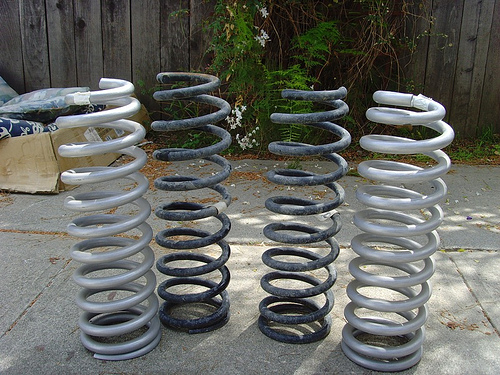
In order to achieve "competition" spring rates (that is, coils that don't fail under heavy usage) OME has increased coil diameter to achieve the additional load bearing, and OME uses a fairly tight wind that also adds material - added to this is a lot of spring damping (higher valve rates) and you really can't expect a supple ride in a wide range of load conditions. The FOR springs in contrast are not an increased coil diameter and they actually have less winds than the basic OME springs, so there is less material being used while still achieving the load bearing chacteristics of the higher rate coils.
My thoughts on this are pretty simple - the 80 is a heavy and top heavy solid axle quad coil rig, and you can really see and feel the results of spending on very high end coils. This allows you to use a fairly basic and simple shock with low valving rates to achieve a very good ride across a range of load conditions.
As I have represented this option over the last 15 months, my only real concern has been the people would find the rear too soft. I could make the argument to actually firm up the rear end just a bit, but I have the prototype and the final kit has a bit more damping in the rear.
Here is a picture of the front coils vs. OME medium.