Dumb question: What exactly is RTI?

This site may earn a commission from merchant affiliate
links, including eBay, Amazon, Skimlinks, and others.

Joined
May 7, 2005
Threads
303
Messages
2,353
Location
South Jordan, UT
I know it's a measure of how well a suspension flexes.
How is it calculated?

I was leafing through a magazine in the store (Four Wheeler, maybe?) that showed RTI scores for the H3, new JK Rubicon, and the FJ Cruiser. I'm wondering how the 80-series numbers would compare.

I'm NOT suggesting we dive into another 80 front end flex marathon, I was just wondering, what kind of score does a stock 80, or OME 2.5" 80 get?

Hayes
 
Copied from:

http://www.offroaders.com/info/tech-corner/rti.htm

A vehicles RTI or ramp travel index is a measurement of a vehicles suspension (and frame) flexibility. In many situations off-road a vehicles flexibility may be the determining factor of whether or not it can get over an obstacle. If a vehicles suspension is too stiff this may cause a tire or two to be lifted, loosing contact and traction, especially apparent in vehicles with open differentials. While locking differentials will help to maintain forward momentum when a wheel is off the ground, good flexibility will help to keep the wheels on the ground and more able to conform to the terrain.

ow to measure your RTI score without a ramp.

So you don't have access to a ramp and you don't feel like building one. How can you find out what your RTI score would be if it were tested on the ramp? Since the RTI score is simply mathematics it can be measure and calculated without a ramp. The RTI is a measurement of how high a tire can travel vertically you will need to safely raise one of the tires until one of the other tires almost comes off the ground. This can be done by using a forklift with the tire resting on a pallet or by using a floor jack and the tire resting on a flat surface underneath which is the floor jack. Be sure to do this safely. The main objective is to raise one wheel as high as possible before lifting a tire off the ground. Once raised measure the distance between the bottom of the tire and the ground. If using a fork lift you would measure where the tire meets the pallet to the floor. Since a 20 degree ramp rises at .345 inches per inch divide the height of the lifted tire by .345 (for 20 degrees). Next divide that number by your vehicles wheelbase. Multiple that number by 1000 to acquire an average and you have your score. While the ramp is a true measurement of your RTI this calculation is pretty close. The calculator below does the math for you and allows for different ramp angles.

They have ways to calculate without a ramp.

Ryan.
 
RTI's are great for bragging rights, and for seeing potential problems when the suspension is run thru "some" of it's travel...

believe me, the RTI does NOT max your suspension travel...the only "true" max travel is measured when two opposite corners are fully compressed and the opposite two corner tires are drooped in the air.

RTI also does not measure suspension balance....IMO, a very important part of suspension function....a rig where the front does the majority or the rear does the majority is generally not as versatile on the trail as one where the travel front and rear is close to equal, and works at equal moments. A skilled driver will work around suspension imbalances, but the more equally the front and rear suspension works together, the better the rig will generally be offroad.

That said, bragging rights never hurt ;) My FJ40 will drive over most ramps (60"+ under a rear tire with the other 3 on the ground) - the 80 is in the 600's IIRC, swaybars attached and stock springs...RTI'd it once in stock form
 
I did 685 a few years ago with my 91. J springs and 35" BFG MTs. Swaybars connected.
 
RTI's are great for bragging rights, and for seeing potential problems when the suspension is run thru "some" of it's travel...

believe me, the RTI does NOT max your suspension travel...the only "true" max travel is measured when two opposite corners are fully compressed and the opposite two corner tires are drooped in the air.

RTI also does not measure suspension balance....IMO, a very important part of suspension function....a rig where the front does the majority or the rear does the majority is generally not as versatile on the trail as one where the travel front and rear is close to equal, and works at equal moments. A skilled driver will work around suspension imbalances, but the more equally the front and rear suspension works together, the better the rig will generally be offroad.

Thanks Woody, you saved me some typing.

I have never ramped my BJ42 in its "latest" configuration even though many people have coaxed me to... reason being is that I don't really feel that RTI is a particularly good index for a trail truck since it leaves out too many factors, like balance.

One day I'll probably ramp it, but for the most part I couldn't care less about bragging rights. Fourwheeling isn't really meant to be a pissing contest...
 
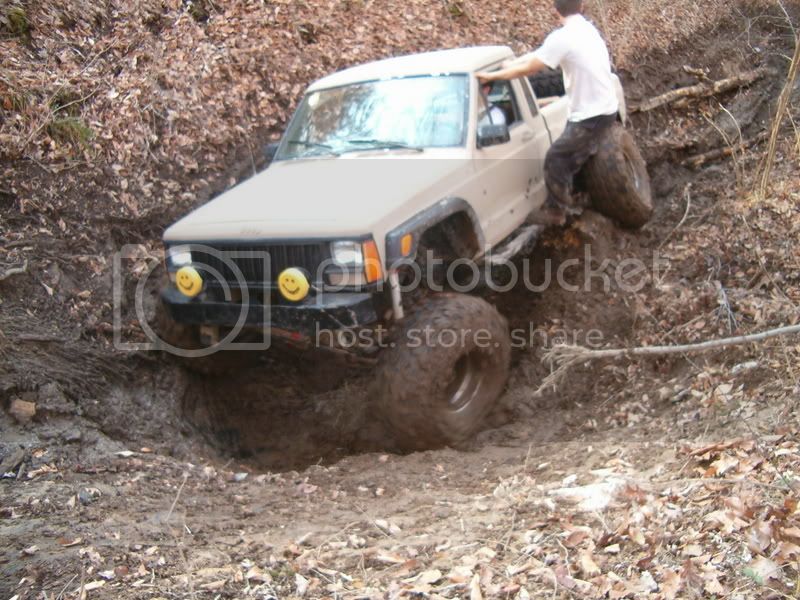
Here's a nice example of RTI


100_1712.jpg


I just couldn't resist.:D Really, as said before, only good to test limits on new build, or suspension additions. Helps check for shock length, brake line length, etc.


Here is an example of real world, defin. don't want to loose a brake line out here...

HPIM0605.jpg


P.S. Those bald swampers came off of a 17y/o's truck after some major burn-outs... ahhh, remember those good 'ol teenager days?
 
Back
Top Bottom