

Navigation
Install the app
How to install the app on iOS
Follow along with the video below to see how to install our site as a web app on your home screen.
Note: This feature may not be available in some browsers.
More options
Style variation
You are using an out of date browser. It may not display this or other websites correctly.
You should upgrade or use an alternative browser.
You should upgrade or use an alternative browser.
deep water
- Thread starter dano82
- Start date
This site may earn a commission from merchant affiliate
links, including eBay, Amazon, Skimlinks, and others.


Cruiserdrew
On the way there
I'd say pretty deep---


Perfect Katrina Truck? Let's go to N'Orleans!!

Dano,
Hard to answer that question. With proper technique, I'd cross 30" of water and have a dry interior and dry engine. With poor technique, you can ruin your engine and soak the interior in 20" of water. Poor technique means too fast with lots of splashing, no plastic over the grille, not prewalking the water and getting stuck so the truck is stopped for long periods, etc.
Even at the 20" depth and correct technique it's advisable to grease the driveshafts and check the diffs for water daily. These trucks will DO deep water, but if you want the truck to remain fully functional for its operational life then you must be prepared to respond to immersion with immediate maintenance. Check any well prepped bush truck and you'll find a grease gun in it.
DougM
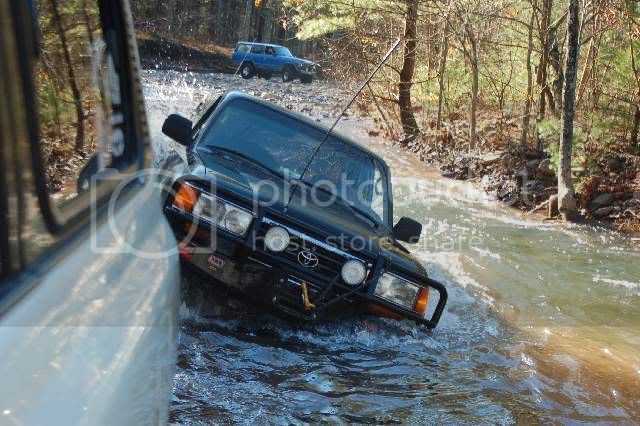
PS - the truck above is a little above the perfect speed for water crossing but much better than most - note the 'bulge' of water at the grille vs the level at the sides near rear wheel. Naturally the perfect speed varies according to the bottom and other factors, but you want a bit of bulge up front, but not frothing whitewater and pushing it up over the hood. Water takes a great deal of force to push through and the force rises exponentially. Moving at 2.5mph vs 2mph may take 50% more power and place the tire's grip at the edge of adhesion, causing periods of digging down - which then causes yet more power needed as the truck is punching an even bigger hole in the water AND climbing out of holes the tires needlessly dug AND the deeper settling of the body means more flotation effect that also takes away traction. People generally get nervous and think speed is their savior when the opposite is often true.
We should have a water crossing thread.
DougM
We should have a water crossing thread.
DougM


covering the grill is something not many think of before they dive into the deep stuff...can be a truck saver for sure. Also, the WD-40 spray down is a good trick to know too....spray the whole engine bay down to keep the water out of the connections.
Cruiserdrew
On the way there
Doug is right about the PM needed after lots of water. That pic of me was taken 3 weeks ago in the Sierras. The spring run off had flooded the trails up to about 30 inches deep. I did drive home that same day and greased all the u-joints, and the next day changed the differential oil front and back. Interestingly, both of the diffs were free of water-but I do have breathers for both at the top of the firewall. Same for tranny and t-case.
What really surprises me is the fording depth of my 40. I do not have a snorkle but have sunk my 35 inch tires several times with water pouring in the t-case shifter, and other than a fluid change later, it just keeps on trucking.
What really surprises me is the fording depth of my 40. I do not have a snorkle but have sunk my 35 inch tires several times with water pouring in the t-case shifter, and other than a fluid change later, it just keeps on trucking.

Mark Whatley has a great article in the July/August 2000 issue of TT where he discusses many of the issues that people face when dunking their vehicles intor bodies of water. He goes through preparation, water crossing techniques (for still water, deep water, fast moving water, etc.), and then what needs to be done afterwards (see CDrew's response above). I highly recommend that article for its great tech info. as well as Mark's great writing.
Here's me in Virginia this past Thanksgiving with the MD/VA guys....I dropped into the pretty fast moving water and my front end sunk pretty quickly. I gave a bit of gas so that I wouldn't go any deeper and hydro lock my engine:

Me chugging along:

Trying to get on dry land--this is a Land cruiser, not a yacht:
Almost there:

A view from behind:

Here's me in Virginia this past Thanksgiving with the MD/VA guys....I dropped into the pretty fast moving water and my front end sunk pretty quickly. I gave a bit of gas so that I wouldn't go any deeper and hydro lock my engine:
Me chugging along:
Trying to get on dry land--this is a Land cruiser, not a yacht:
Almost there:
A view from behind:

what do you guys think about putting RTV on the distributor cap?
Cruiserdrew
On the way there
what do you guys think about putting RTV on the distributor cap?
It would make more sense to vent the distributor cap up high. On My 40 and 60, the distributor is sealed with an o-ring and the vents go to the top of the firewall in the 40 and into the aircleaner in the 60.
On the 80, the distributor is already high, it would be interesting to install a vent in the cap and seal the hole in the body. I amy have to try that!
Looking at the pics from the ACT-Those guys are the experts at super deep water, but even they drown trucks.
what do you guys think about putting RTV on the distributor cap?
The 3FE has a vented distributor cap and an O-ring seal, so FJ80s probably wouldn't benefit.
The 97 FSM shows only a "packing material", which looks like a rubber gasket, for the 1FZ-FE.
Have drivers experienced problems with water intrusion on FZJ80s?

Have drivers experienced problems with water intrusion on FZJ80s?
I do. After I got mine few years back, went to the car wash for the firs time and the truck stalled right after I passed the under body high pressure water blast. There's a hole in the distributor and it is pointing straight to the ground. The whole is not on the cap, it is on the distributor itself. So after asking around here, got a tip from ActionJackson. If I remember correctly, he suggested to attach an extended rubber hose/grommet tightly in that hole and I did but I was loosing my hose after each wheeling trip. I think he did the same thing. So I basically RTV-ed that hole and never looked back ever since. Maybe I will permanently glue a small hose (again) in there, when I get some time, in one of these days. What is still interesting though, in high water, the truck never stalled with that hole open. I guess in car wash water gets in there due to the pressure. Oh well,


just a note...
on a non-snorkeled 80, the air intake resides behind the US PS front corner light.
getting much deeper than that for too long might cause some issues...
on a non-snorkeled 80, the air intake resides behind the US PS front corner light.
getting much deeper than that for too long might cause some issues...


- Joined
- Aug 17, 2005
- Threads
- 449
- Messages
- 5,644
- Location
- Forest Falls, CA
- Website
- www.adventureduo.com
Wasn't there just a thread about this a few weeks ago?
https://forum.ih8mud.com/showthread.php?t=154450&highlight=water+crossing
https://forum.ih8mud.com/showthread.php?t=154450&highlight=water+crossing
Wasn't there just a thread about this a few weeks ago?
https://forum.ih8mud.com/showthread.php?t=154450&highlight=water+crossing
What else is new.....

How deep
Well if you have a snorkelled diesel then very deep is the answer. Open the sunroof first. The rear end will float but the front will stay on the bottom. Not recommended for the faint hearted and please do not stop.
I have had water over the bonnet. Remember to est the ventilation to recirc or water will flood into the heater ducts.
Cheers