Circulating heater install on 1HDT

This site may earn a commission from merchant affiliate
links, including eBay, Amazon, Skimlinks, and others.

Joined
Nov 3, 2008
Threads
107
Messages
1,146
Location
Winnipeg, Manitoba, Canada
My lower rad hose heater is dead. It's getting cold here, so I need to move on replacing the heater. I was never very impressed with the performance of the lower rad hose heater. Likely due to the thermostat being in the way. I'd leave it plugged in all night and there'd be minimal heat in the actual engine - just enough so that it would start at sub -30°C temperatures.

My :princess:'s TDI has a circulating heater that works amazing on that engine. Heats the engine to normal operating temperatures in no time. This is the route I plan on going for my HDJ. But, there is not much info on plumbing one.

Essentially, the heater needs to plumb its inlet to the lowest point on the engine water jacket. I would think this would be either the lower rad hose, or the engine block drain. I'd rather use the block drain, but what are the threads in there?

Warmed coolant then gets fed into the heater hose going to the heater core. This will create a convection flow of warm coolant through the engine and heater core. I'm not sure which side of the water valve on the firewall to "Y" into.

So, two questions:
  1. What is the engine block drain plug thread size?
  2. Which side of the water valve on the firewall should I plumb into?

I'll fully document my install once I get this info.

Thanks
 
PM sent
 
I'm about to install a webasto on my 1HD-FTE, I would also be interested to know where to connect.
 
I have a 1500w zerostart at home I've been waiting to install on my 1KZ-TE, I'll be watching this for tips as there's very little info out there to go on.
 
I've done just this install on a 2h. Most threads I've seen are bsp (British STD pipe) but I was able to make a npt fitting of the same size work. I wager a guess you'll find the same thing. Bsp fittings can be found and though but are likely special order.
My heater is plumbed into the drain and into the supply line to the heater core. This set up works great. Truck starts like summer when it is plugged in.
 
The block drain is on the oil cooler cover... right next to to one of the ACSD coolant supply ports.. which in the absence of the ACSD device, is begging to be used for a Zerostart supply port.
I've been eying it up on for a zerostart my 1HD-FT
 
70sguy said:
The block drain is on the oil cooler cover... right next to to one of the ACSD coolant supply ports.. which in the absence of the ACSD device, is begging to be used for a Zerostart supply port.
I've been eying it up on for a zerostart my 1HD-FT

So you're planning on using one of the ACSD ports? Is this low enough?
 
Not sure if it's low enough, but It's as low as the block drain. Have to plumb it in and see what happens.
 
Not sure if it's low enough, but It's as low as the block drain. Have to plumb it in and see what happens.

I guess there's nothing to lose. It would be a simple matter to plumb into the lower ACSD port. I've just got the two ACSD lines plumbed together with a union right now.

The only problem I see with this setup is the heater itself needs to be vertical and located between the lower and upper points. That doesn't leave a lot of height to work in. Plumbing into the lower rad hose (as a supply) would give more height to work with. But this would mean circulating through the radiator too. Might be less efficient with more heat loss through the radiator.
 
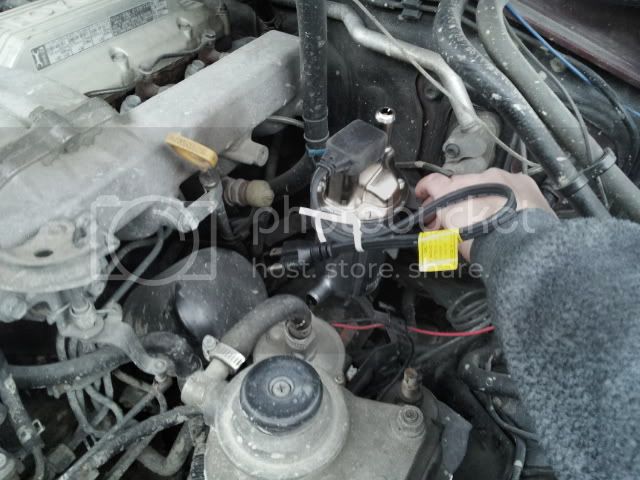
I'm finally going to have some time to put this heater in. I bought the 1500W version for ultra-heat considering it has to heat 11.9 liters of coolant. The size of the heater is fairly reasonable to allow it to sit vertical between the input and output points. I see a good spot to mount on the firewall on the intake side of the engine (above the starter).

20120108_160315.jpg


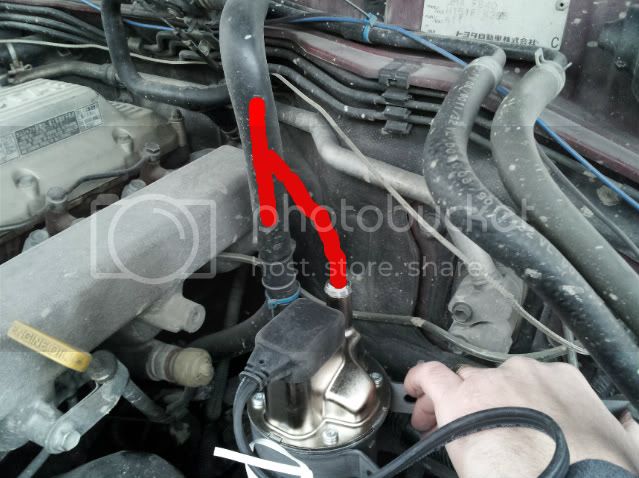
I'm planning on using the lower ACSD port as a supply to the heater with a straight length of 5/8" heater hose. As for the outlet side, I was planning on using the supplied "Y" fitting and inserting it into the vertical portion of the hose running from the engine to the heaters.

20120108_160325-1.jpg


With the heater valve open (heater set to hot), this should circulate from the ACSD port --> through the Zerostart --> through the heater core --> into the engine.

Can anyone confirm my connections? Recommendations?
 
The Zerostart heater has a check valve installed. Will this cause issues?

The instructions mention to keep the heater 3" from any wires, plastic, etc. My location on the firewall is perfect to maintain that clearance.

I was thinking of adding some foam pipe insulation to the heater hoses to prevent a bit more heat loss. This may be overkill though.
 
It would be interesting to see what other people say, I just did this install and plumbed it the same way you mentioned. Had it pre-heating this morning for about an hour... i feel like that probably wasnt long enough. The hose leaving the heater gets really hot... about 80 Degrees on the outside. The hose coming out of the firewall is slightly warm so the system is moving the water... tomorrow i will try for 2 hours and see what happens. It seems you can hear it bubbling when it first heats up and then the bubbling goes away? could it have an internet on off switch when it reaches a certain temp.. i dont remember reading anything in the instructions.
 
I did the install yesterday. I plumbed it as I mentioned above.

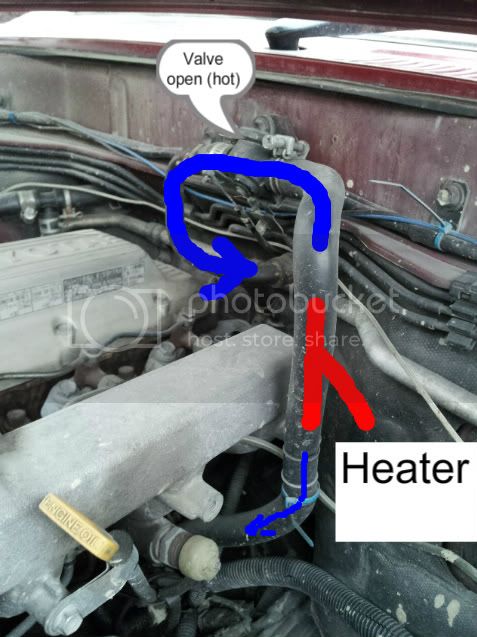
When I first plugged it in, there were lots of bubbles going through the white plastic "Y" fitting. You can easily see the coolant in there. The bubbles were flowing in the right direction so all seemed good. The bottom supply line stayed cold, so the check valve is definitely working. The top hose got hot and that heat was going through the water control valve and presumably into the heater cores and back to the engine. I could also feel the lower part of the hose I plumbed into getting hot - so some flow directly back into the engine. Here's a visual of what was happening:
20120108_160111-2-1.jpg


Today there are no bubbles. I guess that was the air in the system working its way out. I had the heater on a timer to come on 2 hours before I went to work. The heater control was set to full hot and defrost. Most of the snow was melted off the hood above the heater when I went out. After 2 hours at -20°C, the engine started quite easily. But not as easily as I was expecting. Also, there was no movement of the temp gauge when I first turned on the key. It still took the normal amount of time before I started getting heat out of the vents. In my wife's Golf TDI, the temp gauge goes up to normal operating temp ~90°C before you start the car, and there is instant heat. But, I'm not sure if hers circulates through the heaters or not.

At lunch today, after being plugged in for 4 hours, the truck did not start that much easier. And there was a bit of smoke too. I didn't verify if there was power at the plug. I'll do that before I go home.

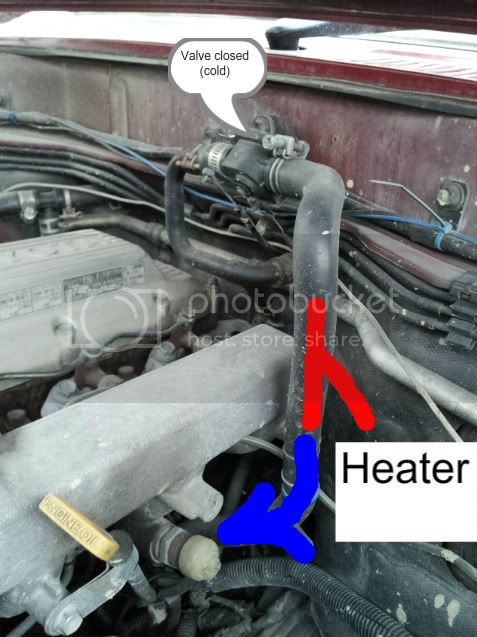
I'll have to experiment a bit more with the heater control setting. I figure if the heater is set to cold, the coolant will be blocked by the water control valve and thus flow down into the engine bypassing the heater cores and a bunch of coolant. Another visual:
20120108_160111-2-2.jpg


I used the lower ACSD hose for a supply and this stock hose is like 10mm. I plan on replacing it with 5/8" heater hose when it's warmer out. I'll have to swap out the port most likely. Anyone know the ACSD port thread diameter/pitch?

Tonight the temperature is supposed to drop even lower. I'm going to try it for a couple of hours with the heater set to cold. We'll see if that makes a difference. I'm hoping it will warm the engine more instead of losing heat through the heater cores.

BTW: this heater is thermostatically controlled to prevent overheating. When I was testing it yesterday, it would run for a few minutes and then shut off for a bit, then run, etc.

I'll post photos soon, it was too cold and my hands were too dirty yesterday.
 
Last edited:
interesting, let us know what works, it seems i have mine plumbed in the same as you do, except that i used a T instead of the Y.

Where abouts is the thermastate located? if you go right back into the block does that go in before or after the thermostate. Just curious as to if that heated water would just reach the closed stat and not go into the rest of the block.
 
I was contemplating the same thing but I was just going to use the upper and lower ACSD lines. Any thoughts? I don't care if I go through the heater core or not. Just heating up the block should suffice.

My concern is that the thermostat may be in the middle stopping the flow.
 
I noticed air in the top of the white plastic "y". So I have trapped air. It's a high point. I'll have to bleed it tomorrow.
 
I have installed two of these the first one I did the way you are doing and it did not work very well. I ran the discharge along the firewall and connected it to the heater lines coming out of the firewall. This way it takes the coolant from the bottom of the block and circulates it to the top of the block. Works way better and heats up the whole engine.

Cheers
 
Not having a good morning

This morning I warmed up the engine (driving the kids to school), then returned home to try to bleed the air out of the cooling system. It's -28°C here this morning. The heater valve is definitely the highest point in the cooling system. I loosened one of the clamps with the hopes of burping some of the air out. With the engine running, the air pocket disappears.

Anyway, after scratching my head a bit more, trying to figure out how to get the air out, I get sprayed in the face with hot coolant!!!! The plastic "y" adapter that came with the heater has a split in it and is spewing all over!

Great, now I have to hoof it to a parts store to find a new "y" fitting.

Any suggestions for getting the air out of the raised hoses with the water valve? And any suggestions for doing that outside, in -28°C?
:bang:
 
Back
Top Bottom