


Been reading a lot on hear about caster correction and have a question about the caster plates. It seem that with bushings, both the front and rear bushing hole is offset. In regards to the plates, is there any correction in the on the rear bolt hole or does it pretty much become the pivot point the axle moves around? Guess I'm just trying to visualize it.
Navigation
Install the app
How to install the app on iOS
Follow along with the video below to see how to install our site as a web app on your home screen.
Note: This feature may not be available in some browsers.
More options
Style variation
You are using an out of date browser. It may not display this or other websites correctly.
You should upgrade or use an alternative browser.
You should upgrade or use an alternative browser.
Caster Plate Question
- Thread starter hootie
- Start date
This site may earn a commission from merchant affiliate
links, including eBay, Amazon, Skimlinks, and others.


depends on the plate used. My design relocates both the front and rear holes so as to rotate the axle on it's axis.
- Thread starter
- #3
I was thinking that it would make sense if the front bushing is lowered that the rear would have to move up in the bracket. When using your plates, how do you know the location of where to drill the new holes? Or, do you 'slot' the holes?
- Thread starter
- #4
Nevermind, I looked around some more and after looking at your plates a little closer I think I see how they work. These look to me like they have the simplest install and it definitely makes sense to me that both holes should be repositioned. Thanks.
Nevermind, I looked around some more and after looking at your plates a little closer I think I see how they work. These look to me like they have the simplest install and it definitely makes sense to me that both holes should be repositioned. Thanks.
Only if you choose that route. You can go with polyurethane offset bushings OR you can get the LANDTANK Caster plates that keeps the bushings centered and still uses the OEM rubber bushings.

can't you get offset rubber bushings as well?Only if you choose that route. You can go with polyurethane offset bushings OR you can get the LANDTANK Caster plates that keeps the bushings centered and still uses the OEM rubber bushings.

I'm still chasing caster too. Have 2.5" OME lift and 285 MTRKs and Slee 3* caster bushings and only have +1.2 caster. Too wandery, too darty at speed.
Has anyone tried 3* caster bearings?
Would caster plates work for me or would I get into drive whine issues?
I know LCP likes his part time solution, but I'm not there yet.
Has anyone tried 3* caster bearings?
Would caster plates work for me or would I get into drive whine issues?
I know LCP likes his part time solution, but I'm not there yet.
can't you get offset rubber bushings as well?
With caster plates.
- Thread starter
- #11
Only if you choose that route. You can go with polyurethane offset bushings OR you can get the LANDTANK Caster plates that keeps the bushings centered and still uses the OEM rubber bushings.
Yes, I'm aware of the bushings but I am leaning toward the plates. When I posted this question I was considering doing the washer type mod and was thinking I would need to adjust the rear bushing location if I moved the front. Pretty much have decided to just buy some plates to avoid the hassle of messing with it myself.

Only if you choose that route. You can go with polyurethane offset bushings OR you can get the LANDTANK Caster plates that keeps the bushings centered and still uses the OEM rubber bushings.
Or you can do the washer mod and get the angle you want, within reason.
the washer mod is fine, just keep in mind that you can find yourself in a spot where the usual drive shafts won't cure your drive line vibration.
When approaching the amount of caster needed to be in the 5-7 degree range you need to setup for a DC shaft if you intend on maintaining your AWD. That is the area where you can run into vibration problems. So it's best to plan for it rather than deal with it later.
When approaching the amount of caster needed to be in the 5-7 degree range you need to setup for a DC shaft if you intend on maintaining your AWD. That is the area where you can run into vibration problems. So it's best to plan for it rather than deal with it later.
- Thread starter
- #14
I've pretty much decided on the plates but have a question. If one wanted to relocate the holes, would it be a matter of just using jack bolts(I've see them in pictures on here) through the bracket to return them to factory caster? And if this is true, would it then be a matter of being able to mark where to drill the new holes for the front and back? I may be wrong, but just looking at the Landtank plates compared to others, it looks like the new bolt locations do no range past the factory bracket width. If you could correctly mark the locations would you even need the plates? I guess the real question is, are the plates merely serving as templates for where to drill your holes or are they structural?
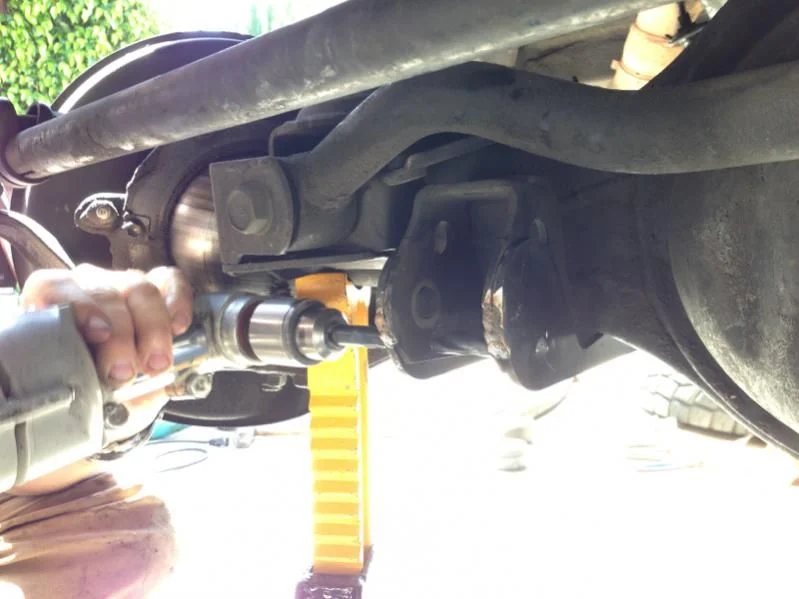
If you saw the material you are drilling through and realizing where the bolt head rests you'd realize one of the reasons the plate is important. This is my install from three years ago.
- Thread starter
- #16
I thought the correction might take the bolt locations close to the edge of the bracket. My main question is would simply using jack bolts to push down on the control arms put them back into the correct spot. I'm thinking this may not be exactly true because once both front and rear are removed, I thought the entire axle might have freedom to move forward/aft and may give an incorrect location by merely pushing down the control arms.


Calculate how much caster correction you need first. It changes approximately 1.7 degrees for every inch of lift. You can get more caster correction from the plates that rotate the axle around the rear bolt before you run into drag link interference problems. No drilling is required for this style of plate. About 7-8 degrees is the max.
it looks like the new bolt locations do no range past the factory bracket width. If you could correctly mark the locations would you even need the plates? I guess the real question is, are the plates merely serving as templates for where to drill your holes or are they structural?
Where I have you drill the holes it accomplishes a few things. It corrects caster for lifts in the 4" range, aligns the pinion angle to use a DC shaft correctly, drops the arms slightly to gain more clearance between the arms and the tie rod to avoid contact between the two and rotates the axle on it's center to maintain the axle's original position on the arm to avoid spring contact with the bump stops.
In the end the front holes are rather close to the edge of the axle bracket so the plates do add some structural strength and they are also a drill guide for drilling the new holes.
I'm not saying you can't replicate the position of the holes without my plates, but I have to believe it would be challenging to do so and accomplish everything I have.
- Thread starter
- #19
Certainly, from all the reading I've done your method seems like the preferred plates for what I want to do. This is probably the route I will go.
Certainly, from all the reading I've done your method seems like the preferred plates for what I want to do. This is probably the route I will go.
It's a little but of effort but once installed you'll be very happy.