

Amp draw question

This site may earn a commission from merchant affiliate
links, including eBay, Amazon, Skimlinks, and others.

Joined
Mar 25, 2012
Threads
37
Messages
158
Location
Mooresville, NC
Hi,
I think I may have an extremely slow draw on my hj60 and have been trying to hunt it down. I went through every fuse and unfortunately didn't see any change to the below DCA on the reader.

May not be an issue if you guys say this amount isn't enough to drain batteries.

After replacing with new batteries, current reading is:

Driver side: 12.78
Passenger side: 12.68

When I hooked them up a week ago, they read:
Driver side: 13.00
Passenger Side: 12.98

Here's the amp draw reading from today.
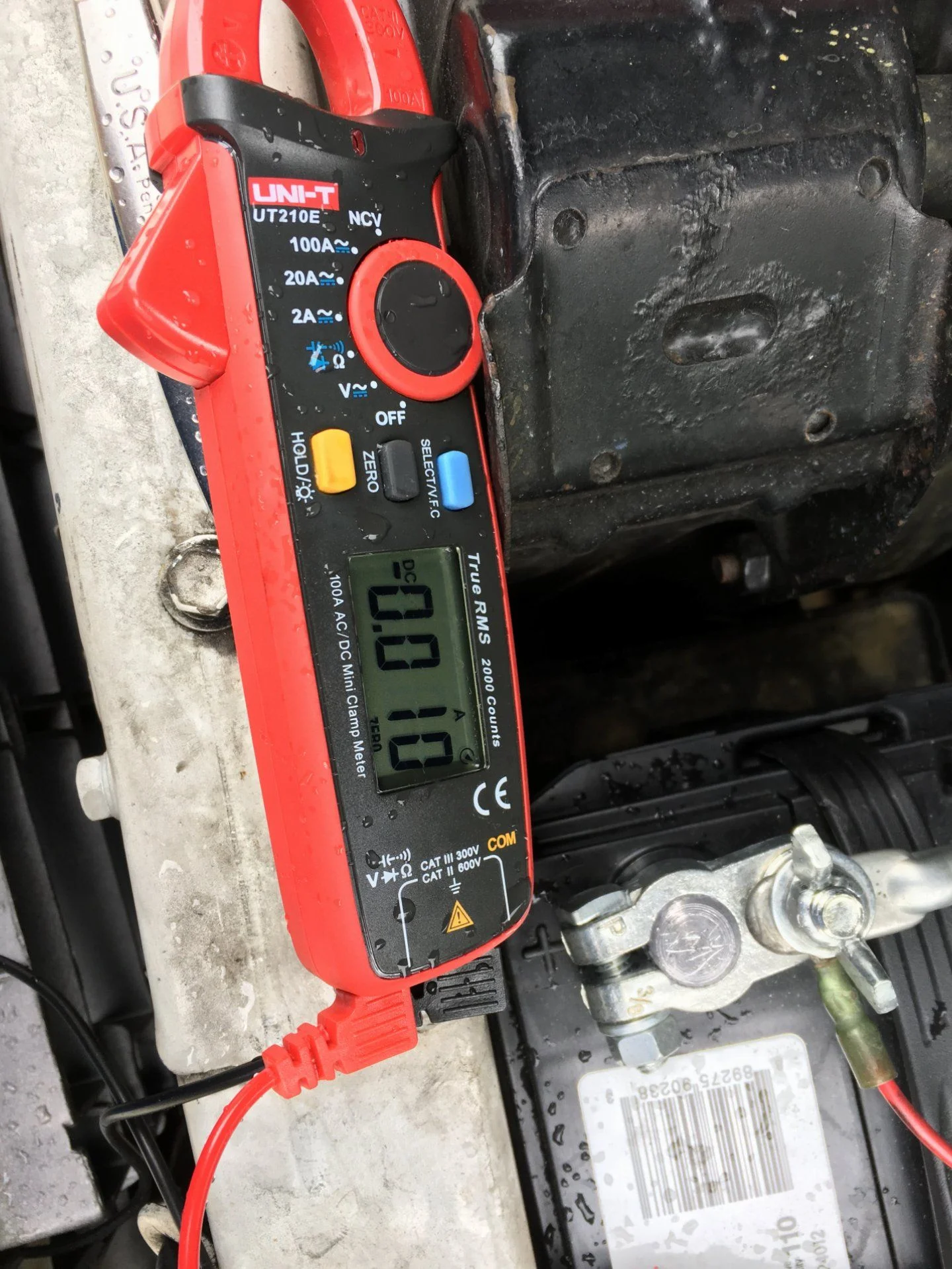
IMG_4238.webp
 
10 milliamps is certainly within the normal range. Anything less than 40 milliamps is good. The only thing I would be concerned with is the "amp clamp meter" in my experience, isn't very accurate. Pull the positive off one battery and connect a true amp meter in series between the positive terminal and positive battery cable. This will give you a true reading of any draw.
 
10 milliamps is certainly within the normal range. Anything less than 40 milliamps is good. The only thing I would be concerned with is the "amp clamp meter" in my experience, isn't very accurate. Pull the positive off one battery and connect a true amp meter in series between the positive terminal and positive battery cable. This will give you a true reading of any draw.

Yeah, I'm going to try with a regular multimeter.

I do have one question though, I've read conflicting articles on what post to test in series. The most recent was a Popular Mechanics that said to use the ground side, but I have read to use the positive side.
 
You can also put a 12 test light between the positive cable and the positive post to see a draw. If you have a drain on two or more circuits then pulling each fuse one at a time and replacing it... won't find the draw. You may need to pull them all out leaving them out and see if your draw goes away. Then put the them in one at a time finding the circuits that have a draw.
 
Yeah, I'm going to try with a regular multimeter.

I do have one question though, I've read conflicting articles on what post to test in series. The most recent was a Popular Mechanics that said to use the ground side, but I have read to use the positive side.

Either post is fine, I actually just double checked and Chrysler service information says negative cable.
 
Vehicle manufacturers say negative side, but some textbooks say positive.
I recently learned, and have proven, that you can find a live circuit by measuring voltage drop across fuses. The ones with current flowing will have a drop in millivolts, while others will show zero.
 
Does not matter which terminal you pull to measure current. As pointed out amp-clamp on DC circuits are iffy, so use a multimeter in DC current mode. 10 mA is not going to run down the battery for many many days.

Voltage across a fuse is not a very accurate way to ascertain current draw. Far easier and more accurate to pull the fuse and make the connection with the current meter across the fuse socket terminals (recall a "perfect" amp meter behaves like a piece of wire, very low resistance, the lower the better).
 
Just to clarify, checking voltage across the fuse is actually not intended to measure the draw. It's just a way to find out which circuits are live. You either have millivolts there, or you have nothing.
 
Just to clarify, checking voltage across the fuse is actually not intended to measure the draw. It's just a way to find out which circuits are live. You either have millivolts there, or you have nothing.

Thanks for that clarity. I started trying that method today after work and was two fuses in, got what you described, and then it started to rain. I'll go back to the battery tomorrow to try testing for draw.
 
I would do the draw test on the whole system (at the battery post) first, before chasing individual fuses. If it truly is at 10 milliamps that is considered no draw. That is about what a radio draws for the clock to stay correct. You can park it for at least a 6+ months on that little of a draw. Especially with 2 new batteries.
 
Work on the negative side. That way, when the wrench bumps the body, it doesn't get a chunk out of it.

Textbooks that recommend the positive terminal are good to use to start fires with abovementioned wrench and spark.
And some hydrogen gas from a battery that's been charging. Although that usually just goes 'bang' and you wonder
where the top of the battery went all of a sudden...

Also, don't forget the alternator- the 'field coil' is always hooked to the battery, and sometimes the diodes get a bit 'leaky'...

t
 
Back
Top Bottom