Alternator Bad

This site may earn a commission from merchant affiliate
links, including eBay, Amazon, Skimlinks, and others.

I swapped coils out in my 78 to the Pertronix Flamethrower just because I had the kit-coil/SS ignition. I have a non USA dizzy in it.

Anyway, before I swapped, it was a slow starter. It would not catch until many revolutions went....:frown:

After replacing the coil, it starts almost as easy as my 85 4Runner with EFI! It is still running the points, too!
I see the coil was failing even though it worked when "prodded" along. Truck even ran good when the old coil was in it.
Flamethrower runs engine better and mileage is up there. I figure around 18 hwy :D
I had a terminal on the back of a Denso alternator bend. The plug would appear to go in and it would not charge. It took a little to figure that out. :doh:
Got it all straightened out and it charged again.
 
Questions:hhmm:..........where and how is the startor motor grounded?.......if the ground strap is gone?!.......suggestions?

should I get another BR that has a higher than 1.5 Ohm rating to try and drop the voltage at the coil a bit more while running? TIA

Lou

You need a ground strap or you can have the problems you are experiencing, like slow cranking and hard starting.

You don't need a different resistor. Did you get a coil that needs a ballast resistor? If it says ballast resistor type, then it needs a resistor. If it is the type of coil that doesn't use a ballast resistor, then using one will be counter productive.

Measuring the voltage drop on a running engine will fool you because the coil is rapidly switching off and on. If you want to measure it, do it while you ground the - side of the coil to get an accurate reading.
 
symptoms

"with ignition at acc.....wants to energize starter solenoid and crank! but 0 volts at F"

"when switch turned to ACC engine cranks!"

Sounds like you are going after two different problems in your approach. If the coil/resistor was bad it wouldn't crank slow and it would not crank in acc pos! You would have no or weak spark but it would crank fine.

a bad starter ground will not kill your battery or make it crank in accessory pos

The altenator appears to be charging from your readings with the meter yet your battery goes flat

sounds like a short to me--probably is the ign switch


You said you shot for continuity on the wiring but no mention of shooting for shorts

to shoot for shorts isolate the wire from the components and put the pos lead on the wire and the neg lead to the body --if you have continuity then it is shorted to ground

you can check for shorts through the switch too--with it in start or run what do you read continuity to through the switch how about switch contacts to the case?--aka a short to the case

Continuity checks can prove a wire bad but not really for proving it good--for instance in the case of a large power load it only takes a couple strands to read continuity yet the wire will not carry a load so take those readings with a grain of salt and use a bypass wire where you can


I think your solenoid could also be shorted but not sure how that plays into the accessory pos on your switch w/o seeing the schematic here. I once had this and the power wire from the solenoid to the coil was sucking power away from the plus side of the coil to ground in the solenoid and burning up my b/rs in the process--not an FJ though

Here's a way to see and possibly get you up and running

-disconnect the run and start wires from the coil
-buy a remote starter and hook the remote starter to your solenoid terminals and route the remote starter switch into the cab
run a wire from pos on the batt through a toggle switch and on to the pos side of the coil

- turn the toggle on then squeeze the remote starter and you should start up fine. to shut it off switch off the toggle switch

this is okay for troubleshooting/ emer repair purposes be careful not to let the toggle switch power short in the cab or the smoke will get out of the wires! You could in line fuse it.


if you do this set up and still have probs then I think your starter/solenoid is shorted since all of the ignition system will then be isolated. this can be checked with a meter too though

I think cranking in acc is the key to the whole thing and is the cause of the batt going flat due to a short

I hope that is food for thought in any case


You sure have a fine meter there--I love using them old simpsons most appropriate for an FJ!
 
bad ignition switch

<thanks Pin/Cooler/bssmith and Toyrunner........yep; the switch is definitely bad:frown:........can't do a lot of trouble shooting as when the switch is in the ACC position it cranks:hhmm: and it seems to crank lots faster than in start:confused: took it out and gave it a good look BUT it does not seem to be something that is made to be taken apart.........as it is; it marginally works and don't have a back up for it........so just put it back in:frown:
i do have a good ground wire from B - to firewall and the motor.....went over took the heavy ground and dremmel wired the bolts, connectors and washers; both split and flats along with the firewall and the motor beneath them.....did not notice any change.

:confused:seems like most of the time I spend on this pig is sorting out PO improvements?!........like taking the ballast resistor out of the system and capping off all the vents to the gas tank:confused:
thanks..........the old Simpsons are hard to beat.....wish it had an audible for continuity and could check AMPs with it though
did put in a tested coil + ballast resistor back in to the system........now just waiting for UPS to deliver on the new ignition switch........can't wait to jump on it again!!...last news from UPS is that at midnight it was in Montgomery AL about 100 Miles away and should be here this afternoon...... will let you guys know results after install thanks again:cheers:


Lou
P.S.
bssmith...where are you at in the panhandle?
coolerman.....whereabouts are you in KY?
 
ign

We'll soon know, I like to hear the final results
I am near Fort Walton Beach and Destin

It's nice here-and it's all like a small town atmosphere even with the touristy bits but we have to move because of my work next July
 
6 volts at starter solenoid!

well, thought my troubles would be over when saw that the beautiful new ignition switch :D from Kurt at cruser outfitters had come in this afternoon:bounce:.......:bounce2:
6 hours later :crybaby: @ midnight
OK positive things......can place the switch into ACC and it does not crank! ......yippppiiii
ballast resistor working; get a reduction in voltage of 12.6 to 8 when key in run position and when running!
bad things:bang:
key in ignition switched to start;
only 6 volts to starter solenoid!:bang::crybaby::bang:only 6 volts at BW wire at ignition switch??~!!!:confused:
ALL fuses have 12.4 volts when in run posititon:hhmm:

please correct me if am in error.......
my findings
BR wire at ignition switch Always tests 12.4 volts......in off and the other positions!
in Run position and when running.......BR, Blue red and BY always test 12.4 volts
then comes the :confused:
turn the key to start and only 6 volts to BW wire and from there only 6 volts at starter solenoid at ..........BR wire..confusing color code but traced it back and found it spliced with a butt connector to BW wire that gives 6 volts in ST position
where are the 6 volts disappearing to???:bang::crybaby::bang::confused:

can it be a starter problem??!!:hhmm: ....
BTW.....the amp meter is only an idiot light in mine......also took it out and could find no wires feeding into it so it must have an internal feed; also did not find any BW wires coming from it so don't think that in this case has anything to do with the fact that am only getting 6 volts at starter solenoid......all fuses in fuse box also check out 12.4 volts on both sides and no evidence of any resistance as they all check out with 0 resistance! Please share your thoughts;

TIA

Lou

I agree your key switch is bad. There are no fuses for the battery/amp meter/ignition system but if your amp meter is open you will have no power to the key switch. You can jumper the amp meter terminals to restore power flow in this case.

Edit: I originally posted a 1971 schematic. It did not match the 1974 key switch shown. Found a FJ55 schematic that was a much closer match... Corrected description below...

The AM (B+) terminal of the switch is a Black/Red wire. It originates at the starter as a White wire where it is connected to the +B wire from the battery. There is a fusible link in this line right at the battery! This wire splits into two wires. One WHITE wire goes to +B terminal on the alternator providing it with +12V. One RED wire goes to the fuse box where it feeds two fuses that are ALWAYS hot. One fuse is the + side of the coil, the other is the headlight switch. This is the main power to the key switch. Measure voltage here: It should ALWAYS have +12V regardless of the key position!

The ST terminal goes straight to the solenoid on the starter and is a Black/White wire. When the key is in the ST position is ties the AM terminal to the ST terminal providing the solenoid with +12V, energizing it, allowing power flow from the battery to the starter.

The IG (run) terminal on the key switch is a Black/Yellow wire. This wire goes to the fuse box and feeds three fuses:

Fuse One: The ignition coil.

Fuse Two: The turn signal fuse, the voltage regulator (IG terminal) and the horn relay.

Fuse Three: The gauge cluster fuel,oil and temp gauges and front/rear heaters,

When the key is in the IG (run) position it ties the AM(B+) terminal to the IG (run) terminal.

Sorry for the confusion!

HTH!
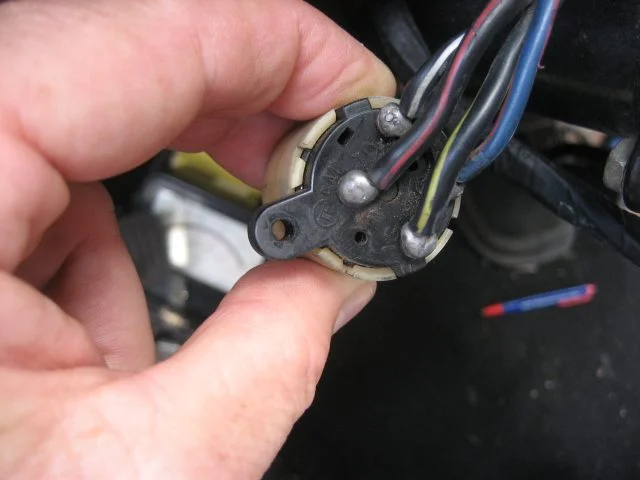
IMG_2665 backside ignition switch.webp
IMG_2678 Starter Motor Wiring butt conector.webp
 
Last edited:
"ballast resistor working; get a reduction in voltage of 12.6 to 8 when key in run position and when running!"


turn the key to start and only 6 volts to BW wire and from there only 6 volts at starter solenoid at ..........BR wire..confusing color code but traced it back and found it spliced with a butt connector to BW wire that gives 6 volts in ST position
where are the 6 volts disappearing to???:bang:

The 8 volts is normal while running as you said. The 6 volts is due to the fact you are putting a large load on it while cranking and maybe the battery is not fully charged since you've been cranking it a lot and that is contributing to it

The wire should be a straight shot from the sw to the solenoid so if you are really worried about it shoot it for resistance or just run a new wire between the sw and solenoid but I think you are good now


The function of the wire is to send a full 12 volts to the solenoid by bypassing the BR. With the load the full 12 volts is dropping to 6 but it is functioning because the engine is starting. If you used the ignition wire through the Ballast Resistor you would start with 8 volts drop 6 and wind up with only 2 ---not enough to for it to work. That's why the wire bypasses the BR
 
bs123:idea:...........yes, the battery is only at 80% from all the cranking + no running.......although it was still reading 12.4 volts..........but an old name for batteries was "accumulators" and in my simple mind they have a certain volumn/charge and it was probably depleted when it registered 80%...... will do a slow charge this morning and see if it changes things.......had not thought it being low:o thanks again for the expertise.........owe y'all:beer:

Lou
 
The battery voltage always drops during starter motor operation, but there is always a voltage drop across a resistor too (if current is flowing). If the battery V is 9V during cranking and there is only 6V at the solenoid, then there is a bad, high resistance connection (maybe the butt splice) in the start circuit wiring.

OTOH, if your battery V drops to 6V during cranking, then either the starter motor is sinking too much current or your battery can't deliver the juice.
 
ballast resistor working; get a reduction in voltage of 12.6 to 8 when key in run position and when running!

So it does start? Where did you measure this 8 volts?

Key in and ignition switched to start;
only 6 volts to starter solenoid!

Which terminal? The S terminal(Black/White wire) or the B terminal (black/red wire)

ALL fuses have 12.4 volts when in run position...

This is correct.

my findings
BR wire at ignition switch Always tests 12.4 volts......in off and the other positions!

This is correct.

In Run position and when running.......BR, Blue red and BY always test 12.4 volts

This is correct.

Then comes the confusing part:

Turn the key to start and only 6 volts to BW wire and from there only 6 volts at starter solenoid at ..........BR wire..confusing
color code but traced it back and found it spliced with a butt connector to BW wire that gives 6 volts in ST position
where are the 6 volts disappearing to???

I think this is the heart of your problem. The black/white wire connected to the S terminal on the solenoid (closest to the engine), and should go STRAIGHT to the key switch. It will have a FULL +12V when the key is in the ST position.

The Black /red wire connected to the B terminal on the solenoid (closest to the fender) should go STRAIGHT to the + side of the coil. This is the ballast resistor bypass.

The ballast resistor should have a black/yellow wire going straight to the fuse box on one side and the other side should be connected to the + side of the coil. This will give you 8-6 volts to the coil when running.
 
starter wiring questions

last night it started with ether assist........runs and idles beautifully :)
just insufficient power to starter:confused::hhmm:
So it does start? Where did you measure this 8 volts?

on the down stream side of the BR with the ignition on Run


Which terminal? The S terminal(Black/White wire) or the B terminal (black/red wire)

measured 6 volts on the B terminal wire <BR wire Butt spliced to BW>when ignition switched to ST...and ST when engaged also measured 6 volts


I think this is the heart of your problem. The black/white wire connected to the S terminal on the solenoid (closest to the engine), and should go STRAIGHT to the key switch. It will have a FULL +12V when the key is in the ST position.

:hhmm:I don't think that BW wire carries current unless the ST is engaged and I believe it is coming from the BR wire that is butt spliced to the BW coming from the ignition start position as I read 6 volts there and 6 volts at the starter terminal:confused:

The Black /red wire connected to the B terminal on the solenoid (closest to the fender) should go STRAIGHT to the + side of the coil. This is the ballast resistor bypass.

it gets confusing 'cause that BR wire is spliced to a BW wire that ties in to the ST wire on the ignition:confused: when switch is in ST... get a 6 volt reading there and at the starter solenoid side supplied by the BR spliced wire

The ballast resistor should have a black/yellow wire going straight to the fuse box on one side and the other side should be connected to the + side of the coil. This will give you 8-6 volts to the coil when running.

correct, it does comes from the fuse box.....have not been able to isolate which fuse supplies it as all fuses in RUN are 12.4 volts....on RUN the only terminal that is 0 volts on the ignition switch is the ST...which when turned to ST reads out 6 volts??:confused: which is the same reading am getting at the butt spliced BR/BW on the starter:confused:

feel that voltage is draining somewhere/somehow; will check the resistance of the butt spliced br/bw wire this evening then still very confused as where and how the voltage is dropping across the ignition when the ignition is switched to ST:bang::confused::crybaby: it reads 6 volts at the ST position on the ignition switch then 6 volts at the starter......:hhmm:but have not read the voltage with it disconnected <BR wire at starter> so perhaps the starter solenoid is draining the current down??....but I think it should be getting full 12 volts like everything else is in the system except downstream of the Ballast resistor on run where I get 8 volts as expected!!

:idea:maybe time to test starter solenoid with a remote starter? will have to get a new one, mine has dissapeared:frown:
easy way would just place a toggle switch with an inline fuse and send 12 volts directly to the starter solenoid but am too compulsive to go that rout except in an emergency!!


TIA

Lou


Quit screwing around and just use a screwdriver to jump across from the battery cable terminal to the solenoid pull in coil terminal.
 
I decided to do a crude drawing of the starter/ignition circuit so folks could easily see the connections described above.


Hope it helps to better understand the actual connections involved here.

After you get the battery charged let us know what happens!


:cheers:
StartingCircuitW.webp
 
starter checks

Looks like your getting some good tips. I thought that getting the battery charged up might help ----as the battery discharges under load internal resistance goes up- but that's just one possibility.

no sense reinventing the wheel so here is some good checks to do
http://ceu.educommons.net/automotiv...rtation-technology-i/AutomotiveElectrical.pdf


I think If I were you I'd swap in another fully charged battery and do the checks again, then replace the solenoid wire, and go from there. It may be possible to just hook in a second wire in parallel and see an improvement if high resistance is the problem but this would not really help for a short


You could try checking the voltage with the wire disco'd like you said and if it still reads bad at least you eliminated too much current draw as a cause. Full voltage does not prove the wire good though because a wire can read full voltage but not be able to carry current sufficient for the load.

just to clarify the wire is spliced but just goes from st on the ign sw to the solenoid right? There is no other wire heading off somewhere else right? like a repair if the wire broke?

Good luck and keep us posted!


Nice schematic coolerman I'm sure we will be seeing that pasted all over the place now;)
 
high starter solenoid draw

Ok.......Pin/Cooler and bs123..........appreciate all the wisdom you have given.........and the sketch was perfect to help get a better view of where things needed to go
battery fully charged this evening and my 12 year old to turn the key:steer:
attempted to crank......barely turning over with a good battery reading 100% charge:frown:
disconnected BY wire from starter S terminal.......turn key to ST... 12. 4 volts at disconected wire!:)
same time BR wire reads 8 volts as does downstream side of Ballast resistor:hhmm:

reconnect BY wire to starter S terminal
disconnect BR wire from starter B terminal
turn key to ST; again 6 volts at S terminal and also at B terminal!!
battery reads 7 volts or a bit less while cranking! :hhmm:
that starter is pulling a lot of power......any way to test? or is this enough to go ahead and either purchase a new one or try to replace with a used one off of an 85 2F that I have kicking around? are they compatible?.......TIA:cheers:

Lou
IMG_2678 Starter Motor Wiring.webp
 
Take the starter off, take it apart, clean the brushes and commutator, check the bushing in the nose (common to wear and WILL cause dragging) if your willing then unsolder the solenoid, take it apart and clean or replace the contacts. Should help... OR just take it to Napa and get a gear reduction starter!
 
fj 60 2F starter on a 1974 F 1 1/2 motor, compatability?

off to Napa later today...........will try to rebuild the old one when I take it off........Cooler, I do have one off of an
85 fj60 2F that was working nicely when removed recently..... is was removed to install a mean green?.....was able to get it for free; would it work on a 74 F 1 1/2 motor, any compatability issues? TIA again.........:cheers:

Lou
 
Back
Top Bottom

