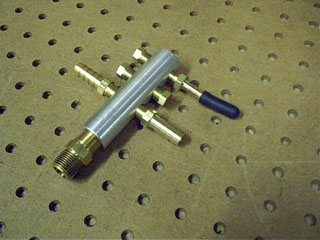
2F Intake "Gas Filter" vacuum fitting ???

This site may earn a commission from merchant affiliate
links, including eBay, Amazon, Skimlinks, and others.

Joined
Mar 31, 2014
Threads
26
Messages
4,470
Location
Gone
Is the "Gas Filter" vacuum fitting thingy (tri-pipe) that screws into the intake manifold a one way air fitting? Or can air flow through it in both directions?

image.webp
image.webp
 
It is my understanding that it is not a valve in any means of its behavior, so it will flow both ways. It is a constant manifold vacuum source. The reason it is called a filter is that there is a porous medium in it to prevent flame from passing from the intake manifold into the vacuum fittings in case of an intake backfire. That's why it's called a "filter."
Anybody else?
 
Both ways. My guess it either as above or supposed to 'prevent or reduce' gas vapors from creeping into the vacuum lines when engine is shut off. I had one come apart and it's just wire mesh with some spun media in it.

I looked into replacing it with just a brass vacuum tree when mine broke, but since it was still available from Mr. T, I went with a new one.


sp01011b.jpg
 
Thanks all for that info. I suspected it wasn't a one way valve, but the choke opener vacuum diagram (and plumbing) has a small bleed through escape route for the vacuum going to the Choke Opener. There's a small vacuum bleed from the air cleaner housing through BVSV 2 to the gas filter.

A question came up recently about reconnecting the Choke Opener to a de-smogged engine that was missing the spaghetti piping...and at first I couldn't see why a secondary constant slow bleed line in the vacuum going to the CO would be needed.

But then after running all the variables through the bat cave Cray XMP Supercomputer, the conclusion was drawn that the small vacuum bleed for the CO provides a backup release of vacuum in case BVSV 2 malfunctions while the engine is running and blocks off the vacuum source.

If that happened, the CO would be locked open permanently & the engine would no longer have a choke (until the vac hose was pulled).

...and non savvy campers in Iceland wouldn't be able to start the engine (without a choke) and they would freeze to death in the sub zero temperatures.

So we've got to thank Toyota engineers for thinking way beyond the box... and who knows, maybe, just maybe, that tiny vacuum leak plumbed into the choke opener saved someone's life...

image.webp
 
Last edited:
For further clarification... in the desmog guide, the choke opener port is routed to one of the three open ports on the air cleaner. What is the point of this? Since neither port is a vacuum source, couldn't they both just simply be capped off, if you wanted to delete th CO? Adding a vacuum line accomplishes the same thing, but at the expense of looking deceptively useful haha.
 
Since neither port is a vacuum source, couldn't they both just simply be capped off, if you wanted to delete the CO?

Yes. Think of that desmog document as as a guide, not a bible. Perhaps the idea behind connecting a vacuum hose from the CO to the pipe on the air cleaner housing was to kill two birds with one stone cheaply with some left over old vacuum hose...instead of having to source up two vac pipe caps of the correct size. Either method accomplishes the same thing (keeping dirt out of them).

Eiminating the choke opener accomplishes nothing good or useful. It's a nice feature to have. It should never be disconnected unless it's BVSV isn't working correctly.
 
Last edited:
Going back to the gas filter, all 3 that I checked had vacuum leaks around the ring. Two not bad, one almost no resistance. I put a solid bead of red loctite around the ring then applied a little bit of vacuum to suck it into the crack a bit. Worked well.
 
Going back to the gas filter, all 3 that I checked had vacuum leaks around the ring. Two not bad, one almost no resistance. I put a solid bead of red loctite around the ring then applied a little bit of vacuum to suck it into the crack a bit. Worked well.


Hmm... I wonder if that's where my elusive 2 in hg of vacuum loss is coming from?

Question for the experts: I lose about 2 inches of vacuum as my engine goes from cold to full operating temperature. I suspected either a hairline manifold crack, beacause the expansion makes sense as the engine gets warm. However, could a leaky gas filter also open up at temperature?

What process did you use to test the filter?
 
To test it, it has to be out of the intake, I just plugged all but one port and hooked the vac to the 4th. Not sure it's worth pulling out to test. Just put a little loctite or gasket maker around the seal if you're worried about it.
 
You could probably put soap suds on the rim then blow air thru it from the base and see if they bubble.
 
I was wondering about that connection from CO to air cleaner. Didn't think that would work. Wish I had a CO.
At least my gas filter checks out OK!
 
Both ways. My guess it either as above or supposed to 'prevent or reduce' gas vapors from creeping into the vacuum lines when engine is shut off. I had one come apart and it's just wire mesh with some spun media in it.

I looked into replacing it with just a brass vacuum tree when mine broke, but since it was still available from Mr. T, I went with a new one.


sp01011b.jpg
Hey man, Where did you get the tree from?
 
Hey man, Where did you get the tree from?
Any pick n' pull junk yard will have dozens of them under the hoods of wrecked Japanese vehicles. I have a Ziploc of them somewhere but it would take a bunch of digging to find one. I'll look... I'd be happy to send one to you for the price of shipping.

A couple of interesting points:

1) the intake is NOT threaded 1/8 NPT female. It is 1/8 BSPT female which is slightly different. Most Japanese vehicles that have a similar part are similarly threaded.

2) the "gas filter" has a bit of wire mesh internally which prevent little pieces of gunk from getting sucked into the intake through vacuum leaks in the spaghetti and as a flame arrester of sorts.

HTH.
 
Here are the 3 variations I have in my horde

single

double

and the tripple

I have seen other shapes and port configurations on other toyota Vehical s

But Never a 4 or quad port ?


6B42ED23-AA80-4D7D-A306-FED3F7F43291.webp
249DFA3E-3C8D-4647-B85F-974D0874622C.webp
C2C9C933-4931-48FA-89C5-7268DFDC7C9F.webp
 
Back
Top Bottom