

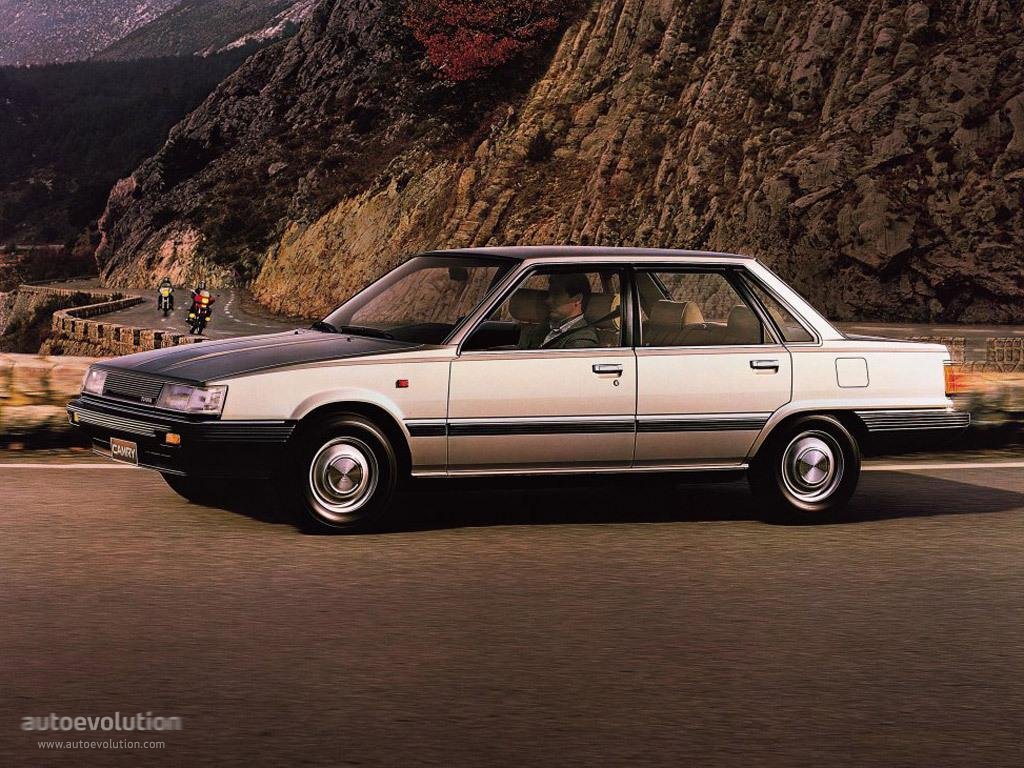
1984 Toyota Camry / Vista with 1.8l turbo diesel 1C

This site may earn a commission from merchant affiliate
links, including eBay, Amazon, Skimlinks, and others.

Awesome! Watching with interest, looking forward to seeing a trip report. ;)
 
Awesome! Watching with interest, looking forward to seeing a trip report. ;)
Ah you sonova bitch . This is all your fault lol


And these guys . The Grand Tour finale had me feeling like i gotta go get behind the wheel of something that makes me happy and want to drive

power-speed.gif
 
Last edited:
FF refers to front-engined, front wheel drive and is not an engine designation. The article mentions in parentheses that the engine is a 1C-TL. In Toyota nomenclature the C is the name of the engine series, the 1 is the number in that series. Following the hyphen are engine features - so T refers to a Turbocharger and L to its transverse layout in the engine bay. In the case of the 1C-TLC which you initially mention, I don't know what the suffix C refers to - possibly some North American-specific emissions control equipment.
 
Not sure what FF means but I suspect it is not the engine designation. The article mentions in parentheses that the engine is a 1C-TL. In Toyota nomenclature the C is the name of the engine series, the 1 is the number in that series. Following the hyphen are engine features - so T refers to a Turbocharger and L to its transverse layout in the engine bay. I don't know what C refers to - possibly some North American-specific emissions control equipment.
Ah, yeah that seems spot on. Thanks for adding that . Looking forward to hearing it pur...this will be my first diesel haha

I read the L means transverse engine configuration and you're right the C means it has a catalyst
 
Last edited:
Ah, yeah that seems spot on. Thanks for adding that . Looking forward to hearing it pur...this will be my first diesel haha
Diesel for the win! Seriously though, once you've owned a small diesel car and experienced the mileage that comes with it, there's no going back. I sold my last Jetta a couple of years ago, but have been driving my brother's and have been thrilled to be back in a car that cruises 80mph and gets 50mpg, with 388k on the clock. I keep looking for another one for myself, just haven't found the right one yet.
 
Yeah that's awesome, I hear those VW of certain generation are the bees knees.. I'm definitely looking forward to getting the camry. Might even have to build this bad boy a little shed to live in . And by shed I mean big ass tarp in my yard


This is a goodie. No turbo on the Corolla version ? ha! Probably more reliable with less moving parts but neeeeedd moreeee poweeerrrrer
 
Last edited:
Another decent article that has a bunch of pictures and more history behind this vehicle

Claimed 73 hp
0-60 in 14.2

"Toyota even installed an LED digital clock next to the tachometer."
Not really sure what else a guy can ask for
 
this will be my first diesel haha

Diesels are happier revving rather than laboring. Particularly turbo diesel.
If you labor the engine at low RPM holding a high gear to crest a hill, combustion temperatures can sky rocket, burnt pistons and cracked head can be the result.


From wiki

1C-TL, 1C-TLC​

edit
Introduced on August 18, 1983 in the V10-series Camry/Vista it is the turbocharged version of the first generation 1C.[20] This model was only installed in the V10-series Camry/Vista . The European model premiered at the 1983 Frankfurt Motor Show and produces 73 PS (54 kW) at 4500 rpm and 145 N⋅m (107 lb⋅ft) at 2600 rpm.[21]

Applications:

74 PS (54 kW; 73 hp) at 4500 rpm, 14.3 kg⋅m (140 N⋅m; 103 lb⋅ft) at 3000 rpm (US, Net SAE)


The US version looks to have made peak torque at 3000rpm??? This is odd, seems easy to high for peak torque, and is a lot higher than other versions. (2600rpm in Europe, 2400rpm in Japan)

Peak power is at 4500rpm.

You'll have meaningful torque a few hundred rpm before the peak, and peak power will be where the turbo runs out of legs. Redline will probably be a bit higher.
This means, drive it between 2100 and 4500 rpm-ish.
There'll be a sweet spot in the middle where you have enough torque left for some acceleration up a hill or past a car., and without being too noisy.

The injection pump will limit the max rpm with the governor. You can rev it all the way to redline, but revving beyond peak power is mostly pointless, unless you're trying to sneak past that truck before the passing lane ends.

Learn to downshift early rather than late. If you need to downshift on a hill, you want to downshift well before the engine rpm ends up lower than peak torque, or you'll labor the engine, or find yourself grabbing a lower gear in a hurry.
 
Diesels are happier revving rather than laboring. Particularly turbo diesel.
If you labor the engine at low RPM holding a high gear to crest a hill, combustion temperatures can sky rocket, burnt pistons and cracked head can be the result.


From wiki

1C-TL, 1C-TLC​

edit
Introduced on August 18, 1983 in the V10-series Camry/Vista it is the turbocharged version of the first generation 1C.[20] This model was only installed in the V10-series Camry/Vista . The European model premiered at the 1983 Frankfurt Motor Show and produces 73 PS (54 kW) at 4500 rpm and 145 N⋅m (107 lb⋅ft) at 2600 rpm.[21]

Applications:

74 PS (54 kW; 73 hp) at 4500 rpm, 14.3 kg⋅m (140 N⋅m; 103 lb⋅ft) at 3000 rpm (US, Net SAE)


The US version looks to have made peak torque at 3000rpm??? This is odd, seems easy to high for peak torque, and is a lot higher than other versions. (2600rpm in Europe, 2400rpm in Japan)

Peak power is at 4500rpm.

You'll have meaningful torque a few hundred rpm before the peak, and peak power will be where the turbo runs out of legs. Redline will probably be a bit higher.
This means, drive it between 2100 and 4500 rpm-ish.
There'll be a sweet spot in the middle where you have enough torque left for some acceleration up a hill or past a car., and without being too noisy.

The injection pump will limit the max rpm with the governor. You can rev it all the way to redline, but revving beyond peak power is mostly pointless, unless you're trying to sneak past that truck before the passing lane ends.

Learn to downshift early rather than late. If you need to downshift on a hill, you want to downshift well before the engine rpm ends up lower than peak torque, or you'll labor the engine, or find yourself grabbing a lower gear in a hurry.
This is just what I was wondering. Good stuff . Yeah that US spec with a higher peak torque rpm is weird , not sure where that info would have come from .

I doubt I'll push it too hard but it's good to know that diesels generally would rather get it little bit of razzle dazzle instead of just farting along low and slow, which is most likely how I would have driven it .

I'll learn it quickly and just go by feel and sound on this one
 
Similar power and torque to the W115 Mercedes 300D I used to own. Not sure how differently the engine behaves, since it is much smaller displacement but turbocharged I would expect it to do better at altitude, but have less low end grunt. The Mercedes took its sweet time getting up to speed, but could cruise comfortably at 70mph (the guy who bought it from me drove it back to LA at around 80mph, just shy of the rated top speed of 83mph). Diesels like that are definitely happy at a mid range rpm, probably around 3000-3500rpm would be a comfortable cruise for that car. My LJ78's did 3200 at 70mph for hours on end, the newer TDI engines can run at those speeds but have the torque to cruise lower and get better fuel economy.
 
Similar power and torque to the W115 Mercedes 300D I used to own. Not sure how differently the engine behaves, since it is much smaller displacement but turbocharged I would expect it to do better at altitude, but have less low end grunt. The Mercedes took its sweet time getting up to speed, but could cruise comfortably at 70mph (the guy who bought it from me drove it back to LA at around 80mph, just shy of the rated top speed of 83mph). Diesels like that are definitely happy at a mid range rpm, probably around 3000-3500rpm would be a comfortable cruise for that car. My LJ78's did 3200 at 70mph for hours on end, the newer TDI engines can run at those speeds but have the torque to cruise lower and get better fuel economy.
My friends dad growing up loved those Mercedes , old Italian guy used to pick em up in NYC all beat to s*** and then fix em up...he still has a few in the driveway .

Good tips on keeping the rpms up a bit higher than I'm used to , to avoid engine load at lower rpms . I suspect I'll settle in around 60-65mph and just point west .

Just bought a year of AAA membership just in case a tow truck is involved here at some point lol

I'm not too worried about it , it's just going to be a fun car to have and I'm fortunate enough that it's not my only vehicle. I'm sort of sad to be taking it out from its lifetime in shelter and now it's going to be living out in the woods but I guess that's just the way she goes boys
 
Pic of very class man standing next to the petrol jdm vesion of this vehicle . Thanks for pointing that out @Eurasiaoverland I can see the difference in the motor now ..and sorta relieved my rig isnt going to have those mirrors
TOYOTA-Camry-3576_17.jpg


TOYOTA-Camry-3576_19.jpeg
 
Last edited:
Engine pictured is a petrol (gasoline) engine. Wing mirrors are typical in JDM vehicles of that era.
 
Diesel for the win! Seriously though, once you've owned a small diesel car and experienced the mileage that comes with it, there's no going back. I sold my last Jetta a couple of years ago, but have been driving my brother's and have been thrilled to be back in a car that cruises 80mph and gets 50mpg, with 388k on the clock. I keep looking for another one for myself, just haven't found the right one yet.


I think you'll be astounded at how slow, noisey and thirsty this will be. It will not compare to any euro diesel of the same era. It is 1.8 litres, indirect injection and low boost on an inefficient turbo.

Expect 20 seconds to 60mph, about 7-8 litres/100km (~30 USMPG) and no sound insulation. It will likely do 80mph, but take a long flat road to get there.

Toyota designed these cars for doing 80km/h on smooth Japanese roads and they tunnelled through the hills.
 
I think you'll be astounded at how slow, noisey and thirsty this will be. It will not compare to any euro diesel of the same era. It is 1.8 litres, indirect injection and low boost on an inefficient turbo.

Expect 20 seconds to 60mph, about 7-8 litres/100km (~30 USMPG) and no sound insulation. It will likely do 80mph, but take a long flat road to get there.

Toyota designed these cars for doing 80km/h on smooth Japanese roads and they tunnelled through the hills.
All of that seems sort of accurate. This is going to play to role of local commuter so speed isn't top priority .

Current owner says its very quiet , lots of insulation in engine bat, new suspension, and it allegedly floats along quite nicely

The last few times he calculated fuel mpg it was 40+ . Even at anything over 30 that will still be the best mileage of all my vehicles so works for me

Japan designed the smaller engine class of thr Kei cars for those types of speeds
 
Last edited:
I think you'll be astounded at how slow, noisey and thirsty this will be. It will not compare to any euro diesel of the same era. It is 1.8 litres, indirect injection and low boost on an inefficient turbo.

I think you're being waaay too pessimistic here.

My half-time daily is a 1988 4x2 LN85 Hilux.. This has the 2.4litre "2L" Diesel Engine.. NO turbo, indirect injected.. its just fine performance wise, entirely adequate, I keep up with traffic and can sit on 110kph/68 mph quite comfortably if needed. The very large hill on my commute home I can (just) crest at 100kph which is the speed limit - provided I get a bit of a run up at the base.. I love driving this thing around town.

The OPs intended purchase does have a smaller engine, but with a little bit of boost I think the performance will likely be much like my larger NA engine.

Keen to hear back from the OP of his experience after purchase!

1727296190347.png
 
All of that seems sort of accurate. This is going to play to role of local commuter so speed isn't top priority .

Current owner says its very quiet , lots of insulation in engine bat, new suspension, and it allegedly floats along quite nicely

The last few times he calculated fuel mpg it was 40+ . Even at anything over 30 that will still be the best mileage of all my vehicles so works for me

Japan designed the smaller engine class of thr Kei cars for those types of speeds

The only insulation I can see in the pics is the firewall blanket. The biggest noise problem isn't the engine. It's road noise. There is typically nothing under the carpet in those cars except sheetmetal.
The 40+ mpg is unfortunately fiction to sell the car. I didn't know anyone with the 1.8 CT diesel, but I knew a few with the 2 litre CT in Toyota Caldina's. They couldn't do better than 7-8 litres/100km.

Reality is the best petrol engines are more thermally efficient than those old IDI diesels.

I think you're being waaay too pessimistic here.

My half-time daily is a 1988 4x2 LN85 Hilux.. This has the 2.4litre "2L" Diesel Engine.. NO turbo, indirect injected.. its just fine performance wise, entirely adequate, I keep up with traffic and can sit on 110kph/68 mph quite comfortably if needed. The very large hill on my commute home I can (just) crest at 100kph which is the speed limit - provided I get a bit of a run up at the base.. I love driving this thing around town.

The OPs intended purchase does have a smaller engine, but with a little bit of boost I think the performance will likely be much like my larger NA engine.

Keen to hear back from the OP of his experience after purchase!

View attachment 3735132

I've been there. I had a Nissan work-car for 11 years with a similar power diesel. YD22 with 55kw, 155Nm. It put ~30kw to the ground:

1727298639710.png


23 seconds to 100km/h. Was out-accelerated by fully loaded 40 ton trucks so couldn't pass anything. Was so noisey on the open road my ears would heat up. Turned 2800rpm at 100km/h.
This was a 16 valve direction injection engine that was far more efficient than any IDI and it would burn about 7 litres/100km.

Within 3 years I fixed it. Stripped out the gearbox to change shafts and final drive ratio from a euro model with much higher gearing (now 1800 at 100km/h), turbocharged it and stripped out the whole interior to fit about 60kg of sound insulation. Had to remap it myself. Fitted a 2.5" exhaust.
Fantastic result, roughly doubled the power and torque before I ran out of fuel in the VP44 pump. Could actually hear rain-drops on the windscreen and the taller gearing dropped fuel consumption to ~5.5 litres/100km.

But stock it was at the same power level this car has. But this car is already turbocharged.
 
This was a 16 valve direction injection engine that was far more efficient than any IDI and it would burn about 7 litres/100km.

I get 7.2L/100klms on the 2.4 IDI NA above.. cheap motoring!
 
Back
Top Bottom