ATF Exchange Project

This site may earn a commission from merchant affiliate
links, including eBay, Amazon, Skimlinks, and others.

Joined
Nov 15, 2008
Threads
7
Messages
22
After reading through the following writeup, my wheels started turning:

https://forum.ih8mud.com/80-series-tech/19299-transmission-fluid-exchange-writeup.html

What bothers me about exchanging the automatic transmission fluid via the method outlined in the quoted writeup is the potential to run the pump dry. In addition, I own (correction, used to own) one of the POS funnel/hose combos, and am very familiar with the potential for the flimsy tip of it to slip out of the tranny fill tube as I'm filling it. Unfortunately, I am also familiar with spilling the fluid all over the engine as I attempt to fill the funnel up and look at the fill markings on the side of the funnel.

My method is in the works. My goal here is to work out the kinks before I give it a shot. In other words, please do not be shy; criticize all you want.

Pre-exchange, I will do the following:
1) Drop the pan
2) Clean off the old gasket
3) Clean the metal filter & pan
4) Re-apply new liquid gasket
5) Re-assemble pan
6) Replenish the tranny with fresh ATF (fill to full line on dipstick)

By the way, Cruiserdan thought I was crazy when I attempted to order a new filter from him. I would have loved to see the look on his face.


Pictures of the exchange device (AKA The Homer):

The Homer (buckets purchased from The Home Depot)
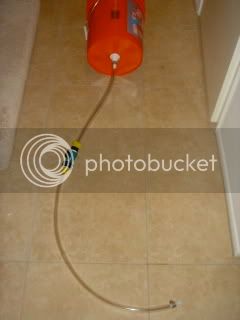
DSC05113.jpg


Markings on new fluid bucket
DSC05110.jpg


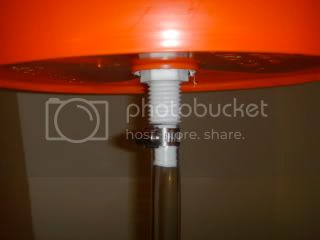
Drain plug fitting (purchased from boating supply store)

DSC05111.jpg


DSC05112.jpg


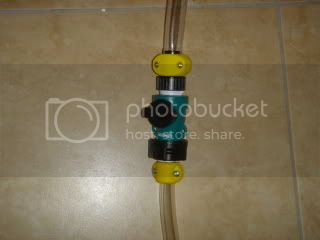
Flow control valve - open (purchased from Lowes)
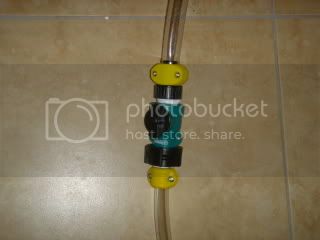
DSC05114.jpg


Flow control valve - closed
DSC05115.jpg


Flow control valve - partially opened
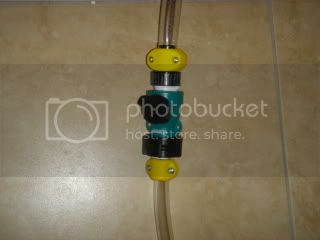
DSC05116.jpg


Coupler at end of 1/2" hose - to mate with return line (purcahsed from boat supply store)

DSC05117.jpg


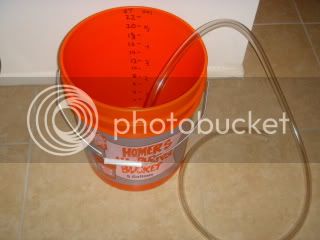
Drain hose and Waste bucket with Quarts & Gallons marked on inside - water was used to mark measurements
DSC05106.jpg


Now for the exchange procedure:
I will intercept the fluid at the line attached to the top of the tranny cooler that runs back to the tranny inlet. To simplify things, I'll refer to this line as the "return line"; and the hose I will attach to the male end at the top of the tranny cooler to my bucket, the "drain line".

1) Remove the return line from the cooler
2) Attach the 1/2" hose to oil cooler, place other end in empty bucket
3) Attach the 1/2" hose (the one attached to "The Homer" supply bucket) to the return line. There is a 1/2" plastic coupler to join the two hoses
4) close the Homer valve
5) Place The Homer on a steady surface at a height above the engine level. I may use a 5' latter. That way you can put The Homer hose down through one of the holes on the top step of the latter. It would be a good idea to secure The Homer to the surface you set it on.
6) Fill The Homer with 5 Gallons of fresh ATF
7) Start the engine. Walk to front of rig (or have a helper sit in the drivers seat ready to shut her off should anything unexpected happen).
8) Observe the amount of old fluid flowing into waste bucket. Crack The Homer valve open to match the flow of old fluid exiting the system with the amount of new fluid being introduced via The Homer.
9) Shift through the gears slowly with foot on brake, obviously. Wouldn't want to run Homer over.
10) Shut off engine once 5 Gal (or whatever quantity it takes you to get clear fluid running from cooler to waste bucket) has passed through the system.
11) Re-attach return line to oil cooler.
12) Check fluid level.
13) Done, hopefully.


Well that's what I've got done so far. I'm open for discussion/comments. Refer to the quoted writeup for more information on this concept of exchanging your transmission fluid.

If this doesn't work, I'll have a fancy funnel to fill through the fill/dip stick tube.
 
Last edited:
Great stuff. Sell this as a kit with the sealant, scraper and instructions. Everything but the bucket, which would be ridiculous to ship and easy to source locally. I'll buy one.

DougM
 
Great stuff. Sell this as a kit with the sealant, scraper and instructions. Everything but the bucket, which would be ridiculous to ship and easy to source locally. I'll buy one.

DougM

Thanks! Not a bad idea, assuming it works. ;)

awesome write up!

I see you also own a sti :cheers:

Never thought I'd see a fellow STI owner on a LC forum. Hello.

You must be also sure that oil is 'thin' enough to pass through the hose at the desired rate. It could be your only problem that oil will be pushed out by the pump much faster than the fresh oil on free-fall.


This is probably the biggest opportunity for the contraption not to work as planed. I'll try to keep the supply bucket as high as possible to create more head pressure; the higher the bucket sits, the more static head pressure there will be on the supply hose end feeding the return line. There is however, the issue of the density of ATF and head loss as the level of fluid in the supply bucket drops.

I have ideas that may get me around this if need be. One would be to put a sealed lid on the bucket, drill a small hole on top to receive an air hose fitting. By creating some pressure in the supply bucket (maybe 5-10 PSI), the head pressure can be increased. If we were dealing with water here this wouldn't be an issue . I may make the lid and have it & a compressor handy just in case.
 
In my crystal ball I see some OCD 80 owner covered head to toe in 5 gallons of fresh ATF when the upper bucket lets loose from the ceiling!:D


I have done the pump 4 quarts at a time, and even if the pump starts to run dry for an instant it doesn't hurt it according the Rodney of Wholesale Automatics.

Nice effort though.
 
One more thought

If the typical operating pressure of the tranny cooler was know and reasonably low, a small pressured (regulated air over the fluid) container of fresh ATF would be the safest method of refilling via cooler lines. Does anyone know the approximate pressure on the tranny cooler at idle?
 
In order to forget about calculations of flow rate, pump efficiency and liquid viscosity you need the following device.

Two sealed containers connected with each other. Old ATF is pushed by the pump and enters the first container. As it enters it pushers air away to the second container. As air enters the second container it forces the fresh ATF into the tranny. You just need a pair of sealed containers and you are 100% sure that you pour just the amount you drained.
atf.webp
 
WOW! Every retired physical science teacher should read MUD!

This is probably the biggest opportunity for the contraption not to work as planed. I'll try to keep the supply bucket as high as possible to create more head pressure; the higher the bucket sits, the more static head pressure there will be on the supply hose end feeding the return line. There is however, the issue of the density of ATF and head loss as the level of fluid in the supply bucket drops.

I have ideas that may get me around this if need be. One would be to put a sealed lid on the bucket, drill a small hole on top to receive an air hose fitting. By creating some pressure in the supply bucket (maybe 5-10 PSI), the head pressure can be increased. If we were dealing with water here this wouldn't be an issue . I may make the lid and have it & a compressor handy just in case.

Ala pressurized brake reservoir lid for bleeding brakes?


In my crystal ball I see some OCD 80 owner covered head to toe in 5 gallons of fresh ATF when the upper bucket lets loose from the ceiling!:D

I've practiced this art with Synthetic 90W in Samurai TC & axles. Who knew a funnel w/screen could wreck such havoc? Lots of fun watching the captured air bubbles in clear sections of tubing attempt to defy the laws of physics as I repeat every :censor: epitaph known to :wrench:ers with opposable thumbs.


In order to forget about calculations of flow rate, pump efficiency and liquid viscosity you need the following device.

Two sealed containers connected with each other. Old ATF is pushed by the pump and enters the first container. As it enters it pushers air away to the second container. As air enters the second container it forces the fresh ATF into the tranny. You just need a pair of sealed containers and you are 100% sure that you pour just the amount you drained.

I like where this is headed. Please video results for instructional DVD & included bloopers. Suggest this for soundtrack: YouTube - RICHARD STRAUSS - ALSO SPRACH ZARATHUSTRA Wear mask to protect identity on YOU TUBE?

May I suggest my favorite accessory for this type of adventure:

4xoddic-albums-fix-picture2684-drip-tray.jpg


In spite of my scientific credentials, and after much experimentation rivaling Edison's Light Bulb History - Invention of the Light Bulb, I reverted to using a small pump similar to this using CLEAR TUBING ONLY! In your case, ATF viscosity is on your side. . . . on your arm . . . on your back . . . in your hair . . .

ITT-34060-0010_med.webp
 
While I applaud all the efforts...ATF is really not what I want to comb my hair back with! I happily paid someone $100 with a B&G machine to exchange my transmission ATF with the Amsoil that I sent with the 80 to the shop. I figured it was a once in a lifetime expense anyway. (In addition to changing the fluid, the $100 included dropping the pan, cleaning the filter and magnets, and replacing said pan with genuine Toyota red FIPG.)
 
I had a similar idea using a 5 gallon bucket with a flexible bladder inside under the lid. As the transmission pumped fluid into the empty bladder it would expand and force the fresh ATF out of the bucket and into the transmission using the same pressure as the transmission pump. I'm too lazy to actually build it so I'll stick with changing the ATF at each oil change for now (until I think I've changed it enough).
 
In order to forget about calculations of flow rate, pump efficiency and liquid viscosity you need the following device.

Two sealed containers connected with each other. Old ATF is pushed by the pump and enters the first container. As it enters it pushers air away to the second container. As air enters the second container it forces the fresh ATF into the tranny. You just need a pair of sealed containers and you are 100% sure that you pour just the amount you drained.

Though I do like this idea, something tells me that the added volume of fluid to push will put a strain on the pump, slowing the flow INTO the oil cooler, and in turn, slowing the flow of new fluid back to the tranny. There would have to be . I really wish someone could tell me the head pressure at the cooler created from the pump.

If anyone has an idea of how I can measure the pressure coming from the top oil cooler return, let me know. There's got to be some sort of gauge I can use to measure the PSI. I'd be willing to be the guinea pig.


EDIT:
While I applaud all the efforts...ATF is really not what I want to comb my hair back with! I happily paid someone $100 with a B&G machine to exchange my transmission ATF with the Amsoil that I sent with the 80 to the shop. I figured it was a once in a lifetime expense anyway. (In addition to changing the fluid, the $100 included dropping the pan, cleaning the filter and magnets, and replacing said pan with genuine Toyota red FIPG.)

I've spent about $25 so far, and if it works I will have something to use over and over again.
 
Last edited:
I've spent about $25 so far, and if it works I will have something to use over and over again.

Don't get me wrong. I think you're doing a great job. It just wasn't worth my time and If I only need to change the Amsoil every 100k miles then my 80 is done for many many years.
 
I got 6 Gallons of Amsoil ATF.

I have downloaded the FSM from the TIS site. I've been looking through it and cannot find the procedure for removing the transmission oil pan and cleaning the magnets & filter screen in the FSM. I also need the torque specs for the drain plug & pan bolts.

If someone can direct me towards a thread that can help that would be great. Thanks.
 
I got 6 Gallons of Amsoil ATF.

I have downloaded the FSM from the TIS site. I've been looking through it and cannot find the procedure for removing the transmission oil pan and cleaning the magnets & filter screen in the FSM. I also need the torque specs for the drain plug & pan bolts.

If someone can direct me towards a thread that can help that would be great. Thanks.

So you have 1 extra. Alwys good when starting a project.

The torque specs are on page AT-71 of the 1997 manual. The pan bolts are 7 foot-pounds, the drain plug is 15 foot-pounds.

There is a really great description of the pan removal proceedure in the 1989 manual I have, but not in the 1997 manual. It's pretty obvious what you do. Just be sure to have the tube of FPIG and the drain plug gasket before you start.
 
Excellent info and pics, thanks for the effort.

Would it be helpful to place the hole in the Homer bucket on the side, near the bottom? This way, you can place it on any flat surface (if hanging is not an option) for this procedure. Couple of rubber washers can take care of any minor leaks due to curved wall of the bucket.

Again, excellent info.
 
Well, It worked.

I ended up keeping it super simple. I didn't want to make this a huge expensive project. I spent $5 on the buckets and under $20 on all the fittings. I had some of the hoses already. My two main goals were to keep the mess/spillage down, not let the pan run dry, and to run several gallons through the system without shutting the engine off to refill the ATF through the dipstick ( I hate trying to pour a gallon jug of tranny fluid through the dipstick, it's always a struggle). I accomplished the first 2 perfectly. This honestly went far better than I expected. I had a lot of doubts.

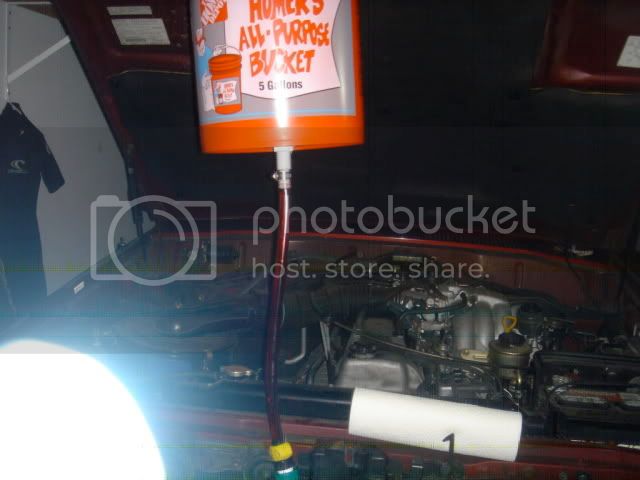
Here's the setup. I put 3 gallons of ATF in the fill bucket and hung it from my garage door by the handle. When I dropped the pan and cleaned it out the ATF in there was actually pretty clean so I didn't feel that 5 gallons was necessary. By the time the 2nd gallon passed through, the fluid draining into the waste bucket looked as clean as the new fluid. I did run it through the gears a few times.

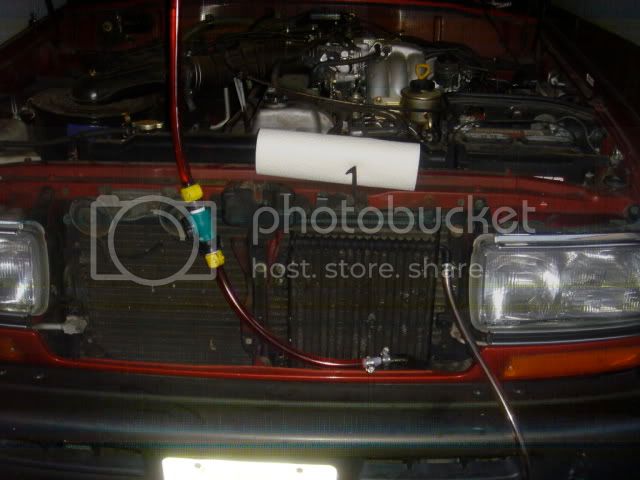
Here's the hoses all hooked up
DSC05122.jpg

I unbolted the oil cooler in order to get better access to the clip holding the hose onto the oil cooler. Once I got my hoses hooked up I bolted it back on.

supply bucket hanging from garage door
DSC05124.jpg


waste bucket
DSC05123.jpg


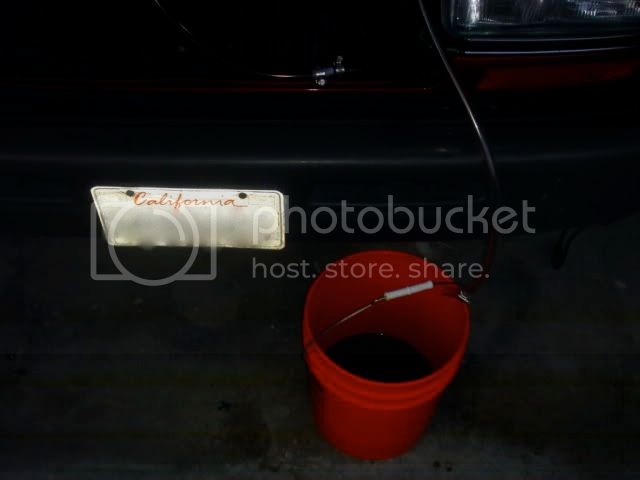
After cleaning out the pan and getting that re-assembled, I filled the tranny up with fresh ATF to the full line on the dipstick. I used a gallon here. Then, I got my setup all hooked up as you see in the pics and opened up the valve to allow the fluid to start flowing into the pan from the supply bucket. The bucket had 3 gallons of fresh ATF in it, hanging from the ceiling. To my surprise, without the engine started yet, the fluid actually began to flow into the tranny through the supply hose. So I started up the engine and the old fluid began to fill into the waste bucket. By looking at the markings on the fill and waste buckets, I noticed that the fluid was not filling the tranny as fast as it was being pumped out (I expected this to happen). No big deal. I still had time to run from park, down to L, then back to park before the fluid in the tranny got too low. Then i just turned the engine off for maybe 2 minutes, let it continue to fill, and once it got back up to full I repeated the process of running through the gears. I never turned the valve off, I just let it continue to fill. Worked great really. Totally mess free. No fumbling with bottles of ATF and a funnel. I'm quite pleased with how smooth it went.

Honestly, I wouldn't go any further with the contraption. Sure it would be nice to be able to run 3-5 gallons through without shutting off the engine. But, like I said, I had enough time to run through P to L then back to P before I had to shut her off.

I'd encourage anyone planning on doing the flush to try this method. I spent a couple days planning but once it came time to hook everything up, it literally took a couple minutes.

Job done. On to the next project. :cheers:
 
Last edited:
Back
Top Bottom