Replacing damaged Tie Rod End boots

This site may earn a commission from merchant affiliate
links, including eBay, Amazon, Skimlinks, and others.

Joined
Dec 10, 2007
Threads
279
Messages
11,781
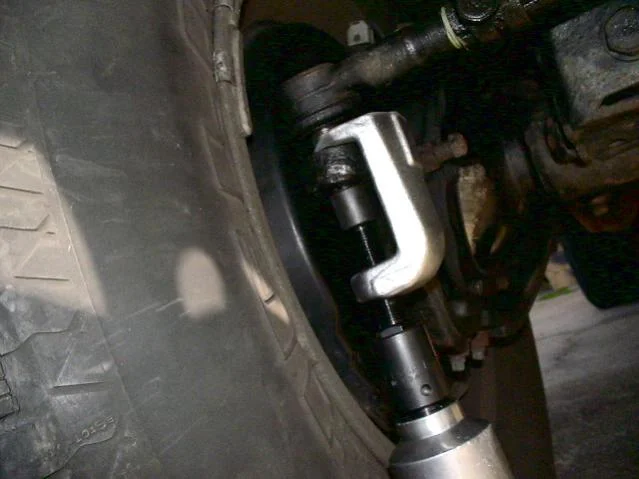
Got around to replacing my truck's split tie rod end boots today. Used the OTC 7315A tool to pop the TRE's off the steering arms; went very smoothly.

Tools required:

OTC 7315A TRE removal tool (Tool_Topia had the best price)
Impact wrench, 19mm socket, flex extension (or 19mm box wrench or 19mm Gear wrench)
Pliers
Hammer
Small and mid size blade screw drivers.

Supplies needed:

Replacement TRE rubber boots (Trail Gear; ~$7)
New cotter pins (~35mmx2.7mm or 1 1/2"x1/8")
Grease to repack boots/TRE
Plastic safe parts cleaner
Paper towels

The only tricky part is attaching the new larger spring at the base of the boot. After cleaning, inspecting, and regreasing the TRE and packing the new boots with grease slide the boots over the shaft without the larger spring, the small spring on the top of the boot can stay attached. Once the new boot is in place you can then slide the new larger spring over the boot working it down around the edge in a spiral manner. You may want to burp any air or excess grease out of the boots before you put on the large spring.

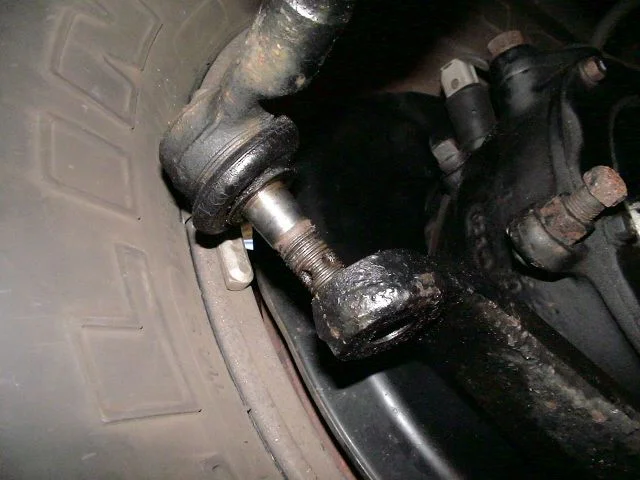
The photos tell the story.
Torn tie rod boot DSC03227.webp
OTC 7315A DSC02258.webp
DSC02260.webp
 
Last edited:
Once cleaned up I found the TRE shafts were not floppy or loose but the ball studs were easier to move by hand compared to a new TRE which are very difficult to move. Also found that both TRE's had grooves worn into the rim of the ball socket where the ball stud had been rubbing (see photo). IME as the TRE's loosen up with age/miles the force of the Old Man Emu steering stabilizer causes the tie rod to twist forward resulting in the boots being stretched on one side of the boot and compressed on the other. It also caused the ball stud to rub against the rim of the socket which made the groove. What's not clear is whether this is a result of an out of spec TRE or just due to acceptable wear combined with the force of the stabilizer?? I haven't noticed any notchy feeling or looseness to the steering and the truck tracks straight with no wandering.
removing TRE boot DSC02268.webp
Tie rod end minus boot original grease DSC02273.webp
DSC02278.webp
 
Last edited:
The last photo above shows how the ball stud bumps up against the rim of the socket. The first photo below shows the wear at the base of the stud just above the ball and the next photo shows the wear on the rim. Bottom photo is after working some Loctite Moly Paste into the socket then adding Red N Tacky grease.
DSC02282.webp
DSC02276.webp
DSC02289.webp
 
Last edited:
Subscribed. Need to do this too.

I wonder if one of my more gearheaded friends already has that or a similar tool.

Maybe a 2 or 3 finger pulley puller can be used in a pinch?
 
The FSM shows a puller similar to the one on the left used to pull the TRE however the OTC 7315A shown on the right is the tool I used, worked perfectly.
DSC02305.webp
 
Last edited:
I just did this on my truck as well. My old ones were in much worse shape. The rubber on one side was torn to shreds and there was very little lube left in the joint.
 
This was partly to inspect the TRE's with them off the vehicle but also to try the aftermarket rubber boots, was curious to see if they would fit properly, they did. For $14 and some grease it's worth the effort IMHO if you have torn boots on good TRE's, also lets you clean and regrease your TRE's. I may still replace the old TRE's, was planning to experiment with a used one by drilling and tapping a hole then adding a zerk fitting to see if they could be made greaseable.
 
Any long term updates on how the boots have held up?
 
This was partly to inspect the TRE's with them off the vehicle but also to try the aftermarket rubber boots, was curious to see if they would fit properly, they did. For $14 and some grease it's worth the effort IMHO if you have torn boots on good TRE's, also lets you clean and regrease your TRE's. I may still replace the old TRE's, was planning to experiment with a used one by drilling and tapping a hole then adding a zerk fitting to see if they could be made greaseable.
Did you ever drill and tap for grease fittings? How did that workout?
 
Once cleaned up I found the TRE shafts were not floppy or loose but the ball studs were easier to move by hand compared to a new TRE which are very difficult to move. Also found that both TRE's had grooves worn into the rim of the ball socket where the ball stud had been rubbing (see photo). IME as the TRE's loosen up with age/miles the force of the Old Man Emu steering stabilizer causes the tie rod to twist forward resulting in the boots being stretched on one side of the boot and compressed on the other. It also caused the ball stud to rub against the rim of the socket which made the groove. What's not clear is whether this is a result of an out of spec TRE or just due to acceptable wear combined with the force of the stabilizer?? I haven't noticed any notchy feeling or looseness to the steering and the truck tracks straight with no wandering.
View attachment 692261View attachment 692262View attachment 692263
So when you replace tie rod ends or adjust the tie rod or relay rod do you roll the actual rod forward so that both ends are angled as much as possible the same direction? This would result in them being as "centered" as possible. You also want to position the clamps so they don't hit the radius arms.
 
I never got around to adding grease fittings (ie: via the metal cap) to the TRE's. With tight boots and proper grease, zerks
may not be needed?? Mentioned in the original (old) posts above I added a heavy dose of Moly (Loctite Moly Paste) along with a sticky grease for ?better protection that should remain in place with the new boot.

Also agree, at 300,000 miles, you could make a case to just replace the TRE's, but that particular 80 still steers and tracks very well,
tires wear evenly, so the quick fix with new boots and grease seemed to be worth the effort.
 
Back
Top Bottom