

Planning a dual battery setup and accessories

This site may earn a commission from merchant affiliate
links, including eBay, Amazon, Skimlinks, and others.

We need to find you some more difficult mountain passes then. :)

Not me, Tim...... you know I'm out there to fish, hike and camp. As much as I love my rig, I love being "outside" even more. I prefer a rolling base camp as opposed to an all day rock crawler. I'll leave the hardcore stuff to you hardcore guys. I'm too soft I guess. :D

Trailhead to trailhead, river to river, mountain lake to mountain lake. I need a third battery....... or an RV.
 
What is a good source for battery cables long enough for a dual battery set up? Where did yall go through the firewall? Especially with the larger wires, for rear fuse block.
 
Genuinedealz.com.

they will make up your cables with a $1 labor charge for each end - did a nice job.

Gil
 
If the wires are really thick, people run them on top of the frame rail and not through the firewall.

I got my wire here: Amazon.com: Raptor BC1/0R-25 1/0 Gauge 25-Feet Battery Cable (Red): Car Electronics

Is there a good spot to re-enter the cab behind the second row of seats.
What gauge wire do you use for the battery cables
What gauge wire running to the back for an added fuse block(running a frig and an inverter and some 12V sockets)
I ask because the T-max system came w 6 AWG wire. I was going to use it to run to the rear fuse block and get a larger wire for the battery cables.
 
natvet said:
Is there a good spot to re-enter the cab behind the second row of seats.
What gauge wire do you use for the battery cables
What gauge wire running to the back for an added fuse block(running a frig and an inverter and some 12V sockets)
I ask because the T-max system came w 6 AWG wire. I was going to use it to run to the rear fuse block and get a larger wire for the battery cables.

I used 1 gauge between the batteries. I used the t-max 6 awg wire to run from the front to the rear.
 
This is a good thread, so I'll add to it. It needs more pics too, so I'll help with that.

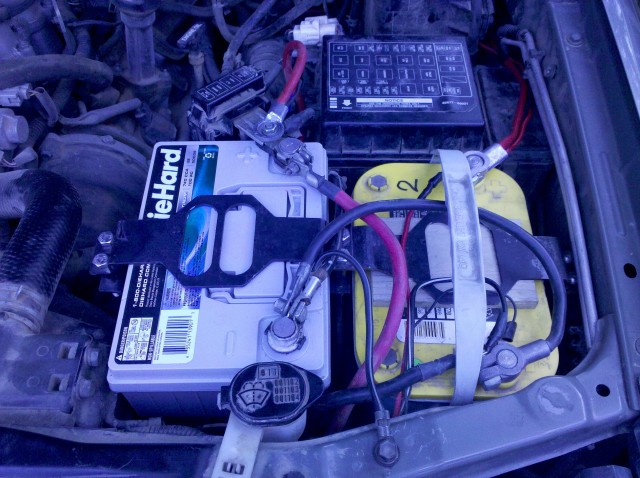
I had two Optimas in the stock location (thread CLOSED for some unknown reason):
https://forum.ih8mud.com/100-series-cruisers/434186-dual-optimas-stock-location.html

One of them died a few weeks ago, after only 4 years. I think I've got some discharging/charging issues that need to be worked out.

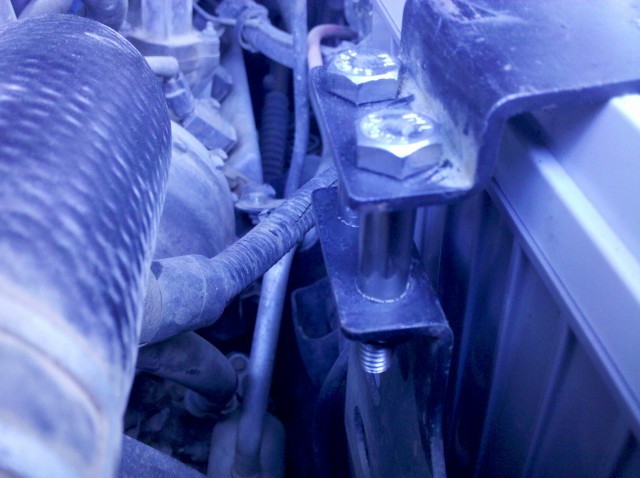
I also have some wheeling and camping that needs to be worked out, so I had to do something. I did not want to go Optima again with all the trouble I've heard, so I went with the Sears version. It turned out to be about an inch taller than the Optima, so I had to modify my battery box a bit to keep them in the stock spot.

I am pretty sure I will NOT be able to fit a second Sears battery in when the other optima goes. Not sure what I will do at that time, but that's what makes this hobby of modding so much fun.

On with some pics!

IMG_20120624_154146.jpg


IMG_20120624_154203.jpg
 
Last edited:
i tried the cole hersee isolator mentioned below, and quite frankly, did not like it. The big surprise was the great amount of heat it creates when the switch is engaged - and the real kicker, instead of disconnecting the starter battery when it reaches 12.7, it did not disconnect until the starter battery was down to 12.45 - it is now down to about 70%, and the juice from the isolator itself is what is drawing the charge down. So instead of using my battery power to warm me in the back while sleeping, it is heating up my hood!

i'm next going to try this item which simply connects anytime there is a charge, and uses very little electricity: Yandina Combiner 100 Battery Combiner. Costs $60.

Gil

I found this "48530 Smart Battery Isolator 200A
" by Cole Hersee.

Dual Battery Upgrade | Pro Pickup

describes an installation with a pickup. Looks to be a relatively simple way to wire up a second battery if you don't need more info/or control. For abou 140 bucks. As i understand it, it charges up main battery first, then switches to charge 2nd battery. When discharging, will discharge both to 12.7 volts, then will only discharge second battery. Sound useful? i'm primarily interested in a second battery to power heating pads for sleeping in my LC when it is cold.


Gil
 
gil12 said:
i tried the cole hersee isolator mentioned below, and quite frankly, did not like it. The big surprise was the great amount of heat it creates when the switch is engaged - and the real kicker, instead of disconnecting the starter battery when it reaches 12.7, it did not disconnect until the starter battery was down to 12.45 - it is now down to about 70%, and the juice from the isolator itself is what is drawing the charge down. So instead of using my battery power to warm me in the back while sleeping, it is heating up my hood!

i'm next going to try this item which simply connects anytime there is a charge, and uses very little electricity: Yandina Combiner 100 Battery Combiner. Costs $60.

Gil

I installed the Cole hersee a month ago and its working fine... didn't verify what voltage it disconnected things at but if ITA over 12 I don't think it matters....
 
I'm wiring up mine and taking lots of pics last night and tonight. SanDiegoCruiser recommended running 200Amp inline fuses on the positive battery cables, as close to each battery as possible. I have these ready to go but I'm wondering what everyone else thinks about this idea?

Wouldn't it cause unnecessary resistance that might defeat the purpose of using the thick gauge wire?
 
Since our batteries are so far apart, I don't see how a 200amp inline fuse is not a good idea. It could prevent a potential fire if your 12ft run of 1 gauge wire is some how shorted. I would like to hear arguments against this approach.
 
It should let the necessary amount of current flow through the fuse up to its limit. It is not necessarily acting as a resistor until it needs to.
 
I currently only have one off the main battery. I have not had a chance to install one on the second battery yet. I installed it next to the main fuse box.
image-375765561.webp
 
I used 200amp fuses since that is what most people run when using 1 gauge wire between batteries. The rating has to be high enough to handle the ability for you to jump yourself from the secondary battery. I have done this once and 200 amp fuse was more than enough to handle it. I am not sure if 100amps is enough to handle the current involved.
 
You guys might be right....

I just used what came in the NL kit. I didn't change the wiring. I figure the engineers that designed it know way more than me about electrical circuitry. The only thing I may do is swap out the fuses with an equivalent resetable circuit breaker. I carry a spare fuse for each right now. But, they are not readily available here in the US. That could be bad.....

Sent from my phone using IH8MUD
 
Back
Top Bottom