Lifted Fj40.

This site may earn a commission from merchant affiliate
links, including eBay, Amazon, Skimlinks, and others.

Joined
Aug 23, 2014
Threads
2
Messages
18
Hey all,

I have a question for everyone that has lifted an Fj40. What did you do with your rear tailshaft. Especially is you have installed a 5 speed.

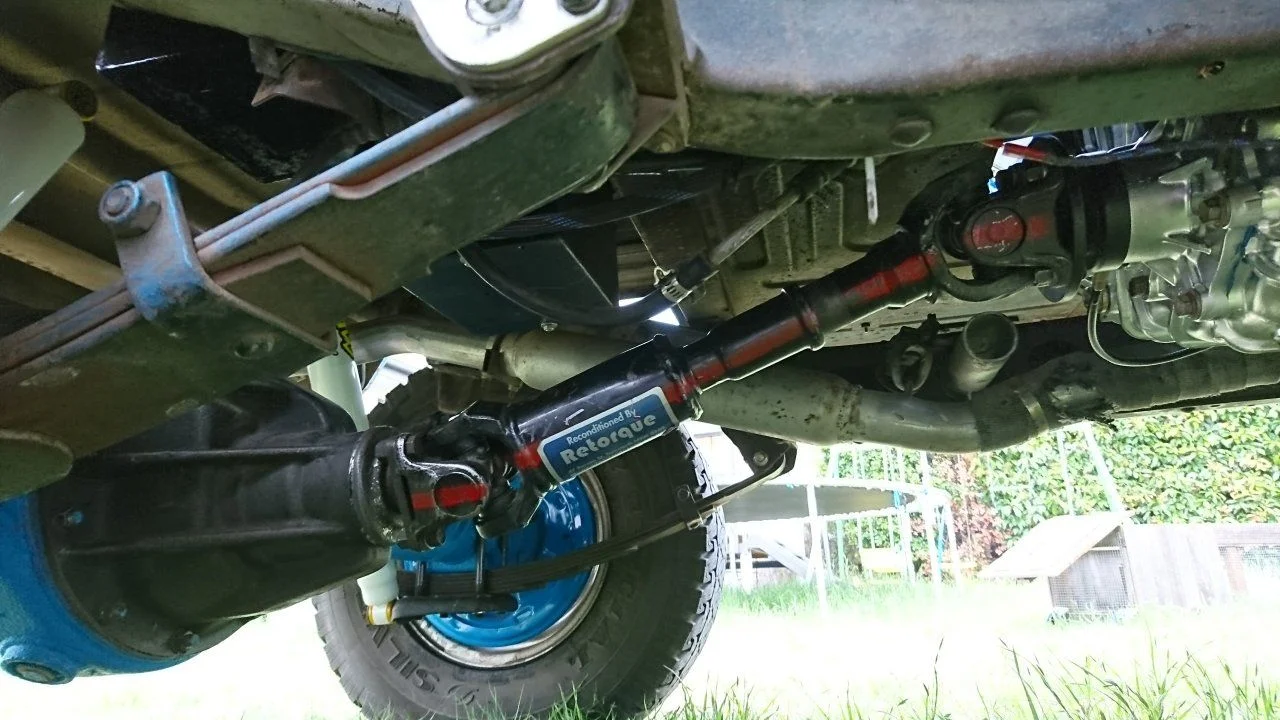
I have a 1977 Fj40 that had a 2'' lift that I never paid any attention to, and installed a reconditioned H55f. Got new front and rear shafts made up and balanced. The rear is now only 475mm (18.7 inches) and sits around 15 degrees. That angle, I hope, is causing all sorts of noises to come from my box (this is the second one that made the same noise as the first). What
DSC_0056.webp


FB_IMG_1435908453580.webp
 
The drive line angles appear to be off adding shims will most likely fix the noise issues if not bearing related noise.
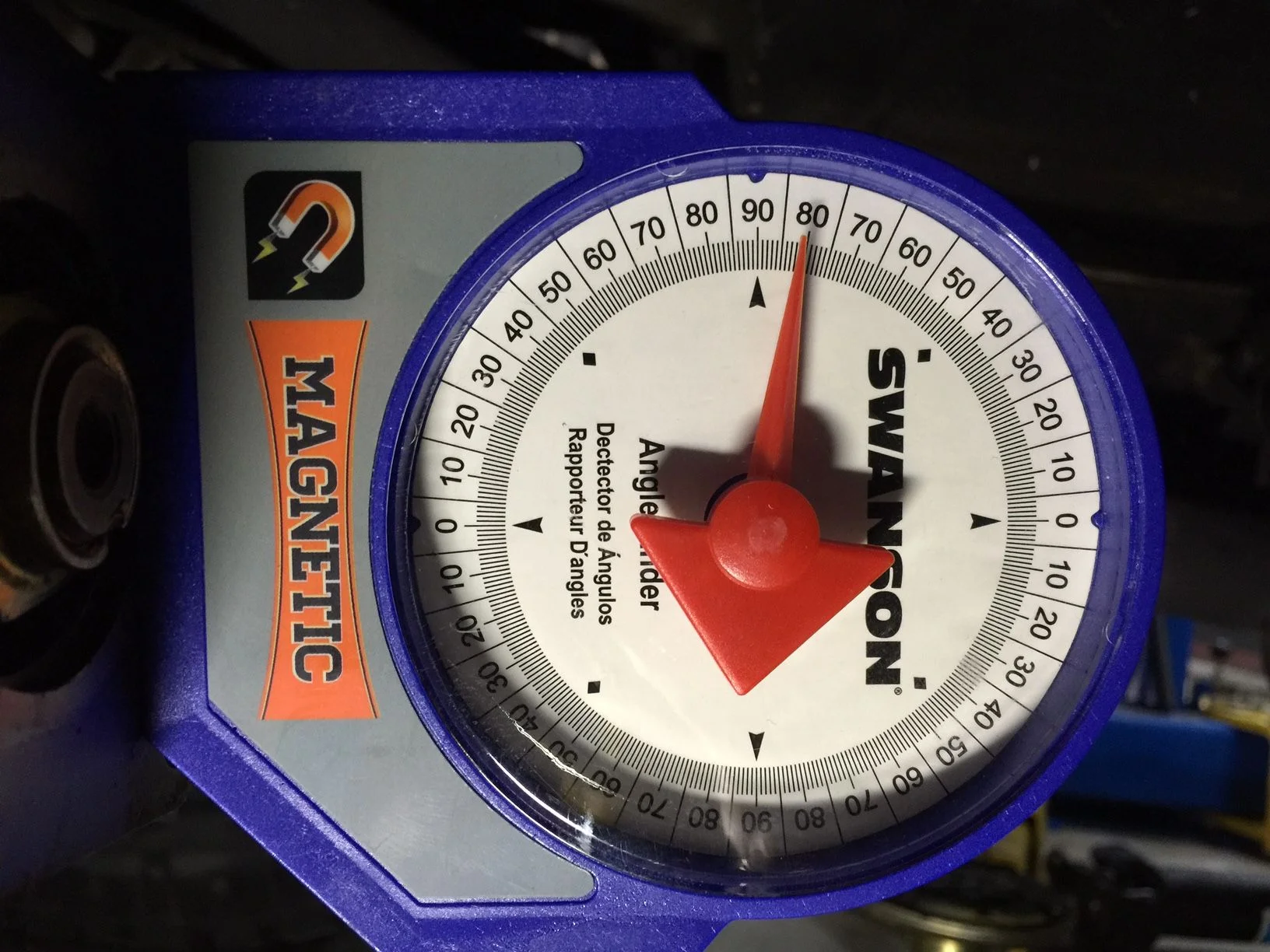
I recommend checking angles with this angle finder for $5 at Lowe's

Remove drive shaft to check angles
full


Do the math to determine shim angle (check both front and rear diff drive line angles)
full
 
Last edited:
The drive line angles appear to be off adding shims will most likely fix the noise issues if not bearing related noise.
I recommend checking angles with this angle finder for $5 at Lowe's

Remove drive shaft to check angles
full


Do the math to determine shim angle (check both front and rear diff drive line angles)
full
 
Bugger, tried doing this on my phone, two posts, one incomplete, one without pics. Can't seem to find the delete option. Flanges are spot on parallel. I have a digital angle finder.
 
I see you cut off the chassis brace and that may be the issue, did you replace it with another?
 
I see you cut off the chassis brace and that may be the issue, did you replace it with another?
Temporarily removed. Had the gearbox in and out so many times, it was easier to do it without. Hasn't been. Driven since removing it.
 
I've used an electronic angle finder in the past and found the angles weren't accurate so then I purchased the analog angle finder and it worked great.

Based on your pic, as mentioned above, the drive line angle doesn't look right, with a 2" lift the angles will change and it doesn't appear that you have any shims above the leaf springs.

I still recommend you remove the drive shaft and check the drive line angles with an analog angle finder.

Another issue maybe the third member that's making noise, has it been checked for bearing wear?

The angle on the pinion flange should read 90 degrees, what does yours read?
 
It appears that you do not have proper slip joint engagement.

If you grab the center of the drive shaft and attempt to move it up and down, what happens?

Tube section of the drive shaft needs to have 1.0" to 1.5" of tube added...

When the rear suspension compresses, the axle moves away from the transfer case.
 
I've used an electronic angle finder in the past and found the angles weren't accurate so then I purchased the analog angle finder and it worked great.

Based on your pic, as mentioned above, the drive line angle doesn't look right, with a 2" lift the angles will change and it doesn't appear that you have any shims above the leaf springs.

I still recommend you remove the drive shaft and check the drive line angles with an analog angle finder.

Another issue maybe the third member that's making noise, has it been checked for bearing wear?

The angle on the pinion flange should read 90 degrees, what does yours read?
The transfer and third member both read 88.9. It was rebuilt after trying to diagnose the noise. Actually, everything has been rebuilt, diffs, brakes, swivel hubs. Everything.
 
It appears that you do not have proper slip joint engagement.

If you grab the center of the drive shaft and attempt to move it up and down, what happens?

Tube section of the drive shaft needs to have 1.0" to 1.5" of tube added...

When the rear suspension compresses, the axle moves away from the transfer case.
There is no movement. There is still plenty of spline in the joint. The paint marks are at full compression.
 
How would this cause drive shaft vibration?

It "may be the issue" not knowing of any other structural mods he's made to the chassis, if the chassis structural integrity is compromised service loads and special event loads and moments may cause undue vibrations and failure. Are you suggesting that a cut off chassis brace is of no consequence while driving?

If you read closely above, he indicated the vehicle hasn't been driven since removing the chassis cross brace so it's a moot point.
 
Low-Speed v. High-Speed Driveshaft Vibrations - Click for more info.

Low-speed vibrations (typically categorized by under 30 mph) can be as a result of mechanical issues such as:


Phasing

Alignment

Straightness

High-speed vibrations can be a result of:

Balance

Very high-speed vibrations can be a result of:

Approaching Critical Speed

Phasing is a term that describes the alignment of the single-cardan joints on opposite ends of the drive shaft. A single-cardan (or u-) joint doesn’t rotate at a constant velocity if the operating angle is non-zero. The driveshaft speeds up and slows down slightly as it rotates, due to the nature of the joint. The joints at each end of the driveshaft should be properly aligned. When the yokes on each end of the shaft line up with each other (as seen indicated by the light blue line in the figure below),

Driveshaft-Alignment-Snip.jpg

the affect will be that the two joints tend to cancel out the speed variations from each other. (In most 4×4 applications, the driveshaft will have a slip yoke in the middle to allow for changes in length.) Phasing, then, is the speed variation of the joint, related to its operating angle and angle of rotation. In order to get the most effective cancellation, the joint yokes “must” be aligned exactly with each other and the operating angles “must” be identical. Any variation in either angle will show up as an un-cancelled vibration. While unequal operating angles result in a vibration that increases with shaft RPM, phasing problems may be felt at lower RPMs and higher loads, like when accelerating from a stop.

For a double cardan driveshaft, phasing is not an issue, although you may want to try and line up the bearing caps anyway.
 
Your U-joints are in phase so that's clearly not the problem, you may want to review the article above.^^^
 
Yep, shaft in phase and balanced. It's not engine rpm related, but road speed. I've read heaps of articles and the common theme is shaft angle. Most say around 7 degree.

So that's my question, has anyone lifted a 40 and put a 5 speed in? What angle are all your driveshafts running at?
 
My driveshaft is 19" compressed, 22 degree operating angle. Their is a difference between a ujoints max angle, and max operating angle. I'm not using cruiser ujoints. My driveshaft started it's life on a gx470, and they seem to handle the operating angle but just barely, I feel a slight vibration at times on the highway. Different ujoints have different operating angles. Go outside of that operating angle range and it could vibrate. If those are stock Cruiser ujoints, you are probably well outside the range of ideal operating angles. Have you lifted the rear axle and tried spinning the shaft? Looks like it's close to binding. I think cruiser ujoints have a maximum angle of 20 something degrees before they bind, so 15 is likely more than their max value of operating angle. You look like your ujoints are almost at max angle at ride height. If the wheel droops, it could bind. Cruiser ujoints are so strong, that if they bind they will not break. Something else will though. Either it will twist the tube in half, or snap the pinion.
 
Back
Top Bottom