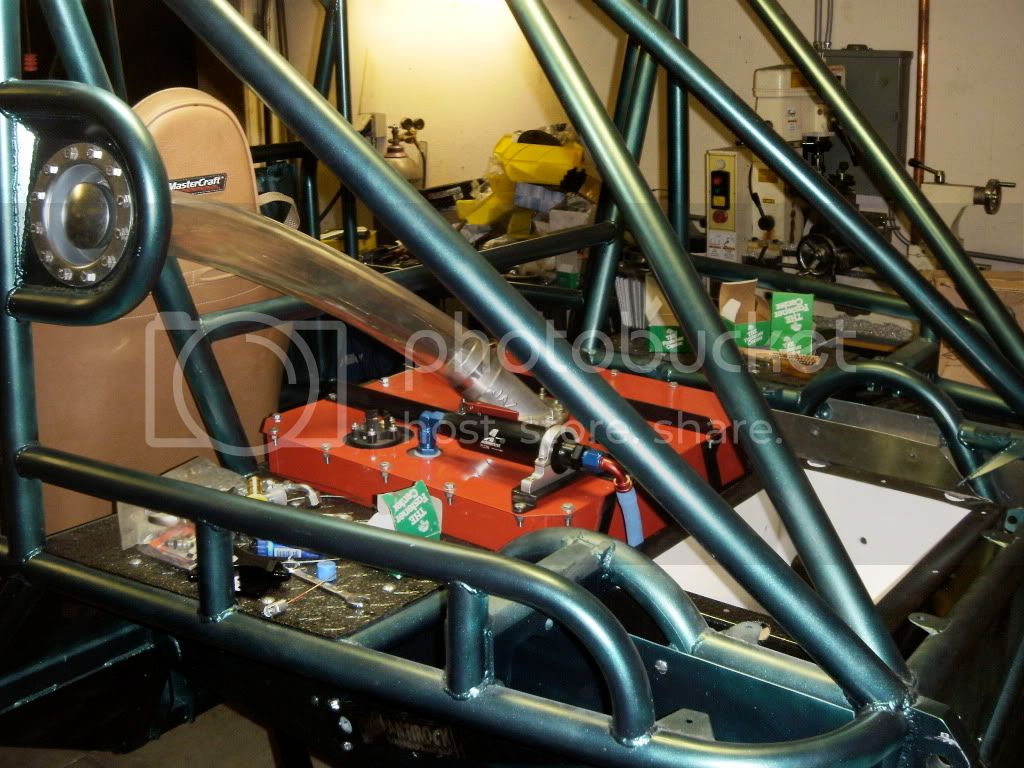
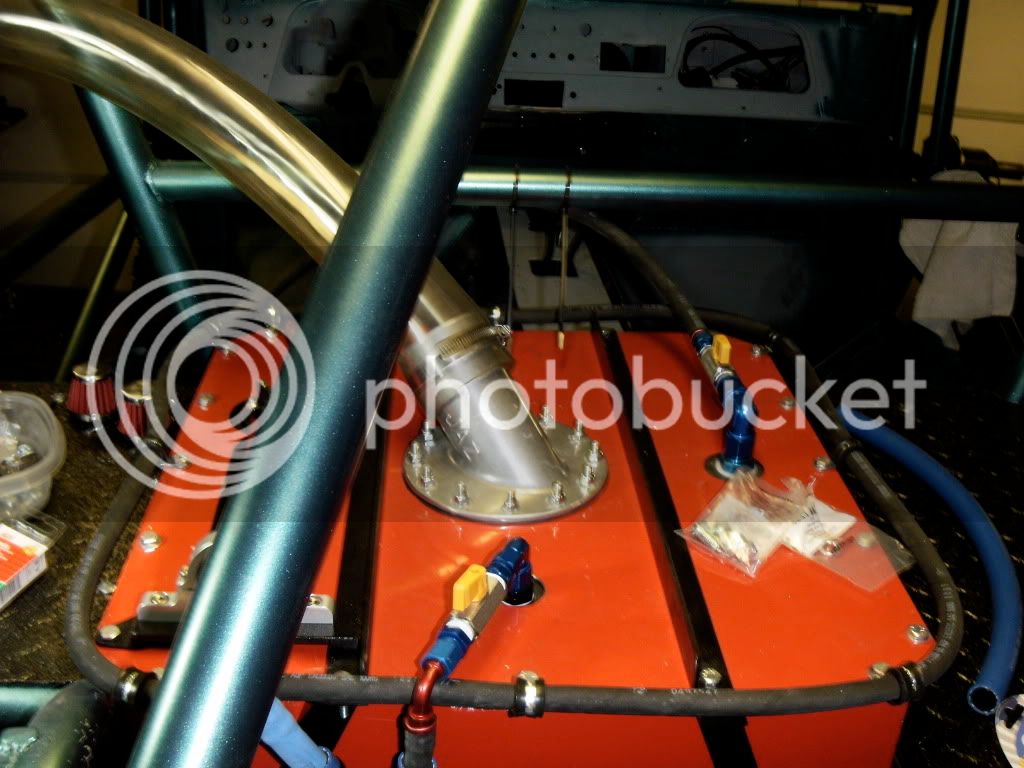
In tank fuel pump???

This site may earn a commission from merchant affiliate
links, including eBay, Amazon, Skimlinks, and others.

Just a simple drawing, paint wont let me tilt the drawing other then 90 degr. so you need to tilt your monitor to get the level horizontal.:D
Because the sump is fed from the corners it will be filled under every angle and you can create the sump beside the track bar so it will not though.
in tank fuel pump set up.webp
 
You're kinda working hard to re-invent the Walbro pickups, there. ;)

If you have open tubes to the corners, then you're no better off. Go back to the drawing I did with the blue liquid at an angle. If there was a tube to the sump from the corner with the fuel in it, it still wouldn't get fuel to the pickup. However, whatever could have been trapped in the sump will drain out!!

Just remember... none of this is an issue when the tank is 3/4 full... it's an issue when the tank is a quarter full and less. Thats still kind of a big deal. That's how your 20 gallon cell becomes effectively 15 gallons, or a 16 becomes a 12.

If you do the pickup-in-a-sump trick, you have to make sure that the fuel return from the pump goes into the sump with little or no loss. Otherwise the pump sucks the sump dry in seconds and the fuel return just dumps it into the low spot away from the sump. It doesn't even have to suck it dry, really... it just has to suck the fuel level down to where the pump is exposed to air and you loose the pump prime. You have to think about how the fuel return is going to flow when the tank is leaning at an angle. If the fuel return goes right into the sump, then it could work.
 
WOW, this is making my head HURT.:crybaby:
Okay... the idea is to keep it as simple as possible and as serviceable as possible and ideally, keep the fab down as much as I can. As comfortable as I am with my welding, I dont wanna push it too much on my tank. Without having checked what the tank would look like if I dropped the back of it to have the stock in tank pump fit, Im considering the idea of the in line pump a bit more. Clearance is a premium UP or DOWN on that tank. Its what I have to work with and the tank is NOT changin at this point. So Belly doc, I referred back to what you had used, and that all may be a bit spendy for my bed pan fetchin ass. Without scouring the web again, what IN LINE pump would be required to fuel the vortec? Im blanking on the pressure requirements for the motor. Would I then be able to use the vette filter/ regulator with the in line pump, or would I just be relying on the FPR on the motor?
Id do SIMILAR to what chop shop had ADEPTLY illustrated, only thing Id do different is tuck the PUMP in the PS edge of the sump al;ong the side of it. It would be BELOW the tank, close to the pick up. Going this route, Id be back to about a third gallon reserve in the sump as Ill build it pretty big 4x14x3. So I feel it would be pretty well protected on the SIDE of the sump, be away from the exhaust and hopefully get some decent air flow to keep it cooler.
Id still really like to make the stock in tank pump work, but if I cant...well...I cant
So the return then should be NEXT to the pick up? This is to keep the motors run off feeding the pump, right?
So off the pick up, next item in line would be the PRE filter, then the pump, and then another filter? Seems that lots of folks put a shut off valve off the inlet? Im assuming that is to make changes to the pump and filter(s) easier? Im planning on AN fittings, and considering the cost of those...this will add up quick. Do I run all this off hard line, or could I use the soft rubber twist tight hose?

Thanks for all the help and input on this gents! I do really appreciate all the wisdom donated here.
 
Just a simple drawing, paint wont let me tilt the drawing other then 90 degr. so you need to tilt your monitor to get the level horizontal.:D
Because the sump is fed from the corners it will be filled under every angle and you can create the sump beside the track bar so it will not though.

Im thinking this could actually work for me IF I built baffles into the sub tank. I get what doc is saying though...with the pump location (without baffles) there would still be a fuel defecit while nose up/ climbing OR decending, depending on where the pump is located.
For me though...waaaay more fab than I wanna do.

Great work though on the design.:cheers:
 
Dumb question, and Jason more than likely can answer this but Ford(Ranger/Bronco2, mostly 2.9 87-90 I think?) used a subpump/pickup/assist/pressure tank wanna be always mounted on the frame rail like Voltswagon Digifant fuel injection was in the early 90's.

It acted only like a pressure tank, it was an assist for the lack of a better term. Thoughts?
 
AN? sounds expensive

Just weld a small pipe thread nipple on the sump and put a barbed fitting on it and then hose clamp a small section of fuel hose to a clear plastic cheapie fuel filter. Then hose clamp another chunk of rubber fuel hose to the outlet of the filter and onto to pump with a hose clamp. Most of/on valves come with pipethread so if you want a shuttoff valve it would be easy to put on the sump outlet with no fancy adapters.

All the above is on the inlet side and is lo/no pressure just a suction line.

Now after the pump you can use a steel line on the framerail upto the engine. Or have a nice fuel friendly hose crimped up with a fitting at each end for the engine and pump.

The simpler the better.
 
I think if you have openings in the corner that allow more fuel to run through them than the pump sucks out of the sump, you use the pricipal of comunicating barrels and your sump will be filled as long as there is fuel above one hole. And it keeps the fuel from slushing out of the sump. Depending on the soze of the sump you can add baffles.

You can try and make a mock up from plastic and fill with water.
 
Here is another view of what I think will work best. You can calculate the size of the tubes by looking at the max intake of the pump and match them to the free flow viscosty of the liquid. So if the pump can pull a gallon a minute you need an opening which passes through a gallon a minute just using gravity. This way "comunicating barrels" will fill the sump in the worst case at the same rate the pump sucks it out. Concidering it will be rare for the sump to be feeded from only one tube you will not have the pump suck the sump dry as long as there is fuel in the tank. You can even run the pump strait through the bottom just keep the hole as tight as possible.
tank from above.webp
 
Here is another view of what I think will work best. You can calculate the size of the tubes by looking at the max intake of the pump and match them to the free flow viscosty of the liquid. So if the pump can pull a gallon a minute you need an opening which passes through a gallon a minute just using gravity. This way "comunicating barrels" will fill the sump in the worst case at the same rate the pump sucks it out. Concidering it will be rare for the sump to be feeded from only one tube you will not have the pump suck the sump dry as long as there is fuel in the tank. You can even run the pump strait through the bottom just keep the hole as tight as possible.

Michael...YOU ROCK! :D:clap:
How much time are you spending on this issue?


K
 
Has anyone brought up the possibility in running a surge fuel tank?

Sent from my DROIDX

Nope...explain please.
I know from doing fire sprinklers what it is, but have never heard of one for a fuel tank?
 
Michael...YOU ROCK! :D:clap:
How much time are you spending on this issue?


K

I Might be using the same system on my other rig so the knife cuts both ways.;)
And its always good to make use of an education, even if its for a hobby.
 
Basically its a tank that is usually a bit smaller than a 2 liter bottle in addition to a normal fuel cell. It utilizes a low (cheap) pressure pump to keep it full from the larger fuel cell and then uses a high pressure pump from it to keep the efi happy. Lots of drifters and old school hot rods that see track time use them to keep fuel to the motor while the fuel sloshes around on the big tank. The advantage is that you build.in a little buffer time of starving the system of fuel due to the shape of the swirl pot/surge tank always being full. Here a quick link that can explain it better. There is a ton of info on the net about them if you search efi surge tank or efi swirl pot. I was planning on running this system when I was going to build the b-jesus out of my small block tbi motor...

http://www.fortunecity.com/silverstone/impala/1012/cars/tech/swirl/swirlfaq.html

Nope...explain please.
I know from doing fire sprinklers what it is, but have never heard of one for a fuel tank?


Sent from my DROIDX
 
Here is another view of what I think will work best. You can calculate the size of the tubes by looking at the max intake of the pump and match them to the free flow viscosty of the liquid. So if the pump can pull a gallon a minute you need an opening which passes through a gallon a minute just using gravity. This way "comunicating barrels" will fill the sump in the worst case at the same rate the pump sucks it out. Concidering it will be rare for the sump to be feeded from only one tube you will not have the pump suck the sump dry as long as there is fuel in the tank. You can even run the pump strait through the bottom just keep the hole as tight as possible.


I don't see this as an advantage at all. Using your lingo, the point of the sump is to create "non communicating barrels" so that fluid is held against the pickup in the sump even if the bulk of the fluid has sloshed away in the main tank. The communications you're talking about just look like drain holes in the sump to me.

It might as well just be a tank with a shallow sloped bottom.

sumppic.jpg


Am I reading this wrong?
 
I don't see this as an advantage at all. Using your lingo, the point of the sump is to create "non communicating barrels" so that fluid is held against the pickup in the sump even if the bulk of the fluid has sloshed away in the main tank. The communications you're talking about just look like drain holes in the sump to me.

It might as well just be a tank with a shallow sloped bottom.

sumppic.jpg


Am I reading this wrong?

You have a point there but at that angle your sump will work for a few seconds and then the pump sucks in air, no mather how big the sump, the pick up point will always be in the middel. I think the advantage my system has is with a slightly lesser angle you can keep driving for a longer periode of time. And the lower the sump/pick up point, the better it works. I don't think there is a perfect system only one that has the least flaws. A surge tank works fine but needs 2 pumps where the first, low pressure, one is going to suck air every now and then reducing its life expectancy. If one of the pumps fails the system won't work. I like the flexible pick up Mace is sugesting, it would however require a round bottom of the tank, otherwise it would be very sensitive to wear.

This is however an interesting discussion that can lead to the best system in the given circomstances.:cheers:
 
... Im blanking on the pressure requirements for the motor. Would I then be able to use the vette filter/ regulator with the in line pump, or would I just be relying on the FPR on the motor?

I'm guessing that the pressure is supposed to be about 60 psi, but I don't know that as a fact. I googled and found references like that, but that's similar to mine so it's probably not far off. Any pump that's rated for fuel injection would probably do that pressure. Many pumps are rated for a horsepower number which is a decent indicator of flow and pressure capability combined. If you saw that a pump is good for 500 or more horses in a fuel injected application, it's hard to imagine that it wouldn't give you everything you need. As far as brands, I have zero personal experience with this stuff and went on recommendations, myself. Aeromotive came highly recommended and so did Bosch.

I also don't know anything about the stock regulator and fuel rail system on your engine. I don't think it's a flow-through system so I think that means you need to have either a fuel pump with a built in bypass/regulator to dump the excess back into the tank, or else you have to use a pump followed by a regulator that dumps the excess back to the tank (or else replace everything with a flow through fuel system...) Then the pressure regulator up at the fuel rails is just to put the pressure right where the injectors expect it.


So the return then should be NEXT to the pick up? This is to keep the motors run off feeding the pump, right?

That's exactly what I'm thinking. If you return the excess back into the sump, then when you're drawing off of the isolated sump, it's only depleted by what you actually burn... and maybe what spills out despite your efforts to contain it.

So off the pick up, next item in line would be the PRE filter, then the pump, and then another filter? Seems that lots of folks put a shut off valve off the inlet? Im assuming that is to make changes to the pump and filter(s) easier? Im planning on AN fittings, and considering the cost of those...this will add up quick. Do I run all this off hard line, or could I use the soft rubber twist tight hose?

The pre-filter is to protect the pump. The post-filter is to protect the injectors. A valve is a GREAT idea so that you can service the fuel line/pump/filters without spilling a lot of fuel. It's also a GREAT idea for when you wreck and you think your car is about to catch fire, or you're on your lid and fuel is dribbling on the ground from a cut fuel line. I've got valves in-line in all three hoses to the tank. The fuel line has one, the return line has one and the breather has one.

My pre-filter has an integrated ball valve, so that's the one in the fuel line. All my valves are on top so that they're readily accessible in an emergency:

P6140283.jpg


P7010325.jpg


Basic hose and hose-end technology is a clean and efficient way to hook all this stuff together. It's forgiving and intuitive to assemble. If you don't like the result, it's easy to modify. I built a fixture for pressing the hose ends on so that I didn't have to muscle them by hand.

A sump with a hole going into it, and the return line feeding directly in... that seems like a simple and solid way to go whether your fuel pump is on the outside or the inside.

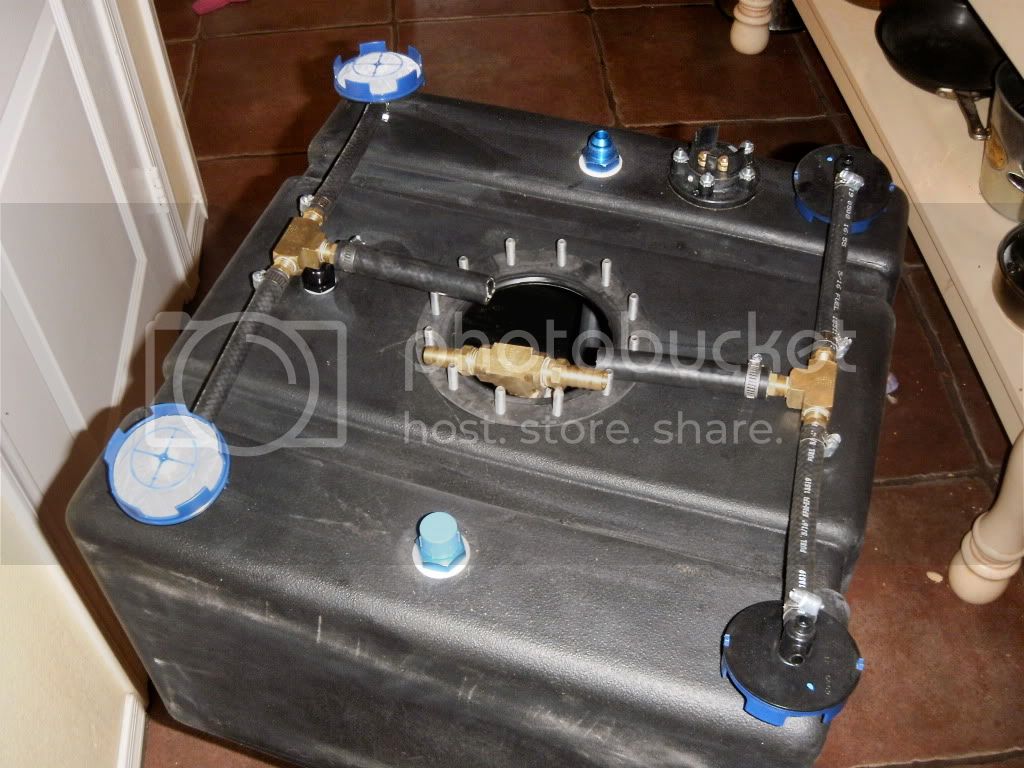
BTW.. I found a pic of my Walbro pickup array going in... this is how I have pickups in all 4 corners. The two that are white-side up are just for show, they go in with the mesh facing down.


P6080274.jpg
 
You have a point there but at that angle your sump will work for a few seconds and then the pump sucks in air, no mather how big the sump, the pick up point will always be in the middel. I think the advantage my system has is with a slightly lesser angle you can keep driving for a longer periode of time. And the lower the sump/pick up point, the better it works. I don't think there is a perfect system only one that has the least flaws. A surge tank works fine but needs 2 pumps where the first, low pressure, one is going to suck air every now and then reducing its life expectancy. If one of the pumps fails the system won't work. I like the flexible pick up Mace is sugesting, it would however require a round bottom of the tank, otherwise it would be very sensitive to wear.

This is however an interesting discussion that can lead to the best system in the given circomstances.:cheers:

Interesting, agreed!! :)

If the fuel pickup and the return are both in the sump, then in my assessment, it only depletes what it burns. This should last more than "seconds". Also, consider that the doodle obviously isn't a scale representation. Chicago is estimating a 1/3 gallon sump capacity, if I'm remembering correctly from a post above.

I'm not actually an advocate of the sump method anyhow... but in my assessment, the sump-with-drains only works if the level in the main tank is higher than the sump anyhow, negating the role for the sump. It's basically a sloped bottom tank.

As you can see in the post above, I'm a fan of the 4-corner Walbro pickup solution. It basically turns whatever corner is below fluid level into the sump.
 
Back
Top Bottom