High Altitude Comp (HAC) Valve

This site may earn a commission from merchant affiliate
links, including eBay, Amazon, Skimlinks, and others.

Joined
Feb 14, 2013
Threads
169
Messages
1,056
Location
Wake Forest, NC
Hi All -

i have a '87 fJ60 stock. I set the timing and then just happened to check the HAC (high altitude compensation) valve according to the emissions manual (section 3-31). When I connected the outer vacuum hose to the distributor, it advanced timing by six (6) degrees...meaning I am at high altitude. However, I am in NC at an altitude of 387 feet, so there should be no advance (i.e. Low altitude). I changed out valves (I had a spare) and got the same advanced timing results. Any idea what is causing this? Do these valves go bad?

Thanks,
Stoshzack
 
Yes, the HAC can malfunction. It's a mechanical mechanism and 29 years old... so it most assuredly can die. It sounds like it's stuck in the hi altitude position or plumbed up incorrectly. Since your spare HAC is doing the same thing, I'd carefully check the vac hose plumbing to make sure it's plumbed right.

You could try removing the HAC valve and clean it's filter and try tapping the valve against a surface to maybe un-stick the internal works.

If you find that the vac hoses are plumbed correctly and the problem still persists, you could buy another used HAC valve & cross your fingers, or if you rarely drive above 4000 ft, plug the vac hose at the source... near the gas filter on the manifold.

When the HAC is in the hi alt position, it also meters extra air into the carb, so if it's stuck in the hi position at low altitude, the engine will also be running too lean (along with detonating) which isn't good and the lean mixture could accelerate burning exhaust valves.

image.webp
 
Thanks @Output Shaft

Ok - I cleaned up both HACs. I placed a manual vacuum on the bottom black nipple on both of my HACs to check altitude position (air flow). Neither one could hold vacuum. I am guessing this means that they are toast...correct?
 
Yes, the HAC can malfunction. It's a mechanical mechanism and 29 years old... so it most assuredly can die. It sounds like it's stuck in the hi altitude position or plumbed up incorrectly. Since your spare HAC is doing the same thing, I'd carefully check the vac hose plumbing to make sure it's plumbed right.

You could try removing the HAC valve and clean it's filter and try tapping the valve against a surface to maybe un-stick the internal works.

If you find that the vac hoses are plumbed correctly and the problem still persists, you could buy another used HAC valve & cross your fingers, or if you rarely drive above 4000 ft, plug the vac hose at the source... near the gas filter on the manifold.

When the HAC is in the hi alt position, it also meters extra air into the carb, so if it's stuck in the hi position at low altitude, the engine will also be running too lean (along with detonating) which isn't good and the lean mixture could accelerate burning exhaust valves.

View attachment 1309126

Output Shaft, thank you for the information; I didn't know the HAC had a filter. I'm going to clean mine, and I live at 8120 feet, so I need it;)
 
Output Shaft, thank you for the information; I didn't know the HAC had a filter. I'm going to clean mine, and I live at 8120 feet, so I need it;)

Yeah, believe it or not, that little filter element is still available from Toyota.
25795-38010. Part Description
ELEMENT, ALTITUDE COMPENSATOR FILTER. $2.50.
I just replaced my dirty ratty thing, though I guess you can clean and reuse them forever. Air is constantly being sucked throug through that filter at low or high altitude.

[edit]
 
Last edited:
@jamesg
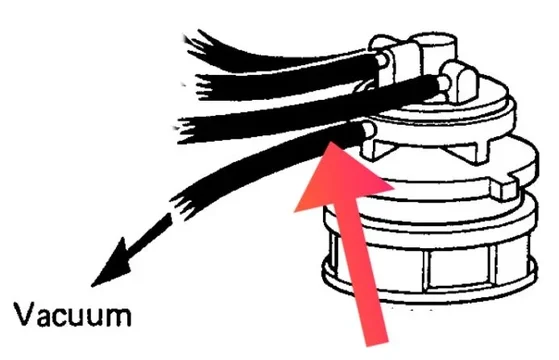
What I'm interested in (to prove my guess) is if at altitude... When a vacuum pump, (which could be a hand pump or a hose sucked on by mouth) is applied to that lower black vac hose pipe on the HAC (red arrow).... does it hold vacuum (aka no air flow) or does it still free flow.

At low elevation, when a vac is applied to that lower pipe, it free flows.

My guess, if the HAC works as I think it does, you should be able to hold vacuum at that pipe at altitude.... but I don't know.... but would like to!

Thanks!

image.webp
 
Last edited:
I'm gonna ask my wife if she's game:cool:. Na, I'll do that tonight and get back with you. I'm going to take it out and replace the filter; thanks for that part number by the way.
 
@stoshzack , if the spare spare HAC you have coming doesn't work let me know and I'll send you another one for free-fiddy-free. I'd love to help you get back on the road.
 
@Output Shaft and everybody.........I did the test output shaft asked for. I am at 6300 feet here at the house in Idaho. the bottom vac port indicated in red does in fact hold suction here at altitude. @Output Shaft we have had discussions about altitude and my disconnected EGR system in the past as I traveled back and forth across the 2600 to 3900 foot trigger altitude. What we had there proved my HAC valve was working. By the way, OS....I have since acquired a rebuilt and recurved dizzy from JimC but yet to install it.
 
@Bear Lake Cruiser
Thanks T. Your test validated my guess. I think there is some question by many as to exactly how the HAC valve and plumbing works. I know I had one. I think I've figured it out now.
 
So just as a summary:

When the engine is running, air is ALWAYS being sucked through the little removable air filter at the bottom of the HAC valve..both at low and high altitude. At low altitude, air gets sucked through the valve to the intake manifold (designed vacuum leak). At altitude, air gets sucked through the valve by the carb.
 
Next question is when it does its switch from low to high altitude and back again is it a gradual modulated switch as you pass through the 2600 to 3900 foot trigger range or does it suddenly change?
 
I believe the HAC valve uses a spring loaded poppet to seal and close passages inside the valve. So I think it's actuation is either on or off.

>>>>

High Altitude:
  1. Bellows expand and seal off port A inside valve.
  2. Vacuum increases below spring loaded poppet and pulls poppet down, port(s) B open allowing carb to suck in extra air.
  3. Vacuum on lower black pipe nipple is now sealed (port A is closed) so secondary vacuum advancer on the dissy is now actuated.
image.webp


Low Altitude:
  1. Bellows contract and open port A inside valve
  2. Vacuum releases below poppet, allowing spring to push poppet up and seal off port(s) B to carb,
  3. Vacuum now is allowed to flow through HAC valve to manifold which releases vacuum from secondary vacuum advancer on the dissy.
image.webp
 
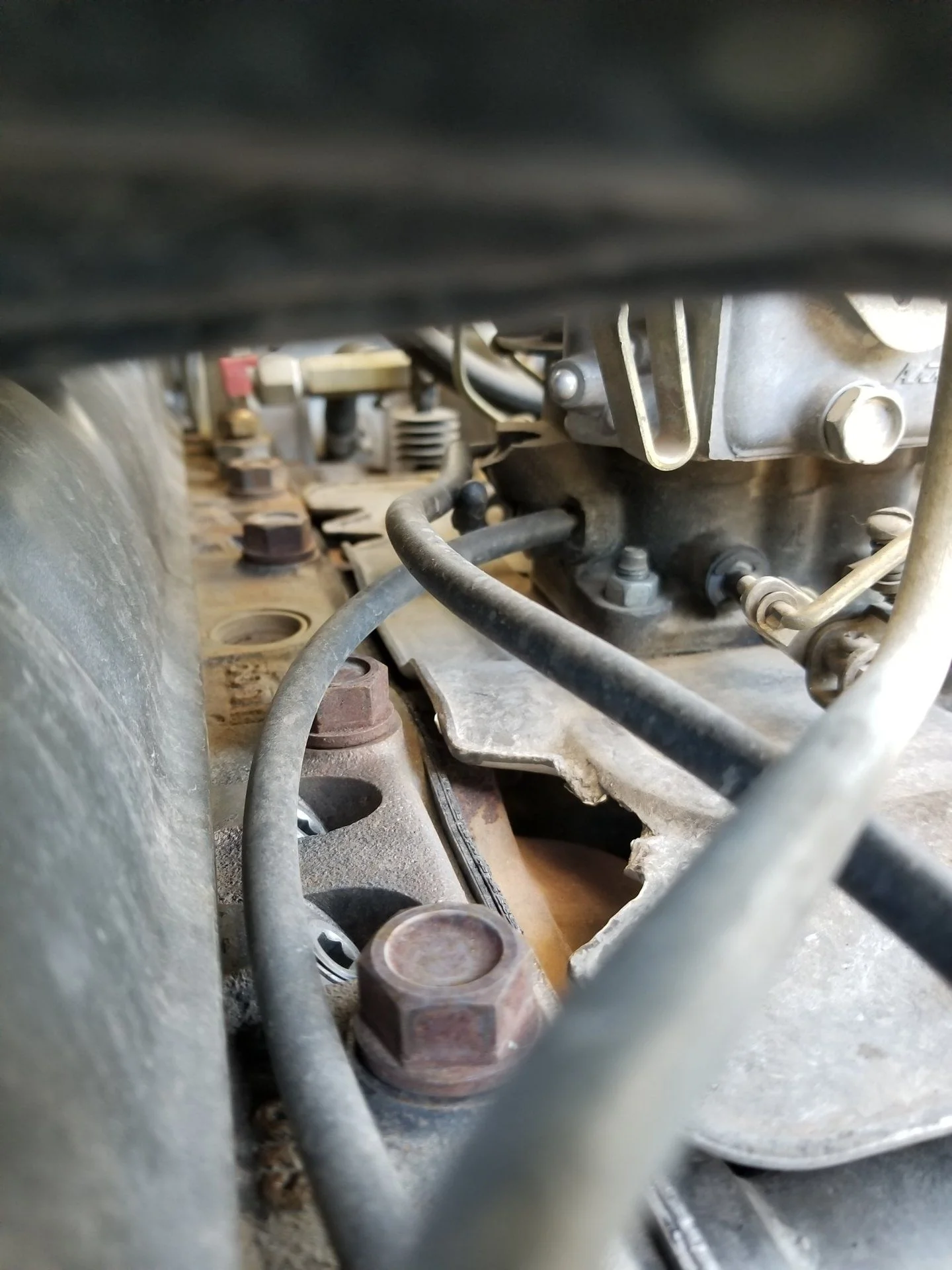
Dredging up an old thread I know, but I'v been playing around under the hood while waiting for the local dealer to get back to me on other things and started looking into vacuum stuff. Long story short I had some heavy engine work done about 9mo ago and hadn't noticed until just recently that the HAC isn't there anymore. I assume it got removed when they did the head, so I'll be trying to get that back but y'all know how that goes. Anyway, I live at 5000ft, so I definitely need that working. After looking at the diagrams above I'm not really sure what the hell the shop did. Guessing they plumed it to always be set for high altitude, but I can't tell. What I have going is both vacuum lines from vacuum advance on the dizzy run straight to the carb. The one is supposed to I know, but the other would be the HAC which is now plumed directly to the carb. Would this be functional? I apologize for the awful pictures, but I had a hell of a time getting my phone in there to take the pictures.

The hose going to the front of the carb is coming off the HAC sub diaphragm of the dizzy while that rear hose is coming off the main diaphragm.

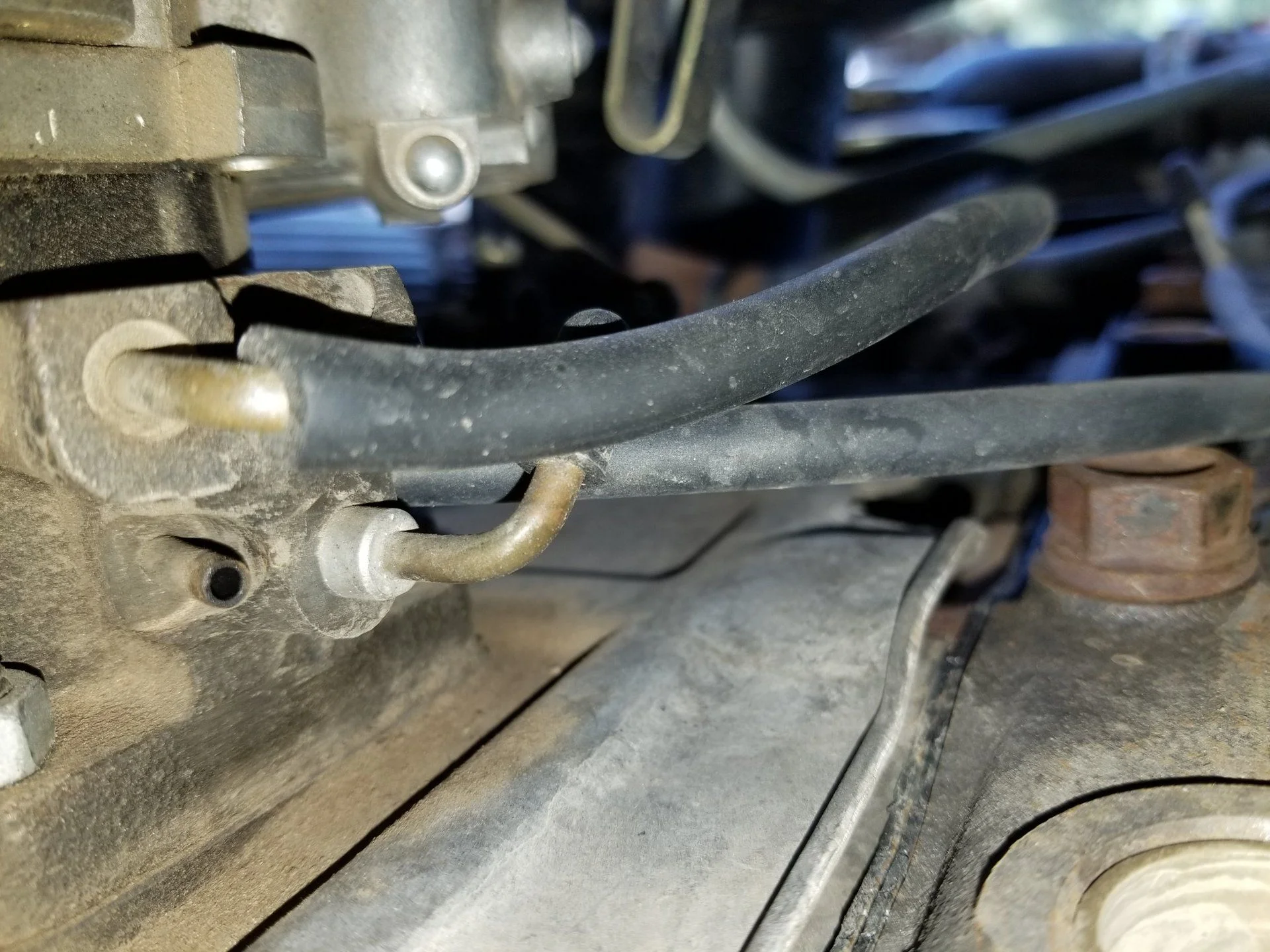
And a closeup of the engine side of the carb. In this image the line closest to the camera is off the main vacuum advance, while the one barely visible is off the HAC sub diaphragm.

The line coming off the HAC sub diaphragm also has a connector mid way where I'm guessing the check valve is supposed to have been.

I also now see that I have an open port that I need to cap, but that is easy enough. Hopefully the two unused ones there are supposed to be unused? Truck has been fully desmogged.
 
Dredging up an old thread I know, but I'v been playing around under the hood while waiting for the local dealer to get back to me on other things and started looking into vacuum stuff. Long story short I had some heavy engine work done about 9mo ago and hadn't noticed until just recently that the HAC isn't there anymore. I assume it got removed when they did the head, so I'll be trying to get that back but y'all know how that goes. Anyway, I live at 5000ft, so I definitely need that working. After looking at the diagrams above I'm not really sure what the hell the shop did. Guessing they plumed it to always be set for high altitude, but I can't tell. What I have going is both vacuum lines from vacuum advance on the dizzy run straight to the carb. The one is supposed to I know, but the other would be the HAC which is now plumed directly to the carb. Would this be functional? I apologize for the awful pictures, but I had a hell of a time getting my phone in there to take the pictures.

The hose going to the front of the carb is coming off the HAC sub diaphragm of the dizzy while that rear hose is coming off the main diaphragm.

And a closeup of the engine side of the carb. In this image the line closest to the camera is off the main vacuum advance, while the one barely visible is off the HAC sub diaphragm.

The line coming off the HAC sub diaphragm also has a connector mid way where I'm guessing the check valve is supposed to have been.

I also now see that I have an open port that I need to cap, but that is easy enough. Hopefully the two unused ones there are supposed to be unused? Truck has been fully desmogged.
Don’t quote me but I believe that open port staring at us is the primary advance that should go to your distributor vacuum advance. I could be way wrong... flip your phone to the side and you’ll find a link for the FSMs in my signature line.
 
Downloaded! And it looks like my primary advance line from the dizzy is hooked up to the fuel cut port. The HAC from the dizzy is hooked up to the EGR R port, while the HAC slow port is capped and the primary advance port is indeed the one that is wide open. I will be swapping the primary advance in the morning and studying the FSM some more to figure out what to do with the rest. Any suggestions on where to run the HAC line for the time being until I either get a replacement HAC diaphragm or make a manual one? I presume I'll figure it out from the FSM, but I also have no idea what to do with the fuel cut port.

Thanks!
Clark White
 
HAC is the lower center elbow one that points toward the fan. Just cap it for now.
Felicity

image.webp
 
Back
Top Bottom