fj62 dome light circuit parasitic draw

This site may earn a commission from merchant affiliate
links, including eBay, Amazon, Skimlinks, and others.

Just pulled the light out (Yes, it's a 62). Should I try removing the fixture? It's never worked properly for me anyway...
OK. No, I don't think (yet) removing the fixture would reveal a quick fix....

What we are confronted with is identifying the short to ground behind the Dome fuse on the Dome circuit.

In other words, with the Dome fuse installed, current is passing through the Dome fuse along a path to ground that it shouldn't.

...so, for example, a switch isn't OPENING all the way when it is switched off, allowing a small amount of current (not enough to illuminate a bulb) to continue to flow even though you have set the switch to OFF.
Or, a small break in a wire might be touching ground, allowing some current to 'escape' and go to ground...

All the door switches for the Dome lights work off the same principle. When the switch at the bulb is set to 'Door', then the path to ground is controlled by the door switches.
So when a door opens, the switch CLOSES and completes a path to ground for the current to flow from the + battery post, through the Dome fuse, through the Dome Light switch, through the CLOSED door switch and to ground.
Ground in this case is the metal body or frame...and since the neg battery post is also connected to the frame, then any circuit that 'sees' ground to the body/frame is complete and current can flow.

If a door switch is not OPENING completely when you shut the door (and the Dome Switch is set to 'Door'), then current might be able to 'leak' through that partially OPEN door switch...but in not sufficient enough quantities to illuminate the bulb(s).

A first step might be cleaning the contacts on all 5 of the Door switches.

You could also, possibly, use a multi-meter to measure for current leaking at each switch:
1. battery installed and both battery cables connected to the battery
2. Remove Dome fuse
3. Set Dome switches to 'Door'
4. Pick a door switch
5. Install ammeter (use the fused setting) in-line between ground side of door switch and ground
6. Sit in vehicle with all the doors shut (or just make sure that all the other doors are shut and the switch you are working on it held shut while you take the measurement)
7. Reinstall Dome fuse
8. Check for current reading on ammeter
9. Remove Dome fuse
10. Unistall ammeter, reinstall door switch and move on to the next door switch

If the ammeter reads a current and that current is the same value as the leak when the ammeter was installed in-line off the neg battery post/cable, then the short is between that door switch and the Dome fuse.

You want to avoid allowing the ammeter to see the full current of the closed circuit (when the bulb illuminates), because if the current passing through the circuit is greater than the capacity of the ammeter, it will blow the fuse (on the ammeter). That is why it is better to use the circuit on the ammeter that is fused. Commonly, they are rated for up to 10A. I'm not exactly sure how much current the Dome circuit draws when closed...but take a look at the rating of the Dome fuse...it should be below 30A...and that rating will be greater than the current that is flowing through the closed circuit.

HTH
 
Last edited:
quick update..borrowed another multimeter and it now looks like I have no draw on any circuit..so now I have no idea why my battery dies after truck sits for a few days...
@Slow Left thanks for all of the advice you give on this forum..:cheers:
 
Last edited:
How about if it is turned off, though? If the switch is off, can there still be a parasitic draw?
Yes, even in that case there can be a leak through the Door switches, but there must also be a leak through the Dome switch too. It is possible, just not as probable.

You can run the same set of measurements at each of the Door switches, but with the Dome switch set to 'OFF', to see if there is a leak at any one of the Door switches AND the Dome switch.

If you don't find current leaking at any one of the Door or Dome switches, then the current is leaking somewhere else behind the Dome fuse and we'll have to continue troubleshooting.
 
as per instructions in this http://www.wikihow.com/Find-a-Parasitic-Battery-Drain from post #15...Not sure how I screwed it up the first time I tried it...
OK. Hmmm.....well, one of the two attempts is giving you a false positive result.

The multimeter should be set to measure DC Ampere (~10-30 A DC) on the fused setting. Is the second multi-meter functioning properly?
The ammeter should be installed in-line between the neg battery post and neg battery cable terminal.
All the accessories/components should be turned off when reading the meter (including the doors shut if the Dome switch is set to 'Door') as you pull each fuse to check for a drop in reading.

Also, this technique outlined in that wiki will only identify a current leak from the circuits behind the main fuses. It is possible that there is a leak in front (in the engine bay)...like associated with the charging (alternator) circuit that does not run through the fuse box, so this trick/technique won't isolate/identify the source of that leak.

I would rerun the test again...maybe team up with a buddy to get another set of eyes on it since you've got conflicting results. Once you have convinced yourself one way or another, post it back up and we'll move forward from there.

Could also just be that the battery is dying. How old is the battery?
 
@EastCanFJ62 , do you have a 3F or 3FE installed in your 62?

I have a 3fe..and my battery is not old..it replaced one that was less than 3 years old...which replaced one that lasted less than 3 years.
 
I have a 3fe..and my battery is not old..it replaced one that was less than 3 years old...which replaced one that lasted less than 3 years.
Does the Discharge Warning Light behave as either of the following two conditions imply?

FJ62 3FE Charging System Troubleshooting_3FE FSM.webp
 
@EastCanFJ62 , the Charging System Circuit diagram shows that the wire that leads from the positive (+) battery post to terminal B at the alternator does not pass first through the main fuse box (or through the Ignition Switch for that matter); instead it has it's own dedicated ALT fusible link.

With the engine OFF and Key OUT of ignition, if you disconnect that wire at terminal B and install the ammeter inline between the disconnected wire lead and terminal B (see FSM instruction in second image below), if there is a current leaking backwards from the battery into a short within the charging system, then you should read a current.

When you install the ammeter like this, don't let the leads accidentally touch ground (any metal) since you are working off the positive battery terminal.


FJ62 3FE Charging System Circuit Diagram_ 3FE FSM.webp


FJ62 3FE Alternator Testing_3FE FSM.webp
 
@Slow Left


no, neither apply.

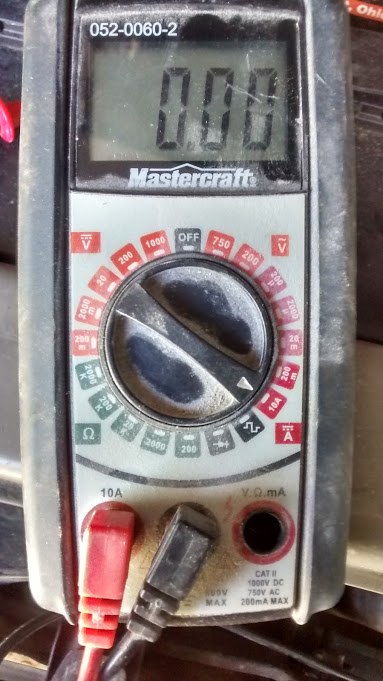
this is a pic of the meter with the settings set when I tested. when tested it read 0.01

q3_Tc8f4DiXbR6VwO-1OoOxy7u8L6SPBvnSX4oAuITC7=w383-h681-no

OK. In this picture, was the ammeter installed in-line between the neg battery post and the terminal on the neg battery cable? ...or was the ammeter installed between terminal B at the alternator and the wire that leads to terminal B (like in post #53 above)?
 
Negative post and terminal on the negative batt cable
 
Negative post and terminal on the negative batt cable
OK....then that rules out a current leak on the circuits that run through the main fuse box.

The multi-meter in the picture is correctly set to measure DC current (Ampere) and it is correctly set for the 10A fused setting.
 
This is what happened on my 60 with a parasitic draw. drove us nuts and took hours to figure it out....I'd pull the fuse(s), put them back in...test it...and no draw indicated. then...I'd turn the key to ACC or "on" then test it again. That's when the draw would re-appear. then, I'd pull the dome light fuse and re-install - meter would read "0.00". turn the key, then it would read 0.01 again. we narrowed it down to the carb cooling fan relay box. take that out of the equation and see what happens. (do the 62s have them?)
 
If a door switch is not OPENING completely when you shut the door (and the Dome Switch is set to 'Door'), then current might be able to 'leak' through that partially OPEN door switch...but in not sufficient enough quantities to illuminate the bulb(s)..

I discovered today that one of the door switches is not functioning properly. Does not illuminate dome light when opened. But, I think it may have been like that already before my problem arose. Not sure.
 
OK....then that rules out a current leak on the circuits that run through the main fuse box.

The multi-meter in the picture is correctly set to measure DC current (Ampere) and it is correctly set for the 10A fused setting.
Ok..thats good to know..
 
Good idea. Yes, the carb cooling fan " computer" is wired through the dome fuse as well ( iirc) on the 60. And yes, the 62 has one as well. SUSPECT.
 
Back
Top Bottom