



When you say you have a rebuilt fuel pump--what does that mean? Did you replace in kind? Does the pump have two or three ports? There may be issues with the pump overpowering the float valve, causing the high fuel level in the carb(this may be due to a bad float valve)Hello,
I have a 1975 with 2F stock and Asian crab.
I have been working on this forever now. I have read a lot on this site with trying to find the source.
The problem starting happening when I would accelerate the car would sputter and not get any power. Sometime it would go away and other times it would never accelerate. It would also backfire on occasion and when I would turn the car off it would rev up and then finally die when the keys were out.
I have replaced, plugs, checked the compression on the engine (all good), replaced fuel filter, rebuilt fuel pump, replaced intake manifold, rebuilt the carb, replaced some vacuum lines, replaced starter with Denso from mid 80'c cruiser, and has a new battery as well.
I followed, I believe it was Treeroot's write up, and when I cover the carb with cardboard it will shut off and does so with out reving up. However I still think I have a vacuum leak because when I try to tune the carb and adjust the idle mix screw it does nothing. On top of this it seem every time I try to start my engine, after a few days sitting, I have to play with the idle speed and idle mixture screw to get it to turn over.
When I put a vacuum gauge on the engine (brake booster to carb) I get different readings depending on the day. I'm in Chicago so if it was new and perfect I think it should sit around 18. Now it will be between 15 - 17 depending on the day. Steady at that reading during that time. I will not jump around.
This weekend when I was trying to tune the crab with the vacuum gauge and tachometer it was reading 15 steady but the idel mixture screw had no effect on the RPM's. Never seems to speed up or slow down the engine when I turn it. The idle speed screw will effect the engine.
When the carb gets to much gas, because I'm pumping the pedal to get it to turn over, I noticed a bit of gas coming out of the primary throttle at the c-clip on the front side of the carb. The primary throttle plate is on a bar and that bar runs through the base of the crab and is held in place with a C-clip. I assume it leaked becuase the carb was flooded from me punching the gas pedal to turn the car over. Is that normal? Should the carb leak like that? If fluid can get out can air get it or is that a one way passage and normal?
Navigation
Install the app
How to install the app on iOS
Follow along with the video below to see how to install our site as a web app on your home screen.
Note: This feature may not be available in some browsers.
More options
Style variation
You are using an out of date browser. It may not display this or other websites correctly.
You should upgrade or use an alternative browser.
You should upgrade or use an alternative browser.
Dam vacuum leak...
- Thread starter csd1982
- Start date
This site may earn a commission from merchant affiliate
links, including eBay, Amazon, Skimlinks, and others.

- Thread starter
- #22
So my dilemma is do I have a gasket leak on the intake manifold or exhaust header? When I spray carb cleaner around the last intake and exhaust area, closest to the cab, the engine will bog down. Which also makes me wonder why it bogs down because I thought, from reading, the engine should speed up.
Not sure what to replace or get machined. The header seems old as is all rusted but no holes. If I get the intake header machined flat and there still is a leak I guess I will know the header is bad…… thoughts?
Or do I need to take in the header and intake manifold together to get machine so they are the same thickness and flat?

yes take them both to a machinist. they need to be the same thickness.
- Thread starter
- #24
Finally got sometime to get back to this dam leak. Before I decided to take my exhausts header in I figured I would clean it up and look for cracks. And what did I find....several cracks. One crack right were I would spray carb clean which causes the engine to bog down. As well as where all the pipes go into one pipe there are many cracks. I assume these cracks could be the issue especially the one where the exhaust connects to the engine block. I'm going to buy a new header and see if this fixes it. Probably get the new one machined down as well to make sure it matches the intake thicknessyes take them both to a machinist. they need to be the same thickness.
my advice is to get a nice stock used exhaust manifold. it will last longer than a new set of headers. get it cleaned up, painted, machinced with the existing intake and it will far out last the header and cost half as much. i really doubt you will miss the header. i can guarantee you wont have vac leak issues after what i proposed. not to mention a no fuss install for any level or wrencher. i lusted after headers too when i first got my 40 but between cost and reading plenty of posts where seasoned pros argued for the stock manifold, i overhauled my manifolds and now i have 22" of vac without trying.
I just go a set of headers from JT Outfitters--been machined flat and are within 1 mm of the intake thickness at the bolt/stud connections. Cleaned, blasted/heated and painted with Thermalox. They are going on the truck on Mon.---Now I'm not so sure---I think I'll keep the exhaust mani for when the headers fail
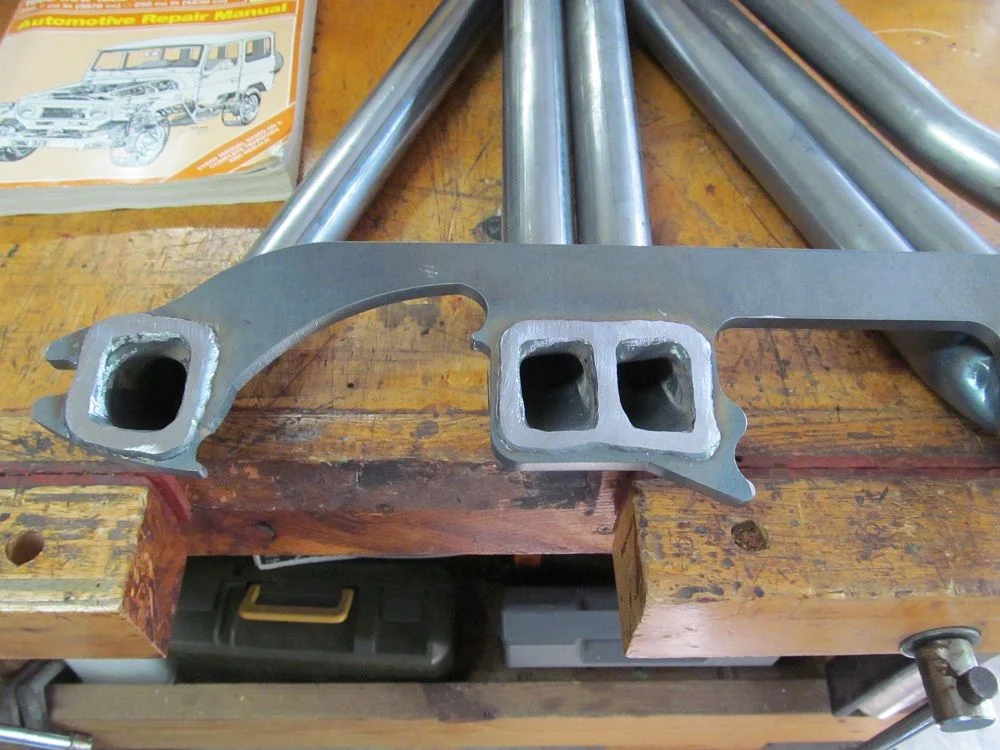

goat-use a remflex with those puppies. are you shimming with half washers to make up the 1mm difference?


- Thread starter
- #29
So I decided to get a new header instead of a stock manifold. I know it was not recommended. Called Mark's Offroad and got one. Had it blasted and ceramic coated. Finally was able to install it yesterday. Now with everything hooked back up the engine turns over much better and every time. I have a vacuum reading of steady 17 at 650 RPM. I still think I don't have the carb tuned correctly. When I spray carb cleaner around the header, intake and block or the base of the carb I hear no change in the engine so I think I have fixed the leak.....
Where the header connects to the exhaust pipe I have a big exhaust leak now becuase the exhaust is old and jacked up. I plan to work on that next. However there is something that I still don't understand. When I am under acceleration the engine will sometimes sputter a bit and have weak acceleration until I get to the end of that gear rang then it will even off. What might cause this, timing?
Where the header connects to the exhaust pipe I have a big exhaust leak now becuase the exhaust is old and jacked up. I plan to work on that next. However there is something that I still don't understand. When I am under acceleration the engine will sometimes sputter a bit and have weak acceleration until I get to the end of that gear rang then it will even off. What might cause this, timing?
timing and carb tuning should solve that hesitation. i had that in the middle of my timing/tuning phase in the spring. i was also dealing with exhaust leaks as well then too, so your known exhaust leak could be contributing to that as well. how confident are you in the spec of the valve lash? remind us what distributor and carb you are running. its been awhile.


I had good luck with the Remflex gasket I replaced two OEM gaskets on my CA thermonuclear reactor manifold within 5 years and the Remflex was still sealing strong when I sold it 10 years later. I torqued mine to the normal torque value for the OEM rather than what remflex recommended. Some people don't like them, but you can't argue with success.
- Thread starter
- #32
i have the remflex gasket as well. i like themI had good luck with the Remflex gasket I replaced two OEM gaskets on my CA thermonuclear reactor manifold within 5 years and the Remflex was still sealing strong when I sold it 10 years later. I torqued mine to the normal torque value for the OEM rather than what remflex recommended. Some people don't like them, but you can't argue with success.
- Thread starter
- #33
timing and carb tuning should solve that hesitation. i had that in the middle of my timing/tuning phase in the spring. i was also dealing with exhaust leaks as well then too, so your known exhaust leak could be contributing to that as well. how confident are you in the spec of the valve lash? remind us what distributor and carb you are running. its been awhile.
This is how confident I am with "spec of the valve lash", what are you asking, ha? I really no nothing I just enjoy reading and learning about working on cars. This is 1/2 the reason I bought my FJ. I think I might take it in to have the timing looked at. Is fooling with timing a hard thing to do in your opinion?
I have the stock carb that I rebuilt and the stock distributor with a vacuum advance.
before my 40 and this forum i also had no idea what valve lash was. zero idea. its the gap between the top of the valve and rocker arm at its widest point, usually at TDC for that cylinder.
timing is extremely easy to adjust yourself. i knew nothing before hand, so i bought a timing gun that is digital and has a built in tach, which helped immensely with tuning the carb. you hook up the timing gun, loosen the dizzy clamp bolt and twist. thats the simple version, but its not far from that. if you bought your 40 to learn, like i did, dont take it to any one until you are totally stuck. and then dont. post up here on mud. someone will help you out.
timing is extremely easy to adjust yourself. i knew nothing before hand, so i bought a timing gun that is digital and has a built in tach, which helped immensely with tuning the carb. you hook up the timing gun, loosen the dizzy clamp bolt and twist. thats the simple version, but its not far from that. if you bought your 40 to learn, like i did, dont take it to any one until you are totally stuck. and then dont. post up here on mud. someone will help you out.

- Joined
- Sep 26, 2003
- Threads
- 117
- Messages
- 11,199
- Location
- Lancaster, Ohio, USA
- Website
- www.tlcperformance.com
Not timing. If the timing is way advanced, the engine will rattle and backfire out the carb. Too retarded and it will be a dog everywhere.So I decided to get a new header instead of a stock manifold. I know it was not recommended. Called Mark's Offroad and got one. Had it blasted and ceramic coated. Finally was able to install it yesterday. Now with everything hooked back up the engine turns over much better and every time. I have a vacuum reading of steady 17 at 650 RPM. I still think I don't have the carb tuned correctly. When I spray carb cleaner around the header, intake and block or the base of the carb I hear no change in the engine so I think I have fixed the leak.....
However there is something that I still don't understand. When I am under acceleration the engine will sometimes sputter a bit and have weak acceleration until I get to the end of that gear rang then it will even off. What might cause this, timing?
The carb has been rebuilt, yes? Using all the new parts that came in the kit? Replaced all the jets?
Then it is too lean. It needs a bigger than USA stock primary slow and primary main jets.
- Thread starter
- #37
Not timing. If the timing is way advanced, the engine will rattle and backfire out the carb. Too retarded and it will be a dog everywhere.
The carb has been rebuilt, yes? Using all the new parts that came in the kit? Replaced all the jets?
Then it is too lean. It needs a bigger than USA stock primary slow and primary main jets.
The stock asia carb was rebuilt but I did not replace the jets becuase I did not have them in my Asian kit. If you recommend a place I can buy the jets at i will order them and try that. I also plan on testing if my vacuum advance has a small leak in it. I read this could cause the engine to run too lean. All the other spots where air could get in seem sealed when i spray carb cleaner in there. Its a 1975 Asian carb for the 2F.
- Thread starter
- #38
Cool I will stick at it.before my 40 and this forum i also had no idea what valve lash was. zero idea. its the gap between the top of the valve and rocker arm at its widest point, usually at TDC for that cylinder.
timing is extremely easy to adjust yourself. i knew nothing before hand, so i bought a timing gun that is digital and has a built in tach, which helped immensely with tuning the carb. you hook up the timing gun, loosen the dizzy clamp bolt and twist. thats the simple version, but its not far from that. if you bought your 40 to learn, like i did, dont take it to any one until you are totally stuck. and then dont. post up here on mud. someone will help you out.
Thanks for all the support with this issue. I keep trying to resolve it.
- Joined
- Sep 26, 2003
- Threads
- 117
- Messages
- 11,199
- Location
- Lancaster, Ohio, USA
- Website
- www.tlcperformance.com
The stock US-spec '75-78 Aisan carb was jetted too lean to run good when new. Factor in today's "gasoline" with oxygenate additives and they are waaay too lean. Dunno about new jets, but drillbits in the 1.45-1.50.1.55 range are readily available. Just sayin...
- Thread starter
- #40
Cool, I found some jets online so Ill order those and try your suggestion to drill some out. Any further suggestions on what size to actually use?The stock US-spec '75-78 Aisan carb was jetted too lean to run good when newou . Factor in today's "gasoline" with oxygenate additives and they are waaay too lean. Dunno about new jets, but drillbits in the 1.45-1.50.1.55 range are readily available. Just sayin...
Also the my carb insulator between body and the base(flange) has a thick outlet on it that the previous owner has capped off using a hose and but with clamps and inside some electrical tape or something. What is this actually for and any suggest on a better way to seal it?