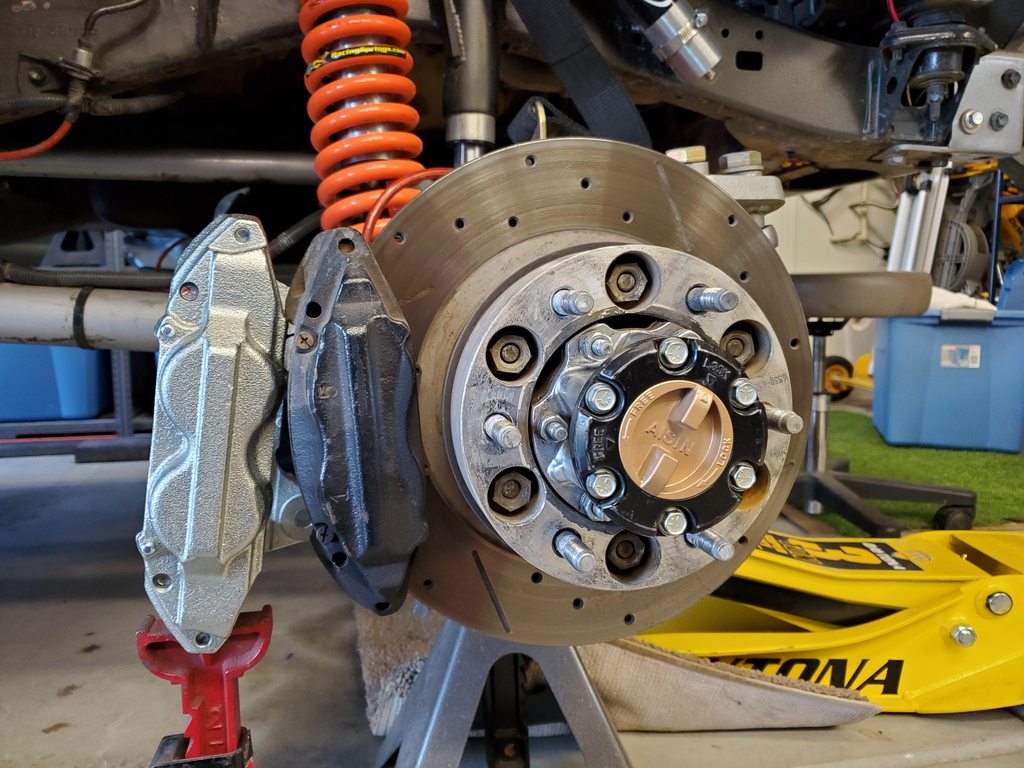
Big Brake kit upgrade discussion.

This site may earn a commission from merchant affiliate
links, including eBay, Amazon, Skimlinks, and others.

Joined
Nov 10, 2006
Threads
113
Messages
940
Location
Bonsall, CA
We all know the brakes in the 80 series were designed with the 15in wheel in mind and hardly updated till 1997. Tiny-ass rotors, not too big calipers. The braking distance from 30mpg to zero over 300ft was maybe decent 40 years ago, but not now.


Some disclaimers:
1. Yes, I've read numerous threads over here
2. Yes, I've read the thread where a guy makes some custom mounting plates which accept Wilwood rotors, made some Wilwood caliper adapters and it looks nice but my guess is the price will be over $1000 and the pads/rotos might be not as easy and cheap to replace in the future.
3. Yes, I've seen all those big brake kits offered for the 80 series online but they are close and over $2000 so I can't justify buying brakes which cost 1/3 the price of the truck or as much as a decent Nissan Pathfinder or LS400.

I am wondering if anybody has been thinking what I am thinking.

- remove the OEM rotors
- buy 2024 tundra rotors
- increase the center bore from 97mm to 105mm for 50 bucks in any shop with a lathe.
- the center bore will let you put the tundra rotos on top of the flange (not underneath as per factory)
- that will move the rotors towards the outside but the tundra rotors are deeper to compensate for that
- I haven't measured the thickness of the rotor mounting flange but if it is between 18-23mm, we should be able to make it work
- longer wheel studs for around $30
- then, instead of buying Wilwood calipers, one can buy OEM Porsche Brembo 6 piston calipers which are around $250

The only hard (maybe expensive) thing would be machining the adapter for the caliper holes but that's still within $200 a pair. Designing is free and then it's a question of sending the files to a CNC shop. Overall that would place the costs like that: $200 tundra rotors, 250 calipers, $50 center bore machining, $30 studs, $200 adapter machining. Around $700.

Why am I the only one thinking like that? Am I very wrong?

Attached files are the 80 series rotor diagram, the 354mm tundra rotor diagram, the rotor vs flange scenario.

80 series rotors.webp


09.5914.10.webp


eurorotor-to6210-1500x1500-Ue9cOg.webp
 
Sounds like a solid plan. Someone needs to make an off-the-shelf kit, ready to ship.

Sounds better priced than the $4000 kits I’ve heard discussed on here before. I can’t justify a $4k brake kit, no way.
 

Similar thought to the 5th Gen upgrade.

Also these, no idea on the function, but reasonable price.
 
Why am I the only one thinking like that? Am I very wrong?

There's no new ideas under the sun.

Late model 4Runner rotors and calipers have been used in a similar way.

I was keen to do the 4Runner conversion, then realised the biggest expense in doing this is the 18" wheel and tire upgrade needed to clear all the shiny new "cheap OEM big brake kit".
 
Consider Powerstop. They won't break the bank like some of those others that are $2k to $4k. Just had them installed on my 80. Very happy with them so far.

 
1. Thanks for the link to the 4Runner conversion. Looks like a super easy thing to do. I will contemplate doing it if there's not enough time, money, will power. However I prefer to either do nothing or go 'all in' so my idea was to go no smaller than 350mm rotor diameter. A small increase in diameter makes for a lot of leverage so the difference is really worth it. I daily drive a Porsche Cayenne which weighs about as much as a stock FZ80 (yes it does), has around 350mm rotors, 6 piston calipers and stops like crazy. That leads me to the second point and second link...

2. The Ceika brake upgrades are almost nice. Almost, because once you click that you want a 350mm rotor, 6 pistons, you get to almost $2K. And if something happens and you need a new set of pads, a caliper or rotor, you won't get it at autozone or Amazon. Contrary to Tundra, 4Runner or Porsche/Touareg/Q7 parts

3. The Powerstop rotor/pad setup is cheap at a little over $200 but I consider it a band aid solution. There is no way to defy physics. You need leverage (diameter) and pad surface. Both of these are small in the 80 series, even if you use top secret nasa materials.
 
Oh and I do want to go 18in. I used to drive on 33in tires, the 285/75/16, but going to 18in rims, I can have the same width, the same sidewall height but eventually the size will be 35in. I am talking about going 285/75/18. So I get benefits and no downsides...

- bigger rotors, calipers
- bigger rims are lighter than bigger tires
- 35in tires that drive on-road closer to 33in tires due to the smaller sidewall.
- overall less unsprung and rotational mass

There is no doubt most overlanders drive 90% on road and only 10% off-road so I will really make it somehow with a 33in sidewall and still have rotational and clearance benefits of a 35in tire.

1745297407506.webp
 
Oh and I do want to go 18in. I used to drive on 33in tires, the 285/75/16, but going to 18in rims, I can have the same width, the same sidewall height but eventually the size will be 35in. I am talking about going 285/75/18. So I get benefits and no downsides...

- bigger rotors, calipers
- bigger rims are lighter than bigger tires
- 35in tires that drive on-road closer to 33in tires due to the smaller sidewall.
- overall less unsprung and rotational mass

There is no doubt most overlanders drive 90% on road and only 10% off-road so I will really make it somehow with a 33in sidewall and still have rotational and clearance benefits of a 35in tire.

View attachment 3889942
Following this thread, and I did go with 285/75/18 for future bigger brakes possibilities.

This size also happens to be the stock size for the Ford Super Duty Tremor.
 
I think almost everyone is approaching this issue incorrectly. First upgrade the booster and make sure the lspv is new. Several booster paths are available. There are vacuum boosters that apply more pressure available. Something around 30% or so. Then you have the hydroboost route which increases the pressure the most. Hydroboost is for when you want to quit messing around and get serious. It leaves vacuum boosters in the dust. My brakes are epic with hydroboost. And I have stock calipers and pads. That said, if all your brake components are original 30 year old components that have never been replaced, you can't expect any sort of adequate brake quality.
 
I second the Powerstop recommendation. They will lock the tires up and their rotors last forever. I'm past 120K miles on my Powerstop slotted rotors. Maybe 2nd set of pads in that time. I tow and drive in the mountains a lot - I've literally smoked the pads and they were fine after cooling. Follow their bedding process carefully for the best braking (should be smoking when you're done bedding in the brakes).
I've gone Powerstop on all my vehicles as I do brake jobs and I'm VERY happy with them.
 
We all know the brakes in the 80 series were designed with the 15in wheel in mind and hardly updated till 1997. Tiny-ass rotors, not too big calipers. The braking distance from 30mpg to zero over 300ft was maybe decent 40 years ago, but not now.


Some disclaimers:
1. Yes, I've read numerous threads over here
2. Yes, I've read the thread where a guy makes some custom mounting plates which accept Wilwood rotors, made some Wilwood caliper adapters and it looks nice but my guess is the price will be over $1000 and the pads/rotos might be not as easy and cheap to replace in the future.
3. Yes, I've seen all those big brake kits offered for the 80 series online but they are close and over $2000 so I can't justify buying brakes which cost 1/3 the price of the truck or as much as a decent Nissan Pathfinder or LS400.

I am wondering if anybody has been thinking what I am thinking.

- remove the OEM rotors
- buy 2024 tundra rotors
- increase the center bore from 97mm to 105mm for 50 bucks in any shop with a lathe.
- the center bore will let you put the tundra rotos on top of the flange (not underneath as per factory)
- that will move the rotors towards the outside but the tundra rotors are deeper to compensate for that
- I haven't measured the thickness of the rotor mounting flange but if it is between 18-23mm, we should be able to make it work
- longer wheel studs for around $30
- then, instead of buying Wilwood calipers, one can buy OEM Porsche Brembo 6 piston calipers which are around $250

The only hard (maybe expensive) thing would be machining the adapter for the caliper holes but that's still within $200 a pair. Designing is free and then it's a question of sending the files to a CNC shop. Overall that would place the costs like that: $200 tundra rotors, 250 calipers, $50 center bore machining, $30 studs, $200 adapter machining. Around $700.

Why am I the only one thinking like that? Am I very wrong?

Attached files are the 80 series rotor diagram, the 354mm tundra rotor diagram, the rotor vs flange scenario.

View attachment 3888839

View attachment 3888840

View attachment 3888841
My brakes don't warp or overheat so my problem was getting enough line pressure from the vacuum assist. Swapped over to Hydro Boost and the thing stops on a dime. I'm running 37's without any issues and I live in the rockies.
 
I think almost everyone is approaching this issue incorrectly. First upgrade the booster and make sure the lspv is new. Several booster paths are available. There are vacuum boosters that apply more pressure available. Something around 30% or so. Then you have the hydroboost route which increases the pressure the most. Hydroboost is for when you want to quit messing around and get serious. It leaves vacuum boosters in the dust. My brakes are epic with hydroboost. And I have stock calipers and pads. That said, if all your brake components are original 30 year old components that have never been replaced, you can't expect any sort of adequate brake quality.
I think you're on the right track. I've had a couple of full scale panic stops with my 80 since I got it and... look, I'm a big 'ol moose of a dude, so when I say I did a panic stop, I'm talking about a 250lb guy. I'm not in phenomenal shape, but I do occasionally work out and I don't skip my legs, and I also spend a lot of time on my feet. I can apply some FORCE, and guess what? This fairly heavy rig with 35" rubber stops in short order when I do. The brakes don't feel as responsive as some folks prefer, but clearly the stopping power is available in the pads and rotors IF they receive enough hydraulic pressure.

Just my 2 cents.
 
I looked into this for my GX a couple years ago. The Tundra rotor has a thickness of 32mm and a min thickness of 29mm. The Brembo vehicles i looked at had rotors specs of 34mm and min thickness 32mm. I stopped there. I do have some used Tundra rotors if you're up near OC and you want to give it a shot.
 
Been developing a big brake system for the 80 series for the past 4+ years, mostly as a side project until recently focusing on it full time.

Lengthy thread here: Bespoke Front and Rear Big Brake Kit(Bigger than big) with Electronic Parking Brake - https://forum.ih8mud.com/threads/bespoke-front-and-rear-big-brake-kit-bigger-than-big-with-electronic-parking-brake.1290784/

14"x1.25" 2pc rotor front
14.25"x1.1" 1 pc rotor rear
Wilwood calipers front and rear
Wilwood Electronic Parking Brake

Over 40% improvement in brake rotor torque over factory, and more importantly over anything else, correct brake bias.
brakepowerandbias-webp.4030773


psx_20220805_205330-webp.3080443

psx_20220805_195257-webp.3080449


Early revision front rotor:
pxl_20211214_205906066-webp.3080894


Mockup of rear:
pxl_20251112_181949733-mp-webp.4029864

pxl_20251113_173438417-webp.4029867


Should be receiving CNC'd rear component samples in the next two weeks, hopefully have some time over the holiday break to work on installing the rear and move on to product testing.
 
We all know the brakes in the 80 series were designed with the 15in wheel in mind and hardly updated till 1997. Tiny-ass rotors, not too big calipers. The braking distance from 30mpg to zero over 300ft was maybe decent 40 years ago, but not now.


Some disclaimers:
1. Yes, I've read numerous threads over here
2. Yes, I've read the thread where a guy makes some custom mounting plates which accept Wilwood rotors, made some Wilwood caliper adapters and it looks nice but my guess is the price will be over $1000 and the pads/rotos might be not as easy and cheap to replace in the future.
3. Yes, I've seen all those big brake kits offered for the 80 series online but they are close and over $2000 so I can't justify buying brakes which cost 1/3 the price of the truck or as much as a decent Nissan Pathfinder or LS400.

I am wondering if anybody has been thinking what I am thinking.

- remove the OEM rotors
- buy 2024 tundra rotors
- increase the center bore from 97mm to 105mm for 50 bucks in any shop with a lathe.
- the center bore will let you put the tundra rotos on top of the flange (not underneath as per factory)
- that will move the rotors towards the outside but the tundra rotors are deeper to compensate for that
- I haven't measured the thickness of the rotor mounting flange but if it is between 18-23mm, we should be able to make it work
- longer wheel studs for around $30
- then, instead of buying Wilwood calipers, one can buy OEM Porsche Brembo 6 piston calipers which are around $250

The only hard (maybe expensive) thing would be machining the adapter for the caliper holes but that's still within $200 a pair. Designing is free and then it's a question of sending the files to a CNC shop. Overall that would place the costs like that: $200 tundra rotors, 250 calipers, $50 center bore machining, $30 studs, $200 adapter machining. Around $700.

Why am I the only one thinking like that? Am I very wrong?

Attached files are the 80 series rotor diagram, the 354mm tundra rotor diagram, the rotor vs flange scenario.

View attachment 3888839

View attachment 3888840

View attachment 3888841

I like the idea, but consider expanding your scope on rotors and calipers.

Jeep TJ guys still swap to Ford Explorer Sport-Trac rotors and simply re-drill the rotor hat to match the lug pattern.

So might need to look outside of Toyota to find an ideal fit.
 
Back
Top Bottom