AC Compressor doesn't engage

This site may earn a commission from merchant affiliate
links, including eBay, Amazon, Skimlinks, and others.

Speaking of life and being busy, sorry I didn't follow up. A quick test to perform before you go any further is to carefully depress the schrader valve on the high side and then on the low side. If you get a solid amount of pressure then you're good; otherwise if its a poof of air and done, you will need to vacuum the system down to inspect for leaks. If you get no air or a tiny burst and its done, then you will need to replace the accumulator/drier. I am doing the same thing to my cruiser right now, so I feel your pain. It is better to vacuum the system down attached to a manifold and use the gauges to check for a leak, because you can also connect a can tap to the vacuum line to charge the system. Either way, you shouldn't need to jump the compressor to get refrigerant in the system. If the can is properly attached it should provide enough pressure to override the switch and cycle refrigerant into the system.
 
A couple things might be going on. Sometimes the cheaper connections to the service port don't depress the schrader core enough to allow the refrigerant to flow. It also can take 5-10 minutes for the can to empty. A set of gauges will probably work better. Also try setting your idle speed up to about 12-1500 rpm.

Appreciate that - was paranoid about running it too long not knowing if anything was getting past the port. I peeked at the port itself and the valve looks clean and OK from the outside, but when trying to fill I didn't feel any "flow" and was also getting leakage from the cheap hose connection. I'll get my friend's gauges before the weekend.

I noticed when I was inspecting the port that the back side of the compressor is labeled "91 land cr" in white paint pen. Doesn't seem like a mark they'd put on at the factory, and I'm wondering if maybe the AC compressor is a used replacement. Anyway, I was already thinking it'd be a good idea to put in some UV dye, and if the PPO (previous previous owner - whose sketchy work I keep discovering) worked on the AC it's a must.
 
Basically all 80's use the same compressor, the only difference was in the early R12 systems, the compressor came with ND6 (mineral) oil. The later R134a compressors came with ND8 (PAG46) oil. Assuming the PPO drained the oil from the used one and put in the PAG46, you should be ok.
 
  • Like
Reactions: 93z
Some good progress this past Friday.

With my friend's non-disposable hose, we were able to get the refrigerant flowing and, as predicted by a couple of you guys, the compressor engaged without having to be jumped. We added the whole can (which included some leak-finder dye) and I'll have to keep an eye on it. The system works, but only blows cool, not really cold. We were measuring 24lbs while it was running (about 85°F ambient temp). Our guess is that since the system was at approx no pressure before we started, there's air in the there. I'm going to run it for a bit and check for leaks while I see if I can find access to a vacuum pump.

I did see what looked like some tiny bubbling from a fitting with a hole in it at the top of the dryer. Not sure what this is, and if the bubbling indicates a leak or is normal. Doesn't seem to flow 0 just bubble.
 
That's the sight glass.

Assuming no air contamination, Foaming = low freon, clear or just a few bubles = good to go.

I think I actually may have some air contamination. But I also better post a couple of pics. Because, yes, I'm getting foaming in the sight glass, but I'm also seeing some external bubbling from teh hole in the fitting just to the left of the sight glass. Anyway, lemme go get some pics.
 
This is it - the top arrow point to the fitting. I couldn't get a good angle on the hole in the middle of that hex-shaped plug thing. I can see what looks like a bubble every second or two - just a flick of movement. Nothing dripping, but something's going on.

0602141738a.jpg


Meanwhile, I'm definitely got some foaming going on. Sorry about the distorted sound on this video...

 
That's one leak.

So what is that bit? Couldn't find anything about it in the FSR, like if it can be tightened, if there's a seal under it, or why there's a hole in the cap. Doesn't seem like that's part of the dryer. I mean, if I pick up a new dryer, it seems like that part doesn't come with it but that the new dryer bolts up underneath it.
 
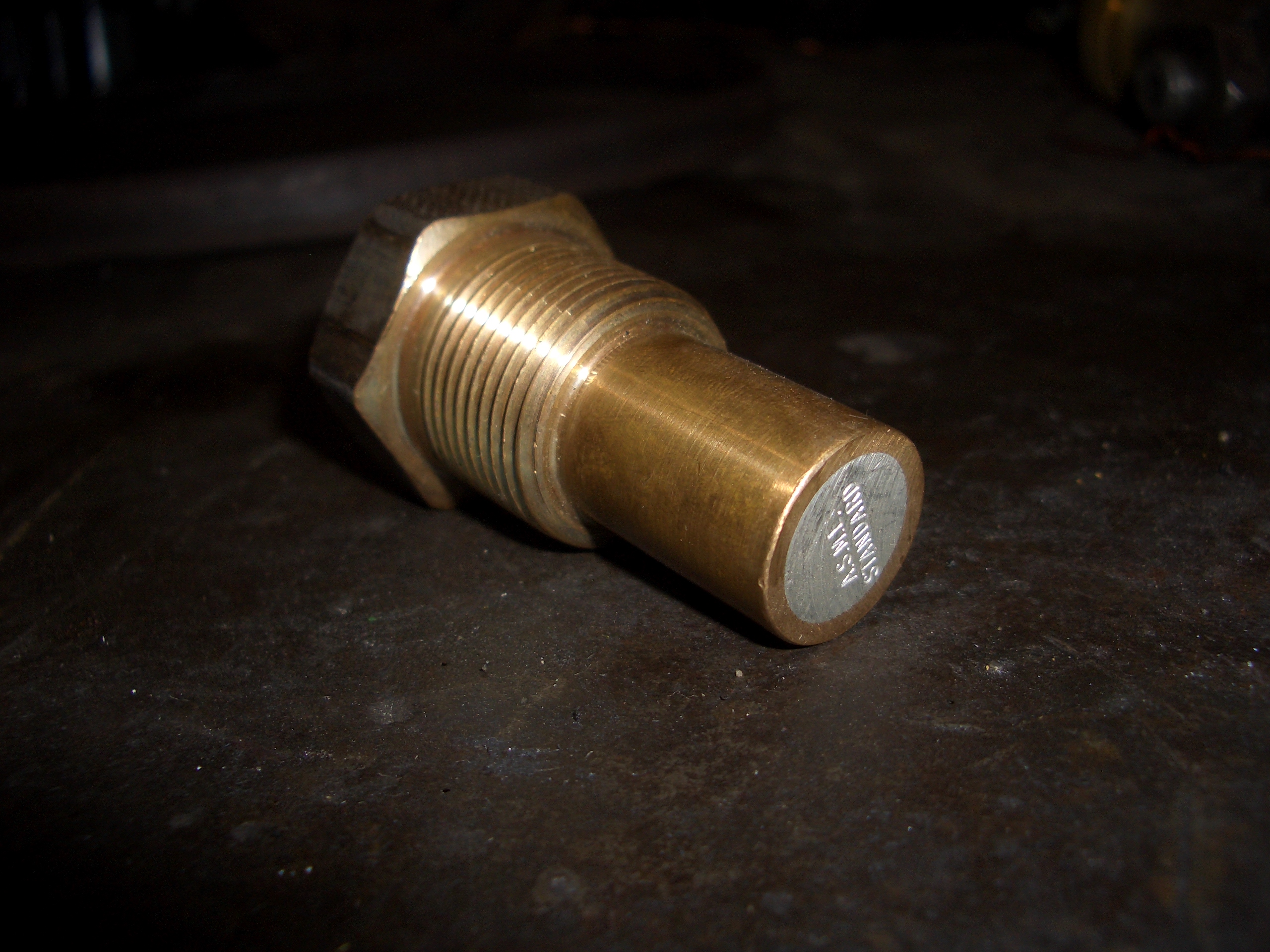
That is a "fuse plug". That small hole is filled with a metal that is designed to melt and let the refrigerant escape should the pressure/temperature become to high. Rarely used now since there are more sophisticated ways of controlling the system, not to mention there are pressure release valves that open enough to let out the excess pressure and then close so all the refrigerant doesn't escape. The fuse plug is replaceable, the hard part is finding a new one. I can get you some 4seasons part numbers in the morning. It looks like you're still low on refrigerant, but I'd fix the fuse plug then vacuum it down and recharge.
 
I don't know what size yours is, but here are numbers for three sizes available in 4Seasons: #35876 1/16x27 NPT, #35870 1/8x27 NPT, #35877 3/8x24 o-ring thread. It's possible that Toyota used a metric thread in which case replacement may prove difficult and you may want to consider welding the hole shut.
 
I don't know what size yours is, but here are numbers for three sizes available in 4Seasons: #35876 1/16x27 NPT, #35870 1/8x27 NPT, #35877 3/8x24 o-ring thread. It's possible that Toyota used a metric thread in which case replacement may prove difficult and you may want to consider welding the hole shut.

Ah ha! Like this one from Wikipedia?

Fusible_plug%2C_view_3.jpg


So, I'm guessing I'll need to evac the system before I try to unthread it to try to determine what the thread is. And if it's the metric version, can I also thread in a short M8 x 1.25 bolt? I mainly ask because I have a hardware store, but no welder. Probably have to match a sealing surface somewhere's, but just asking.
 
So, I'm guessing I'll need to evac the system before I try to unthread it to try to determine what the thread is. And if it's the metric version, can I also thread in a short M8 x 1.25 bolt? I mainly ask because I have a hardware store, but no welder. Probably have to match a sealing surface somewhere's, but just asking.

Yep, evac first. No reason you can't use a bolt with the correct thread and length, I'd use some thread sealer like Permatex #54540 on it.
 
Hey mate, if you vac the system out (I did it for about an hour). When I equalized the system pressure with the bottle pressure that was enough to make low pressure safety and allowed compressor to run. Then while running water over the condenser coil(to keep head pressure down) used the comp to suck in the last couple of hundred grams.
Hope this helps mate, only new to this site..
 
Shop charged me $75 to fill mine. They pull under vaccum which boils off moisture in system and removes air, then they fill into the vaccum. Right way to do this, plus they fill to correct weight as overcharge and undercharge are equally detrimental. Mine works great, but it hasn't really been hot yet in Northern OH.
 
Yep, evac first. No reason you can't use a bolt with the correct thread and length, I'd use some thread sealer like Permatex #54540 on it.

Just want to clarify, it's OK to weld/use-a-bolt-instead-of the fuse plug because there are other safety/relief mechanisms built in to the system?
 
Hey mate, if you vac the system out (I did it for about an hour). When I equalized the system pressure with the bottle pressure that was enough to make low pressure safety and allowed compressor to run. Then while running water over the condenser coil(to keep head pressure down) used the comp to suck in the last couple of hundred grams.
Hope this helps mate, only new to this site..

Welcome! Pretty new myself. :) I've got some manifold gauges and access to a vacuum pump, so I think I'm on my way. Need to replace the plug, check for other leaks, then I should be ready to vacuum down and recharge.
 
Shop charged me $75 to fill mine. They pull under vaccum which boils off moisture in system and removes air, then they fill into the vaccum. Right way to do this, plus they fill to correct weight as overcharge and undercharge are equally detrimental. Mine works great, but it hasn't really been hot yet in Northern OH.

Fingers crossed for me, as it's already hot here in Alabama. :hillbilly:

I think I've got the gear now to do this right - vacuum pump & manifold - so I'll save money assuming I've found all the leaks and don't end up having to buy another $40 worth of refrigerant! Course, I'll test it first - pull a vacuum, shut the valves, and make sure I don't lose vacuum over an hour or two.
 
There should also be a single wire going into a plug on the compressor, you can run a positive straight from the battery to that to see if it engages the compressor clutch

I jumped the low pressure switch - I think that has the same effect of showing whether or not the clutch works and the compressor spins. And it's actually working now, just not blowing cold. Cooler than ambient, but not cold.

So I guess we're now past the thread title and into an AC fix/tune-up, now that you mention it. :)
 
Back
Top Bottom