



I just started to work on my tranny flush.Figured this would come up in the search for somebody down the road. If you remove the tranny pan make sure to remove the dip stick before you remove the pan. I learned the hard way. If not you will mangle the dipstick. Also there is a clip to release the dip stick at the top. Also remove the 12mm bolt on the side of the bellhousing to give a little more wiggle room for the filler tube. Another thing is use a shallow 10mm socket 1/4 drive with small extension to reach the 3 bolts towards the back if you can't find your 1/4 drive universal. The napa gasket fits up real nice and is less than $3.00 bucks.
Navigation
Install the app
How to install the app on iOS
Follow along with the video below to see how to install our site as a web app on your home screen.
Note: This feature may not be available in some browsers.
More options
Style variation
You are using an out of date browser. It may not display this or other websites correctly.
You should upgrade or use an alternative browser.
You should upgrade or use an alternative browser.
Transmission pan removal
- Thread starter Rwhat
- Start date
This site may earn a commission from merchant affiliate
links, including eBay, Amazon, Skimlinks, and others.


The napa gasket fits up real nice and is less than $3.00.
That right there is a *really* good tip.
I've bought their "kit" before with the filter screen and pan gasket, but didn't know whether or not you could buy just the pan gasket.

FIPG I believe ?

- Thread starter
- #7
Tranny pan gasket is ATP 18076. Fits perfect. I found the P/N posted here somewhere. I used a little bit of Coppercoat to get it to stay in place since it's sticky. The factory stuff is FIPG which is a pain to use in this area. Use a gasket scraper or razor toremove the old gasket plus a light touch with a wire wheel. Also I buttoned everything up and realized I forgot to put the magnets in the bottom of the pan back in. Dammit.
Well after NAPA tried to charge me $9 to wait 5-6 days to ship in the $3 gasket I decided I would never go to NAPA again. I went around the corner of the new O'Reiley's and they had to ship it in and would have it the next day. This gasket came in a flat box and all the screws were held in place by the gasket and it was a one hander to install it. That was a pleasant surprise!
Rwhat: How did the gasket work and what type is it, rubber? At some point I need to pull my pan to either fix it (has a spun bung) or replace it, wondering which is less likely to leak long term, FIPG or the gasket?
Often you can re-tap the drainplug hole and put in a new plug ($5/dealer item) without removing the pan.
However, if you're going to replace the pan, I'd suggest Toyota sealant because if it's applied properly, it will last for a long long long time. Is your current pan leaking at the mating surface? How old is the car?
- Thread starter
- #10
Often you can re-tap the drainplug hole and put in a new plug ($5/dealer item) without removing the pan.
However, if you're going to replace the pan, I'd suggest Toyota sealant because if it's applied properly, it will last for a long long long time. Is your current pan leaking at the mating surface? How old is the car?
This is A REALLY BAD IDEA. Why would you tell someone to tap the pan with it installed. Where do the chips go? Would you do this to your oil pan? The threaded portion on the pan is not thick. If your plug in spinning either get out the welder or a new pan.
You can use either FIPG or the gasket. The gasket is easier and doesnt make a mess while trying to install it on your back and lining up the holes.
- Thread starter
- #11
Well after NAPA tried to charge me $9 to wait 5-6 days to ship in the $3 gasket I decided I would never go to NAPA again. I went around the corner of the new O'Reiley's and they had to ship it in and would have it the next day. This gasket came in a flat box and all the screws were held in place by the gasket and it was a one hander to install it. That was a pleasant surprise!
Sorry to hear about NAPA. The gasket really saves time and a mess. I had to chase one of the threads on the bolts since it was going in crooked and didnt want to cross thread it.
I finally did the fluid exchange a few days later. I followed someones instructions on taking a 5 gallon bucket and marked increments of 2 quarts -18 quarts inside the bucket. Made it really painless.

I just started to work on my tranny flush.Figured this would come up in the search for somebody down the road. If you remove the tranny pan make sure to remove the dip stick before you remove the pan. I learned the hard way. If not you will mangle the dipstick. Also there is a clip to release the dip stick at the top. Also remove the 12mm bolt on the side of the bellhousing to give a little more wiggle room for the filler tube. Another thing is use a shallow 10mm socket 1/4 drive with small extension to reach the 3 bolts towards the back if you can't find your 1/4 drive universal. The napa gasket fits up real nice and is less than $3.00 bucks.
Thanks for the tips. I've had one of these gaskets sitting in the garage for two years meaning to pull and clean the bottom of the pan.
This is A REALLY BAD IDEA. Why would you tell someone to tap the pan with it installed.
In my experience, there are very few (if any) chips. Yes, I've repaired quite a few drainplug threads, that is why I know that they're stocked at most toyota dealerships, and that they're about $5 each. I have a couple in my toolbox for this very reason.
Any chips that don't flow out, or aren't stuck to the tap will get caught by the magnet and will not damage the valvebody etc. You're not really 'tapping' a fresh hole anyways. You'd merely be chasing damaged threads, and mostly pushing metal back to where it belongs.
I'm not going to get into a pissing match, I'm merely sharing my experience.
Many technicians will sell you a pan reseal and a new pan, but usually that's not necessary, and often is done as an upsell. Yes, I've also replaced pans, but only on a leaky drainplug that was previously butchered.
/2cents/
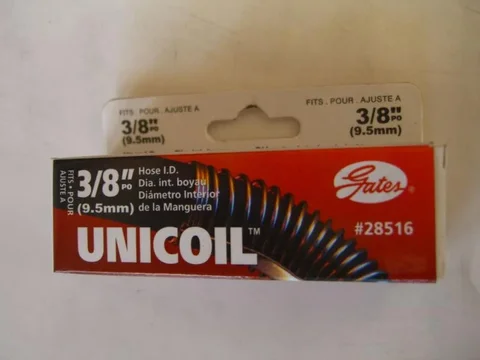
I checked my front hoses going to the radiator and tranny cooler and I seen that the line that connects to the lower radiator cooler had a leak at that nasty 90 degree bend. I went to O'Reilly Auto parts (walking distance from my house) to get a replacement hose. While I was waiting for him to cut it I seen this neat little Unicoil piece that I added because I did not like the proximity of that hose to the lower AC pulley.
Here is a pic after I installed it, I put another hose clamp at the opposite end for insurance that it would not move.
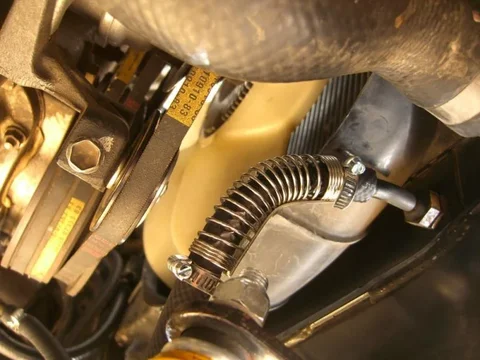


Here is a pic after I installed it, I put another hose clamp at the opposite end for insurance that it would not move.

OMFG - any secret tricks for transmission pan removal?
This might sound really dumb to some of you pros out there but I'm reviving this old thread after doing searches on here and not really coming up with anything about the actual process of removing the pan. Everything says 'remove the pan' as if it just falls off after you remove the bolts and I've never had more trouble getting anything apart than I've had with this pan.
I removed it almost 2 years ago right after I bought my '93 80 because I wanted to check the pan for signs of damage because I was having a shifting issue and wanted to see of there were any chunks of metal in there... thankfully, there wasn't.
But MAN was it a giant PITA to remove it then when it had the orange Toyota FIPG on there... I fought with that thing for at least a couple of hours.. trying to cut around it with a razor blade... trying to stick a thin scraper in between there.. all while being afraid I was going to damage the aluminum flange surface .. whacking the living sh*t out of it with a rubber mallet FINALLY broke it loose...
When I put it back on, I used Black Permatex RTV and it hasn't leaked a drop, but now that I'm trying to remove the pan again the rubber mallet doesn't seem to be doing the trick this time.. maybe I just haven't hit it hard enough, enough times yet but this is very frustrating ... I'm wondering if the black RTV has just stayed flexible enough that it's just absorbing the hammer blows... worried I'm going to dent the pan... I've tried using a flat metal scraper again to pry around the edge but it's just bending and I'm still worried about gouging the aluminum flange... There's not a lot of room to work around that pan anyway.. I don't have the Toyota SST that the FSM shows being used to get the pan off and I thought about maybe cutting the metal scraper in half and then bending what's left to a 90 degree angle, thinking the shorter peice of metal will be stiffer and easier to wedge in there but still afraid of gouging the flange so I'm not sure this is a good idea... I was wondering if anybody out there has some special trick for removing this pan without it taking all day. ...
...
Once I get it off this time, I'm hoping I won't have to deal the sealant mess again because I bought the NAPA kit with the, according to their website, neoprene gasket.. it seems thin but hopefully it will do the job because I don't want to use any sealant on this pan again if I can help it.. the NAPA instructions say not to use any adhesive or sealant with this gasket. Has anyone used one of these gaskets before and has it leaked at all?
BTW, the only reason I'm removing the pan again is that my shifting issue has returned and I've decided to replace the transmission solenoids in hopes that it will finally be fixed.

This might sound really dumb to some of you pros out there but I'm reviving this old thread after doing searches on here and not really coming up with anything about the actual process of removing the pan. Everything says 'remove the pan' as if it just falls off after you remove the bolts and I've never had more trouble getting anything apart than I've had with this pan.
I removed it almost 2 years ago right after I bought my '93 80 because I wanted to check the pan for signs of damage because I was having a shifting issue and wanted to see of there were any chunks of metal in there... thankfully, there wasn't.
But MAN was it a giant PITA to remove it then when it had the orange Toyota FIPG on there... I fought with that thing for at least a couple of hours.. trying to cut around it with a razor blade... trying to stick a thin scraper in between there.. all while being afraid I was going to damage the aluminum flange surface .. whacking the living sh*t out of it with a rubber mallet FINALLY broke it loose...
When I put it back on, I used Black Permatex RTV and it hasn't leaked a drop, but now that I'm trying to remove the pan again the rubber mallet doesn't seem to be doing the trick this time.. maybe I just haven't hit it hard enough, enough times yet but this is very frustrating ... I'm wondering if the black RTV has just stayed flexible enough that it's just absorbing the hammer blows... worried I'm going to dent the pan... I've tried using a flat metal scraper again to pry around the edge but it's just bending and I'm still worried about gouging the aluminum flange... There's not a lot of room to work around that pan anyway.. I don't have the Toyota SST that the FSM shows being used to get the pan off and I thought about maybe cutting the metal scraper in half and then bending what's left to a 90 degree angle, thinking the shorter peice of metal will be stiffer and easier to wedge in there but still afraid of gouging the flange so I'm not sure this is a good idea... I was wondering if anybody out there has some special trick for removing this pan without it taking all day.
...Once I get it off this time, I'm hoping I won't have to deal the sealant mess again because I bought the NAPA kit with the, according to their website, neoprene gasket.. it seems thin but hopefully it will do the job because I don't want to use any sealant on this pan again if I can help it.. the NAPA instructions say not to use any adhesive or sealant with this gasket. Has anyone used one of these gaskets before and has it leaked at all?
BTW, the only reason I'm removing the pan again is that my shifting issue has returned and I've decided to replace the transmission solenoids in hopes that it will finally be fixed.
Thin gasket scraper or putty knife and a small hammer. I grind the side edge of the putty knife. Then tap a corner of the blade in. Smack the sides of the scraper to separate the pan. Clean and re seal with Toyota fipg or equivalent. I don't like gaskets they tend to leak over time. One less leak to deal with ftw. If I'm pulling the pan for shifting issues I'd prolly swap the filter screen while I'm in there. Any evidence of fluid contamination?

I've used the Napa gasket on two different rigs over the last 4 years and haven't had any leakage. Much easier/cleaner than dealing with the FIPG in my opinion.
FZJ80 Transmission pan removal update
Well, I hope that my experience with this might at least help some other poor soul out at some point if they have to do this ...
I spent practically the whole day on my back dealing with this mess.. went out there and whacked the piss out of the pan with the rubber mallet probably a couple hundred times at least with no success.
Bent a cheap putty knife to a 90 and used a short flat head screwdriver to pry on the corners of the pan and slid the putty knife down the sides to cut the black permatex and FINALLY got it loose... it was ridiculous how much work it was to get that pan off. I didn't want to pry around it for fear that I would scar up the aluminum flange on the transmission. I pried against the pan instead and did end up making a couple of small marks on the pan but hopefully it won't make it leak.. I was just at my wits end and didn't know what else to do to get it off.
There were some fine dark particles on the magnets and I could see a few tiny flecks of shiny metal shavings in the bottom of the pan.. hopefully this isn't a big deal.
The pan flange is stamped with a raised bead and is not flat so you can't just scrape it with a razor blade to clean it so I took a wire wheel on my drill to the pan flange and made relatively quick work of removing the black permatex from the pan. It made a mess of silicone dust all over the pan but I wiped most of it out with a rag then put some mineral spirits in a spray bottle and used that to wash the pan out so there would be no lint or other particles in the pan.
Cleaned the trans flange with a razor blade and putty knife.
Changed out the trans filter. BTW, If you've never done this, I hadn't, be prepared for more tranny fluid to spill out when you detach the filter.. I almost got a face full. I torqued the filter bolts to 77 in lbs. Interesting side note: The FSM I have for the A442F trans gives conflicting torque specs for these bolts. On the page that shows the parts breakdown, it shows the same torque for the filter bolts and solenoid bolts (10nm /7.2 ft lbs), and then later on the page that shows installing solenoids, it says to torque solenoid bolts (5.4nm/48 in lb). The page that shows reinstalling the filter says (10nm/77 ft lbs), then shows the pan bolts to be torqued to (6.9nm/61 in lbs, so that ft must be a typo on the filter bolts so I torqued them to 77 in lbs because that seemed more in line with the other numbers.
Installed my 4 new solenoids - easiest part of the whole job and the reason I was doing all this in the first place.
DON'T FORGET TO PUT YOUR MAGNETS BACK IN THE PAN !!!
Put the new neoprene gasket on the pan and stuck the bolts up through the holes thinking this would be a good idea and speed up reattaching the pan.. not so much ... I think the thing to do would be to barely stick the bolts through the gasket so they are held in place but not sticking all the way through.. I had trouble trying to get any of them started in the threads with them all poking out and had to push the bolts back down so I could push the pan up against the trans flange and start the bolts in.
Another question I'm wondering about is if the torque specs for the pan bolts will be ok since I'm using this NAPA gasket instead of FIPG or other silicone stuff... I guess I'll see in a couple days if it starts leaking.
Measured the transmission fluid I had drained to be almost 8 qts so I put almost 8 back in.
Reattached battery cable ( I detached it because I was changing the solenoids and didn't want to risk somehow damaging any of the electrical stuff).
Started it up and took it for a test drive for a couple of miles and it's amazing how different the shifting is now.. I really hope that the new solenoids have solved my transmission problem for good.. well, for a long time at least.
Well, I hope that my experience with this might at least help some other poor soul out at some point if they have to do this ...
I spent practically the whole day on my back dealing with this mess.. went out there and whacked the piss out of the pan with the rubber mallet probably a couple hundred times at least with no success.
Bent a cheap putty knife to a 90 and used a short flat head screwdriver to pry on the corners of the pan and slid the putty knife down the sides to cut the black permatex and FINALLY got it loose... it was ridiculous how much work it was to get that pan off. I didn't want to pry around it for fear that I would scar up the aluminum flange on the transmission. I pried against the pan instead and did end up making a couple of small marks on the pan but hopefully it won't make it leak.. I was just at my wits end and didn't know what else to do to get it off.
There were some fine dark particles on the magnets and I could see a few tiny flecks of shiny metal shavings in the bottom of the pan.. hopefully this isn't a big deal.
The pan flange is stamped with a raised bead and is not flat so you can't just scrape it with a razor blade to clean it so I took a wire wheel on my drill to the pan flange and made relatively quick work of removing the black permatex from the pan. It made a mess of silicone dust all over the pan but I wiped most of it out with a rag then put some mineral spirits in a spray bottle and used that to wash the pan out so there would be no lint or other particles in the pan.
Cleaned the trans flange with a razor blade and putty knife.
Changed out the trans filter. BTW, If you've never done this, I hadn't, be prepared for more tranny fluid to spill out when you detach the filter.. I almost got a face full. I torqued the filter bolts to 77 in lbs. Interesting side note: The FSM I have for the A442F trans gives conflicting torque specs for these bolts. On the page that shows the parts breakdown, it shows the same torque for the filter bolts and solenoid bolts (10nm /7.2 ft lbs), and then later on the page that shows installing solenoids, it says to torque solenoid bolts (5.4nm/48 in lb). The page that shows reinstalling the filter says (10nm/77 ft lbs), then shows the pan bolts to be torqued to (6.9nm/61 in lbs, so that ft must be a typo on the filter bolts so I torqued them to 77 in lbs because that seemed more in line with the other numbers.
Installed my 4 new solenoids - easiest part of the whole job and the reason I was doing all this in the first place.
DON'T FORGET TO PUT YOUR MAGNETS BACK IN THE PAN !!!
Put the new neoprene gasket on the pan and stuck the bolts up through the holes thinking this would be a good idea and speed up reattaching the pan.. not so much ... I think the thing to do would be to barely stick the bolts through the gasket so they are held in place but not sticking all the way through.. I had trouble trying to get any of them started in the threads with them all poking out and had to push the bolts back down so I could push the pan up against the trans flange and start the bolts in.
Another question I'm wondering about is if the torque specs for the pan bolts will be ok since I'm using this NAPA gasket instead of FIPG or other silicone stuff... I guess I'll see in a couple days if it starts leaking.
Measured the transmission fluid I had drained to be almost 8 qts so I put almost 8 back in.
Reattached battery cable ( I detached it because I was changing the solenoids and didn't want to risk somehow damaging any of the electrical stuff).
Started it up and took it for a test drive for a couple of miles and it's amazing how different the shifting is now.. I really hope that the new solenoids have solved my transmission problem for good.. well, for a long time at least.
Any evidence of fluid contamination?
What do you mean by 'evidence of fluid contamination'? I did notice that there was a little bit of a sort of milky looking substance in the bottom of the pan after I got it off and I was wondering about it but thought it might just be something to do with the Lucas transmission stuff I had put in there a few months ago to see if it would help with the shifting issues that would come and go.

Sorry to revive an ancient thread. This is the thread that came up when I was researching pan removal for my solenoid replacement in my A442F, so hopefully it will help someone to see another method that doesn't risk scratching up the aluminum mating surface.
Here is the method I used:
strap around rear pan shield mounting point, breaker bar through the loop, piece of wood against cross member as a fulcrum, and floor jack to leverage the pan downwards. Be 110% sure all the pan bolts are out. The pan came out immediately when doing it this way. I had smacked on the pan with a rubber mallet prior, there was no chance of getting it off.


Here is the method I used:
strap around rear pan shield mounting point, breaker bar through the loop, piece of wood against cross member as a fulcrum, and floor jack to leverage the pan downwards. Be 110% sure all the pan bolts are out. The pan came out immediately when doing it this way. I had smacked on the pan with a rubber mallet prior, there was no chance of getting it off.
Last edited: