

Measuring caster angle

This site may earn a commission from merchant affiliate
links, including eBay, Amazon, Skimlinks, and others.

Joined
Aug 29, 2011
Threads
1
Messages
3
Am 3 linking the front of my fj40. It's on 60 series diffs. I want to set it at 5degs but not sure what is the best way to read it? Across the knuckle bolts?
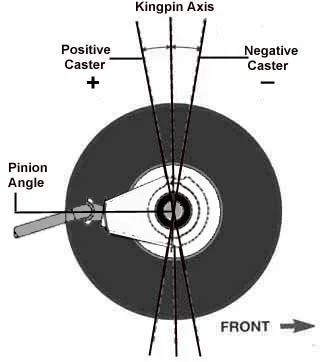

image-1648830530.webp
 
There are a few places where you can measure it. Knuckle bolts is probably fine. There's a flat on the knuckle that I assumed is there for measuring caster and that's what I use. Of course, if you're measuring it with the truck on the ground, make sure to factor in the angle of the floor.
 
Ed, if you could show or describe the flat on knuckle, it would be helpful.
I'm always wrassling w/ filthy knuckles trying to find a decent place to get a measurement.

It's easy if the truck is getting a knuckle rebuild, just measure across the knuckle bearing race. This has to be done w/ the truck approximately level and weight resting on jackstands under the axle.
 
This is the flat that I used-on the bottom.

At some time in the past, Pinhead posted that this flat is level when the caster is set to spec, so it's off by 1 degree. When I used this flat and that correction, and the correction for my garage floor slope, with the tires all inflated to the same reading, I got the same result as the alignment shop.
IMG_0214.webp
 
I wouldn't use the nuts or studs, I think there's to much variation on stud length & if they're installed correctly. Same goes for the nuts thickness. I try to hit the machined lip of the knuckle the cap bolts to or the cap suface itself. Tonight I'm going to try to put a straight edge lengthwise inbetween the nuts, on the cap, then the angle finder to see if I get the same measurement as on the knuckle lip & see if I get the same reading.
 
On stock 40 axles, the machined surface on the knuckle housing for the steering arm and bottom bearing retainer is perpendicular to the caster angle. The stock angle is +1. The spring perch is 0 degrees when the caster is +1. The pinion flange is perpendicular to the spring perch. The flat on the knuckle is probably the most accurate, but you need to be sure that the surface your 40 is sitting on is flat and horizontal. There isn't much room on the flat with the arm installed, so you can use a straight edge in between the knuckle and angle finder.
 
On stock 40 axles, the machined surface on the knuckle housing for the steering arm and bottom bearing retainer is perpendicular to the caster angle. The stock angle is +1. The spring perch is 0 degrees when the caster is +1. The pinion flange is perpendicular to the spring perch. The flat on the knuckle is probably the most accurate, but you need to be sure that the surface your 40 is sitting on is flat and horizontal. There isn't much room on the flat with the arm installed, so you can use a straight edge in between the knuckle and angle finder.

Sorry about my lack of knowledge, is there a video like the one you did on carb rebuild but about how to measure the caster angle?

Thanks

Alvaro
 
No video but here's what I did using an iPhone as an angle indicator:

Park your vehicle on a flat surface (like a garage floor). Fill all tires to the same pressure.
Get a long straight piece of metal and lie it on the ground from the front tire to the rear tire.
Use your iPhone or other indicator on this metal to measure how far off from level the floor is.
Normal garage floors are pitched down toward the door by a few degrees. So if you pulled in front first, the rear of the vehicle will be a little lower. Lets assume that you measure that your floor is tilted toward the door by 4*.
Now put your indicator on the machined flat on the knuckle and measure.
If you measure that it is tilted down toward the door by 5* then your caster is +1* and is to spec.
If it is 3*, then your caster is -1*.
 
No video but here's what I did using an iPhone as an angle indicator:

Park your vehicle on a flat surface (like a garage floor). Fill all tires to the same pressure.
Get a long straight piece of metal and lie it on the ground from the front tire to the rear tire.
Use your iPhone or other indicator on this metal to measure how far off from level the floor is.
Normal garage floors are pitched down toward the door by a few degrees. So if you pulled in front first, the rear of the vehicle will be a little lower. Lets assume that you measure that your floor is tilted toward the door by 4*.
Now put your indicator on the machined flat on the knuckle and measure.
If you measure that it is tilted down toward the door by 5* then your caster is +1* and is to spec.
If it is 3*, then your caster is -1*.

Is the machined part of the knuckle you are referring, the flat bottom part?
 
In my recent inquiry about measuring caster I came to the conclusion that since the frame is supposed to be level that I could simply measure the angle of the bottom of the frame relative to the knuckle. Seeing as my springs are original and sagging a bit it makes more sense than measuring to a level floor. Pete
 
I considered measuring the frame, but in the end, I think that what really matters for caster is what the angle is relative to the ground. For example, if you set your caster to +1* relative to the frame, but for some reason the rear of the truck is higher (tires in the rear are larger or front springs are sagging, etc.) then your caster will be go negative.
 
Back
Top Bottom