



Well since my wife and son are out of town I'm tackling a long list of Cruiser projects this week.
Last night I installed this Marlin Heavy Duty relay rod. Great product, great folks to work with, and a reasonable price. Make sure to call to talk to them when ordering this to make sure to get the right one. There was some miscommunication on steering terminology and I received the wrong one. It is quite a bit bigger than the old one, and it is straight and doesn't have press markes on it from being straightened a few times. It also has Marlin's greasable tie rod ends which seem to be nice.
First, I want to chat a little about removal. My friend owns an automotive repair show and he told me that I shouldn't use a tie rod seperator to remove the rod ends. His technique is just to pry lightly on the rod while hitting the steering rod end with an air hammer. This method is quite effective and you don't tear up the rod boots. Since I just had it off a few weeks ago to straighten it I didn't hardly have to buzz it at all. I'm using a cheap Harbor Freight air hammer. It doesn't have any power at all but it works for this. I think this is the only thing it has ever worked for.
I always find this a good time to check over my knuckle studs too. So I retorqued them.
Next, I ground my control arms more in anticipation for more rubbing. I have the Slee Caster plates with J springs and 1" FZJFilmore sparcers. I wish I would have removed the rod like this when I initially installed the caster plates. It would have saved me a lot of time.
I moved in the rod ends 35 turns on both sides and this seemed to be about right with the old rod. It wouldn't matter if it was 100% or not because the old rod was tweaked. Then I did a home alignment to see how close I was. It turned out I was within an 1/8".
About the home alignment. Basically you lift each front wheel barely off the ground and scribe the tire. Then you measure at the centerline of the tire front and rear to see if the measurements match. If you can't do centerline you have to use the same measurement height both front and rear (in my case I used some wood blocks to ensure that I was measuring at the same height front and rear. Then you adjust the rod until the front and rear match. My friend's dad (74) with the shop taught me this. They used this method in the military for big trucks in the Korean War. He told me that if I was careful with my measurements I should be able to get it as close as a machine. His big reason for teaching me about this was should I need to do a trail repair to get home.
Tomorrow I'm going to take it down and put it on the machine and see how close I got. It drives straight so I'm guessing I'm close.
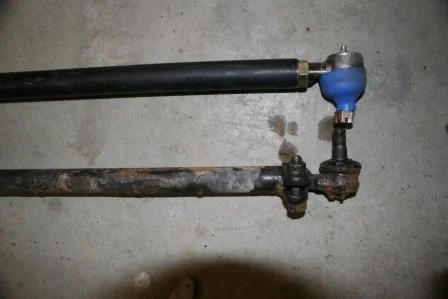
Last night I installed this Marlin Heavy Duty relay rod. Great product, great folks to work with, and a reasonable price. Make sure to call to talk to them when ordering this to make sure to get the right one. There was some miscommunication on steering terminology and I received the wrong one. It is quite a bit bigger than the old one, and it is straight and doesn't have press markes on it from being straightened a few times. It also has Marlin's greasable tie rod ends which seem to be nice.
First, I want to chat a little about removal. My friend owns an automotive repair show and he told me that I shouldn't use a tie rod seperator to remove the rod ends. His technique is just to pry lightly on the rod while hitting the steering rod end with an air hammer. This method is quite effective and you don't tear up the rod boots. Since I just had it off a few weeks ago to straighten it I didn't hardly have to buzz it at all. I'm using a cheap Harbor Freight air hammer. It doesn't have any power at all but it works for this. I think this is the only thing it has ever worked for.
I always find this a good time to check over my knuckle studs too. So I retorqued them.
Next, I ground my control arms more in anticipation for more rubbing. I have the Slee Caster plates with J springs and 1" FZJFilmore sparcers. I wish I would have removed the rod like this when I initially installed the caster plates. It would have saved me a lot of time.
I moved in the rod ends 35 turns on both sides and this seemed to be about right with the old rod. It wouldn't matter if it was 100% or not because the old rod was tweaked. Then I did a home alignment to see how close I was. It turned out I was within an 1/8".
About the home alignment. Basically you lift each front wheel barely off the ground and scribe the tire. Then you measure at the centerline of the tire front and rear to see if the measurements match. If you can't do centerline you have to use the same measurement height both front and rear (in my case I used some wood blocks to ensure that I was measuring at the same height front and rear. Then you adjust the rod until the front and rear match. My friend's dad (74) with the shop taught me this. They used this method in the military for big trucks in the Korean War. He told me that if I was careful with my measurements I should be able to get it as close as a machine. His big reason for teaching me about this was should I need to do a trail repair to get home.
Tomorrow I'm going to take it down and put it on the machine and see how close I got. It drives straight so I'm guessing I'm close.


 Problem solved.