I am still not convinced. Especially using a Hawse......
I like the idea of saving weight, but roller fairleads not recommended because of possible pinching of the line.... and a hawse just screams friction to me.
It will be a while before I have a winch, so I have some time to see others in action first.
You only have to look to sailboat racing to substantiate synthetic lines incredible strength and durability. We have been using them successfully for decades now. Yeah I know, not too many rocks or sharp edges on board but believe me there are plenty of heavy loads and we are directly exposed to them. Nobody in modern racing uses steel, it's all synthetic and for good reason. Having said that read the following for some steel vs. synthetic info.
Safety: Both steel and synthetic winchlines (or winch rope) give a very small amount of stretch, the equivalent of less than 1% at breaking pressure. This tiny amount of stretch stores kinetic energy that is released when the line breaks. Since steel winch line is much heavier than synthetic winchline, the force of that stored energy is devastatingly powerful, particularly dangerous with people near. The synthetic line is so light and therefore stores less kinetic energy, which when released, the winch line virtually falls to the ground with a fraction of the force of steel.
For this reason, 4×4 offroad racing sanctioning bodies do not allow steel cables because of their inherent danger. Synthetic winch lines are now mandatory.
Training: While synthetic winch lines are much safer, recovery operations are still dangerous and we encourage all winch owners with steel or synthetic winch lines to attend safety and training classes from certified trainers such as: Bill Burke, Tom Severin, Bruce Elfstrom, Garrett Porter and others. See I4WDTA for more information.
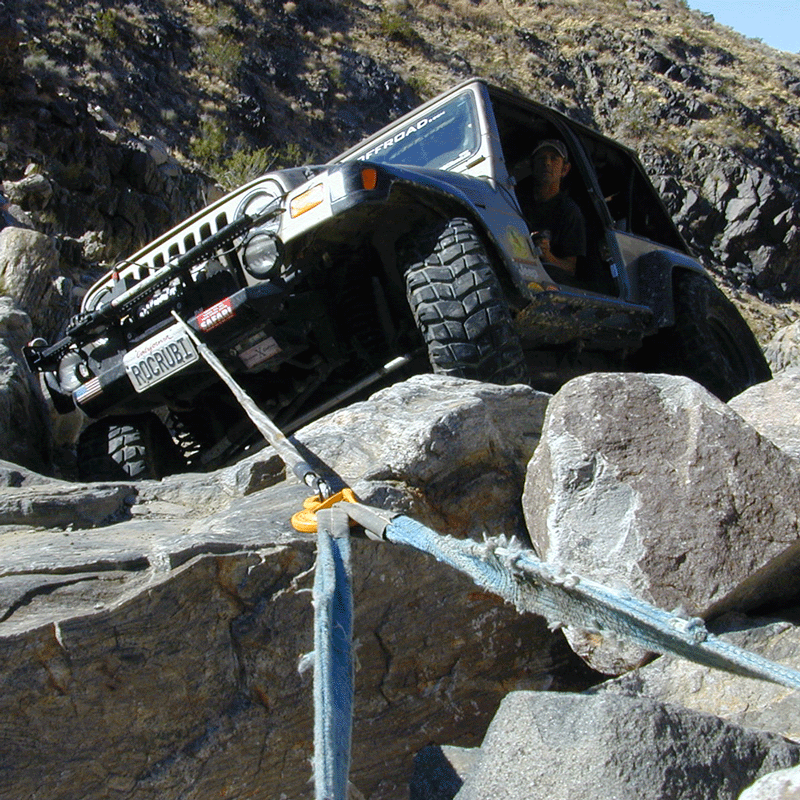
Ease of Handling: Steel winch cables have a tendency to kink, rust, and have very sharp strands once nicked. They also tend to straighten by the nature of the material making them harder to spool back on the winch properly. Our synthetic winchlines have none of these problems. However, synthetic lines are more susceptible to sharp edges (bumpers in particular) and heat, but they are much stronger, safer and easier to work with.
 Strength:
 Dyneema® synthetic winchline fiber is up to 15 times stronger than quality steel and 40% stronger than Aramid fibers on weight for weight basis. This means the replacement synthetic winchline is typically 35-45% stronger than steel cable! Steel cables are typically sized to match the strength of a winch. For example a 9,500 lb capacity winch will have roughly a 9,500-10,000 lb capacity steel cable. The replacement synthetic line would be 5/16″ (7.9mm) or 3/8″ (9.5mm). Viking Trail Lines are rated at 13,000 lb (4,6 metric ton) for the 5/16″ and 19,600 lb (6,2 metric ton) for 3/8″, making them approximately 27% and 49% stronger on the conservative side.
Frequently Asked Questions
New England Ropes - Products
I've run synthetic for 4-5 years....and have owned a winch since the early 90's....
wire sucks...period....heavy, hard on the hands, impossible to 'toss', crushes, burrs, 'requires' constant respooling to prevent damage, etc. All of my lines are from Winchline.com and I use their aluminum thimble on the end of the rope...
IMO, roller fairleads are not the issue....tho the likelihood of a pinch IS higher...the issue is the rollers are usually USED and grooved/scratched from years of wire use on the winch, and those burrs then destroy the new synthetic in short order....NEW rollers make that a non issue.
I run a UHMW hawse on my FJ40 and UHMW rollers on my FZJ80...
Exactly.





 . I work with cable and I can throw it quite a way. Now......synthetic is all the other things you said. However, I've had poor experiences with synthetic on my ATV winch for my plow. Seems like it breaks way more frequently than cable, even with a hawse.
 And I don't think I'd like to meet you in a dark alley, unless I'm carying (which I always am...ooops off point again).
  I wouldn't want to have to huck a steel line any distance myself, but I do have twigs for arms
 .
.
 I'm a big teddy bear and it usually takes quite a bit to get me fired up, but once I'm there, it's really hard to come down.
  sorry , i can not understand you fully , and i think you can contact the company to have a detail information