2F running hot

This site may earn a commission from merchant affiliate
links, including eBay, Amazon, Skimlinks, and others.

Thanks again guys.

DP - your spot on there, IMO the cooling system on these old Toyota's is over engineered and when functioning properly allow the old 45 to carry a full load across the outback without a hint of overheating!

Thus, i knew something was up the second the temp gauge needle moved above its usual position.

..............................................

So far would i be correct in assuming that the radiator hoses should NOT really pressurize during operation, or at least not while the engine is still cold?

Assuming they are, is there pretty much only one possible cause??? (combustion gas entering the cooling system... or something entirely different)

Or is it plausible that some blockage inside the engine would cause the radiator hoses to pressurize?

IMO, i would think that if the hoses are pressurizing almost immediately once the engine has started that this could not be due to a blocked coolant passage within the engine as under normal operating conditions there is NO flow in the engine until the engine reaches the opening temperature of the thermostat and its opened.

Perhaps one could even go as far as saying a blockage in the engine if anything would potentially cause the lower radiator hoses to 'suck' inward on themselves as the water pump draws liquid from them, just as one would expect to see the lower hoses suck inward if the radiator had a substantial blockage?

Then again, with the bypass hose, perhaps that isnt true for the engine blockage as the water could simply bypass the engine...?

Then again, again, i worry that by over analyzing this and looking hard for a problem... what if the hoses are not really 'pressurizing' any more then normal? Can anyone tell me what is normal? Given the hoses are all brand new, and replaced hoses that were at least 16years old it may be possible that the new rubber is simply softer??????

Then again again again, i guess im really over simplifying this as im thinking substantial blockage. I have no idea how many cooling passages are inside the engine and how they are laid out. Is it possible just a small part of the engine to be blocked while the rest functions as normal?

...................................

ed- With regards to running the engine with the radiator cap removed, in the passed i have found that from cold (engine) once started within one or two minutes the coolant will start to overflow from the radiator. In these cases ive simply quickly fitted the radiator cap.... and thought WTH lol, how do these guys to it online! FWIW ive experienced this for as long as ive had the car. I do not believe 'overflowing coolant' related to a head gasket failure etc. As the engine heats up and expands, if the system is 'full' it is going to overflow. (Its just when reading on here, id never ever seen mention of leaving some coolant out of the radiator, or expecting some to overflow...)

So i guess it makes sense, you basically need to drain out the equivalent amount of fluid that the overflow bottle usually rises by when the engine is HOT. Ie. 1" to 1.5" of coolant in the bottle - as you said maybe a cup or two.

I will do this and let you know how i get on.

And yep, as per the first post, engine leakdown test was done and came back a-ok...

....................................

BC - yes ive always try to removed any potential air locks from the cooling system after refilling it following the method you described. Parking the old girl up on a very steep hill and running the engine, squeezing the top radiator hose too... to try and 'burp' it. Heater tap open etc. I usually repeat this for 2-3 days each morning. As it 'burps' i then 'top up' the coolant and repeat.

......................................

So far im getting the vibe that this pretty much has to relate to the head gasket. If only 'THE' tests agreed! An engine running hot MUST relate to the spark / ie. running lean OR something relating to the cooling system? Nothing else.

So, if the engine is running good, it cannot be related to the 'spark'? Which leaves only the cooling system...

I really dont want to overlook something else.

Travis.
 
Travis22,
Handy being in that timezone and waking up to all these wonderful solutions, eh.

The water pump is working from the instant the engine starts and there is a by-pass hose to allow a certain amount of flow, openning the thermostat when reaching a certain temp.
No bypass hose = no flow and the fluid at the back of the engine might boil without the thermostat sensing it.
There is a reserve amount of fluid for water pump suction at the lower end of the rad to keep it pumping until that reservoir is exhausted, then pump suction starvation might occur and it can be seen if the bottom hose begins to collapse, if you check it at the right time.
If there is pressure at the top hose (engine running but not hot), it means the water pump is working (assuming there is no head gasket leak and it looks like there isn't) right from when the engine is started.
But, if the water cannot pass thru the rad freely as in tube blockage, it will pressure up the upper hose, especially when hot.

I'm pretty convinced you have partial blockage in your rad which is why the rad overflows so readily if you remove the cap.
I pull my rad cap off (not with hot engine, but cool or warm) and there is very little or no flow coming up. The level does rise.
This is with a new water pump, new rad and de-scaled block when rebuilt.
The rad should be able to handle the volume without pressuring up the topside.
Just saying.
 
G'day DP - :) Some real time help would be awesome lol.

Honestly, id put money on this not being related to the radiator.

Facts:

Engine started running hot with the original; radiator, water pump, thermostat and hoses.

Engine is still running hot with BRAND NEW, radiator, water pump, thermostat and hoses...

..................................

Everything has been swapped in stages, so the engine still ran hot with the original radiator, original thermostat but just a new water pump and hoses.

Engine still ran hot after i swapped out the thermostat.

Engine still ran hot after i put a new radiator cap on.

Engine still ran hot after i swapped out the thermostat again - i tested all 3 thermostats finding they all operated pretty much the same and within spec even tho they were 'rated' 82, 85 and 88degC.

Engine still ran hot after i removed the original radiator and back flushed it and also cleaned out all the 'fins'.

Engine still ran hot after i removed the original radiator and REPLACED it with a brand new, identical old stock 100% Made in Australia 4 core radiator, and another new radiator cap.

After replacing the radiator, the engine seems to take a little longer before running hot, and once hot if left to idle it cools back down quicker then it did with the old radiator.

Engine was then taken to my old timer mechanic. Leakdown test done, came back good. Hydrocarbon test done, twice, both came back good. His advice, dont pull the head just yet......... Keep watching it closely.

..............................................................

Ive gone back out to the old girl after letting her sit for a week while i calmed down... and will start retesting all over again. (Needed to drive into town...)

So i fired her up, again starts first go, zero smoke.

Radiator hoses didnt really pressurize. Certainly not while the engine was cold anyways.

............................................

Other findings, i believe the engine is coming up to temp faster then 'normal'.

On the last two drives, i believe some sort of current draw has appeared. In the vicinity of 5Amps. Ive quickly checked the grounds from both my batteries to the chassis and they are good but i havent investigated any further.

This load is only present when the engine is running.

Today, for the first time i noticed a very distinct 'clicking' noise could be heard coming from my coil when i started the engine. With the ol' screwdriver to the ear i isolated the source and it is definitely coming from the coil. A fast, tick, tick, tick, tick, tick, tick...........................

Driving into town, the engine ran as good as always. Idles fine, cold and hot and hasnt lost any power. Once it has come up to temp (180), it slowly continues to creep up to 190, if im just cruising around under 60km/h - 37mph it stays at this temp. If i push it out to 80km/h - 50mph then the temp starts rising again to around 200ish. Once it starts getting up there ive been just backing off as i dont want to keep getting the temp higher then that. If i dont back off, it has gone as high as 210-220, but it goes NO higher.

Ive just purchased a laser thermometer online as i dont want to keep borrowing my mates, once it arrives i will go over every inch of the engine and radiator and report back.

Hopefully later today ill drain a little out of the radiator and see if i can get any bubbles to appear in the flow.

Travis.
 
Oh, I have to backup a bit I guess - wasn't with you before on the facts 1 & 2.
But checking out the rad tube temps won't hurt at this point.
Could be that some scale from the water channels broke free (but twice??)

When I did a fresh rebuild the 2F was running a bit hot at first startup and I attributed that to "tight engine". There was a lot of mechanical descaling of the water channels to do in that rebuild and that's what I could see was happening to you.
Then I burped out some air from the square headed plug on the head just before the farthest exhaust valve, and all was right after that.
They do seem to be fussy about getting the air out.
Cheers
 
This is a long shot but worth checking. Not sure if you have the exhaust flapper diverter thing in your market or not. I tried to resolve a weird overheating issue like yours for months, and it turned out the diverter plate had broken off and was partially blocking my exhaust manifold down pipe.
 
You've been through everything I would check...it's gotta be something stupid you forgot to check 3 times...
 
Diverter valve is worth a check. That is a good idea.
Also try pushing in the ht wire on the coil to get rid of the clicking. Theoretically, a gap there that is wider than the spark plug gap could give you a hotter spark. This is a long shot though.
 
Thanks again guys.

I was up all night reading / searching here on Mud and also came across the Manifold heat control valve issue.

Ive been out to have a look this morning and, buggered if i know... i dont 'think' i have one???

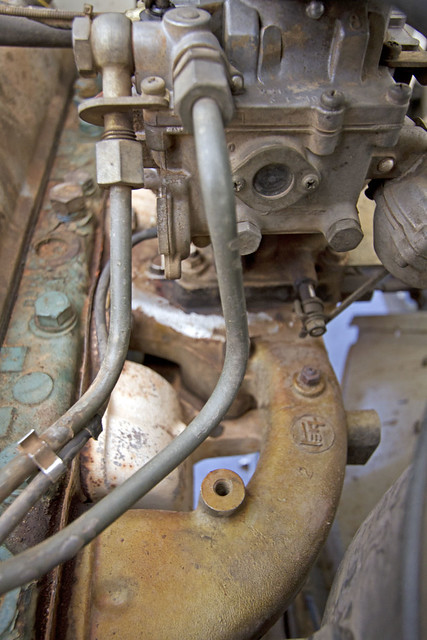
Looking closely and feeling around under there i cannot find any sign of a bolt or shaft running parallel through the manifolds in the area it appears a HCV would be.

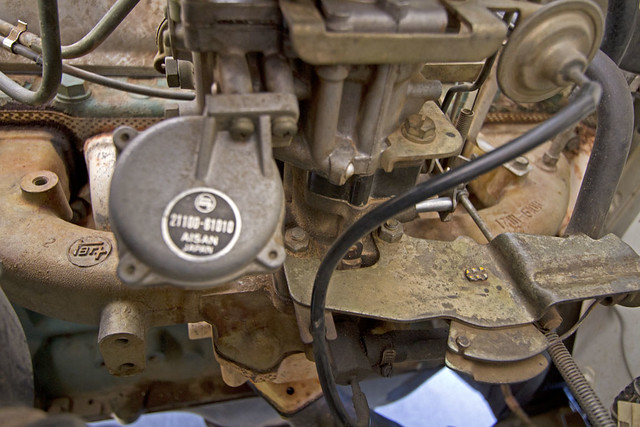
Ive taken some photos, excuse the quality it was dark in there so ive taken them at a very high ISO.

6462882387_78a5f3e0ff_z.jpg


In this i see what i assume is a slight leak on inlet manifold the left side of the picture where it joins the block? Not sure how long its been like that, a fairly long time i think ie. 1 year. However spraying carby cleaner at it while the engine is running has zero effect.

6462882969_22824bd229_z.jpg


..............................................................

The coil - it is most defiantly producing a constant clicking sound now. It does it with the engine cold, and it still does it when the engine is hot.

Coil is a Echlin GX80 - out of production now i believe.

I couldnt find the primary / secondary resistance figures online so i dont know how else to 'bench test' it other then simply deeming it ok as the engine still runs smoothly when cold and when hot. But the tick tick tick tick...... surely not normal!

When running, the voltage between the + / - terminals is 6V so i assume this is a coil with an internal resistor.

I removed all the leads one by one and tested their resistance. Removed the lead between the coil and distributor a number of times and this had no effect on the tick tick tick ticking.

All leads measured between 1.9kOhm and 4.9kOhm.

With regards to my Ammeter reading - the mystery 2-5Amp load while the engine is running........ im not positive but i might have found an intermittent bad ground. I have a 'kill switch' (red key switch things) on the ground terminal for the cranking battery and i got a 5Ohm reading between the two terminals on the switch then i jiggled the red 'key' and removed / reinserted it and the resistance is now gone.

Travis.
 
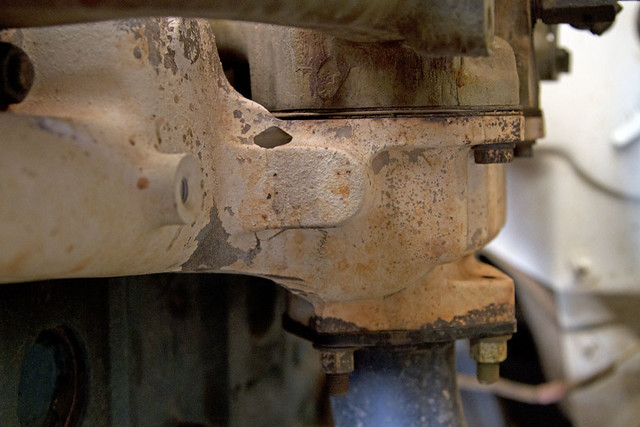
I tried again, and managed to squeeze the camera in for a better photograph of the area id expect to see signs of a HCV if it existed.

6463053769_c1f46d820c_z.jpg


Do you think it would still be worth while removing the carby and manifolds to look between them, or i guess at least the carby that way i could look down into the 'riser' and see what is in there - from the photograph can anyone tell me what might be in there? Without the 'valve' mechanism i dont understand what else would be in there, just a plate blocking it off, or a plate with a hole in it maybe???

Travis.
 
Maybe someone else can tell you if your year had one of the risers. If you do, it's a lot easier to pull the exhaust pipe from the exhaust manifold. Then look up and see if the valve is stuck.

The other thing that I still think you should do is a pressure test on the cooling system. This would show a head gasket leak if one existed, or provide more evidence that it is not exhaust gas getting in the coolant.
 
Thanks Ed - good idea re: removing the exhaust pipe to look up from below. 5 bolts instead of ... who knows, a bunch!

As far as i can tell, the manifolds / the inlet manifold does not have a heat control valve. Perhaps the Aussie 40's didnt come with them...

But who knows what lay's within the 'chamber' area there, id guess maybe some sort of blockoff plate, or maybe nothing............. if anyone has any idea's please let me know.

Im still waiting on my new laser thermometer so no updates there.

Fired it up in the morning and had a close look all around the manifolds and could not see any signs of cracking - at least externally...

Basically this time around she started up as usual, no worries. I let id idle for maybe 4-5minutes, occasionally revving the engine as i felt around for any hot exhaust gas leaks from the manifold. None found.

After around 5minutes the top radiator hose and top radiator tank started to get pretty warm and ALL hoses started to pressurize.

I shut it down and waited 1minute then slowly started to open the radiator cap. The cap has a pressure relief safety mechanism by turning it 1/2way i think it allows the pressure out the overflow hose and into the overflow bottle before anything can come out of the radiator cap.

As soon as i turned the cap half way the pressure purged into the overflow tank, seemed to be air / bubbles. Just a quick rush of bubbles - the tank level did not rise. After the bubbles stopped (1-2seconds) all the hoses returned back to their normal size - with no pressurization. (The water was just warm, definitely not boiling. Bottom hoses remained cold.)

.............................................................

Im yet to drain some coolant from the radiator so i can run it and check for bubbles while the engine is running but before i do, can anyone answer - is this pressurization / build up of air potentially from an air lock in the system?

If the engine has not been burped properly (im sure it has, but want to ask anyways) would it possibly exhibit these signs?

Seems to me once again it would seem a head gasket failure or the like to be the obvious cause... but if there was a cracked manifold causing the engine to run hot, together with say air already in the engine... maybe that cause these signs?

........................................

Oh before i forget, i still have this mistery load on the ammeter, in the vicinity of 2-5amps. Seems the isolator switch isnt the source....

And the coil is still tick, tick ticking away.................. has anyone heard a coil behave like this before?

Travis.
 
I tried again, and managed to squeeze the camera in for a better photograph of the area id expect to see signs of a HCV if it existed.

6463053769_c1f46d820c_z.jpg


Do you think it would still be worth while removing the carby and manifolds to look between them, or i guess at least the carby that way i could look down into the 'riser' and see what is in there - from the photograph can anyone tell me what might be in there? Without the 'valve' mechanism i dont understand what else would be in there, just a plate blocking it off, or a plate with a hole in it maybe???

Travis.

Based on that picture your truck does not have what failed on my truck. Your engine came from the factory without the smog gear. No holes in the head for the air injection from the smog pump either. Your coil should not click, replace it.
 
G'day John, thanks for the info.

I agree re: the coil, i think it needs replacing now. This ticking / clicking is definitely not intermittent, since noticing it the other day it hasnt stopped, if the engine is running it is ticking.... I think it would be wishful thinking to think that it is the cause of the engine running hotter but who knows!

................................................................

I called a local supplier the other day re: coils as they stock MSD brand gear. They were very unhelpful regarding what coils might work with the ol Cruiser (they specialize in muscle cars / V8's)

I was asking about the MSD High Vibration Coil.

MSD 8222 IGNITION COIL HIGH VIBRATION | eBay

Basically the salesman said i could not use this with my car because it does not have an internal resistor.....

I believe the coil currently in the old girl (the Echlin GX80) does have an internal resistor. And my measurements would confirm that as when running the voltage between the terminals is 6V.

But i was of the thought that it doesnt matter what coil you use provided, if it is a coil that needs a ballist resistor, then it has a resistor........ The resistor is basically for the coil itself.

So if you have a coil with an internal resistor then you do not want another external resistor as well, and if you have a coil without an internal resistor that was designed for an external one, then you need the external one and finally if you have a coil designed to work with a resistor at all, then thats that, you do not need / should not run an external resistor with it.............?????


Other then this High Vibration coil, i understand MSD make a lot of other versions - Master Blaster 2, 3 etc. Can anyone tell me which one i should run with my engine?

Engine runs the factory Distributor with points etc.

........................................................................

Lastely the results from my latest 'test' on the engine.

I drained out some coolant from the radiator, basically i siphoned it out as i ran the engine so as to maintain a coolant level - level with the top of the radiator top tank. This required siphoning out approx 500ml+ of coolant.

There were absolutely no bubbles present.

I let the engine idle until it reached full operating temperature. No bubbles.

Then i started revving the engine which would cause the coolant level to drop a little each time, so i then started trying to burp the system etc and then started adding coolant back into the radiator. I guess in the end, by revving / burping the engine i was able to put back half of the coolant that id originally removed.

Basically the end result was everything seemed fine, it was holding a level coolant level at idle and when revving.

I then fitted the radiator cap and continued to run the engine. Hoses did not pressurize. Let it run for a few more minutes then opened the radiator cap again.

Then i simply poured the remaining coolant back into the radiator overflow bottle and refitted the radiator cap.

Will be interesting to see how much coolant gets sucked back in from the overflow bottle as the engine cools.

............................................................

Travis.
 
Let the engine cool for an hour. Radiator overflow bottle coolant level dropped by the usual 'inch' or so.

However FWIW - after siphoning coolant earlier, and refilling while warm then pouring the remaining into the overflow bottle has resulted in more coolant in the overflow bottle / less in the engine / radiator. How much, bugger all, guess maybe 200ml+? BUT - Id have thought, if id somehow managed to get rid of some air in the system that it would take a little more coolant not less, then again i only let it cool for an hour, perhaps it hadnt quite finished sucking coolant back into the system..........

Anyways, then took it out for a run.

Started with the engine still a little warm from earlier, opened / closed the radiator cap. So i started with zero pressure in the cooling system.

Drove up the street, engine came up to temp. I stopped and felt the radiator hoses had some pressure, its hard to say how much but i dont think as much as in the passed but anyways i then carefully 1/2 opened the radiator cap and released the pressure into the overflow bottle (all while the engine was still running).

Went for another run up and down the street. (I couldnt really get up enough speed to see if it would heat up as much as its been doing - moreso just wanted to see what would happen re: pressure in the cooling system. FWIW temps still seemed to be around the 190mark). Stopped at the end again (2miles distance) and checked the hose pressures. They had very little pressure, they felt pretty much how i think they 'used to'. Anyways, again 1/2 opened the radiator cap and purged out what little pressure there was into the overflow bottle, closed it and drove home. Once home i did the same thing again - hoses felt good with little pressure in them. Opened the radiator cap and purged out what little pressure there was then closed... then came inside.

.......................................................

Lets say hypothetically, if this has all been caused by an air lock in the system (i still dont believe this is the cause but...) how could this possibly occur out of the blue? After say 12months flawless operation.

(Not to mention again the fact that ive drained the entire system 4-5times since this all started and i dont believe an air lock occurred or remained each time!)

I mean, the engine / cooling system hadnt been touched prior to the engine starting to run hot. Humor me...

The only thing i could come up with was the water pump... given it had started weeping, maybe during normal operation - engine running / stopping and cooling down. At some stage it could have sucked some air into the system while the engine was cooling???????? Seriously a long shot, but thats my only thought as to how 'it' could happen, if it 'did' happen.

................................................

It really seems like this hose pressurization is a little intermittent. Sometimes they pressurize other times they dont, all the while the engine continues to run hot. Its just not logical!

Travis.
 
Coil: do you have an external resistor? If so, get a coil without a built in. 1.5 ohm primary. Otherwise get a built in- 3 ohm primary. To measure volts on coil, do it with ignition on but NOT running. If you have an external resistor, you will get 12 volts with points open or about 6 with points closed. If internal resistor, then it should measure 12 with points open or closed.

Coolant: i'm baffled you may have air pockets in your system after all. I would repeat that test where you rev then add coolant, etc until you can't anymore, burp hoses, do it on a hill, then close it up and try it for an extended period. If it doesn't get better, do the coolant pressure test. You may be able to borrow a tester from an auto parts store.
 
Latest update:

Coil was replaced with the Bosch SU12 - Made in Brazil (Silver metal body - Not black plastic? one...)

New coil ticks / clicks just like the old one. (Nice, another $50 for nothing)

FWIW - test my mechanic suggested doing the other day; If the lead between the coil and distributor is removed, and the engine cranked over what happens?

= the coil still makes the ticking noise.....................

No idea what it means, guessing this isolates it from the distributor / points / leads etc... being the cause

...............................................................

Engine still running hot.

From cold to hot the hoses pressurize. If i then purge the pressure, drive for another 5min and purge again thats pretty much it - the do not 'pressurize' again. Engine still runs hot.

Let the engine cool, the process repeats all over again.

............................................

Tried further 'burping' of the cooling system with the car on a hill, radiator cap off, engine hot - revving etc... The level does not change (other then the std. 1/4" rise and fall in the radiator fill neck as the engine rev's increase and decrease) lastly, no bubbles appear what so ever.

Travis.
 
That is odd, there are no moving parts in a coil to make noise it can spark internally and click. But that isnt the case if the new one clicks Try the coil test with the coil + disconnected.
 
I know this might be a stretch, but during your trip did your radiator get super dirty? Just from driving through dusty environments or muddy water. Something I learned from driving off road with brush fire trucks. The rig I was driving got hot really fast and I was stumped. My buddy got out and used the hose line off our truck and sprayed the front end off. The radiator was coated with debris and wasn't allowing the air to draw over itself.
 
That is odd, there are no moving parts in a coil to make noise it can spark internally and click. But that isnt the case if the new one clicks Try the coil test with the coil + disconnected.

G'day ed,

Yeh as you said, no actual moving parts in a coil, always figured the sound was electrical / some sort of pulse, sparking etc.

Very strange that it is still occurring with the brand new coil ; the noise is louder on the old coil, but its still 'there' on the new one.

Both coils are internal resistor types - No external ballast resistor.

The new and old coil appear the same in operation, by that i mean with the ignition off there is zero voltage between the + & - terminals. With the ignition on, there is full voltage (12.8V engine off, 14.6V engine running) between the + terminal and ground. With the ignition on / engine running, there are 6-7volts between the + terminal and the - terminal.

.............................

With the main lead between the coil and distributor off there are only two remaining terminals, + & -.

I dont really know what is upstream of these two cables, i guess ill have to look into it and see.

***Looking at the wiring diagram, the - terminal appears to terminate on the distributor*** hmmm, maybe there is more to this...

I dont understand what you mean by to the test with the + cable disconnected. If i was to remove the + cable wouldnt the coil simply do absolutely nothing?

............................

*** In light of recent discoveries, re: the - terminal connecting to the distributor i can only assume this is the source of this 'ticking' noise at the coil! ?????????? Anyone, does that seem right / possible?

Travis.
 
I know this might be a stretch, but during your trip did your radiator get super dirty? Just from driving through dusty environments or muddy water. Something I learned from driving off road with brush fire trucks. The rig I was driving got hot really fast and I was stumped. My buddy got out and used the hose line off our truck and sprayed the front end off. The radiator was coated with debris and wasn't allowing the air to draw over itself.

G'day BigCity,

Thanks for the thought. Unfortunately in my case there is was no chance that the above could have happened. The radiator fitted at the time all of this begun was in pretty good condition and the fins etc. were reasonable clear of dead bugs / grass, dirt and grime.

The engine started running hot less then 1 hour from home while still driving through the 'city' on sealed roads etc.

Thanks again for the thought, i really wish that was the case. After the trip, but before i purchased a new radiator i did thoroughly go over the old one, back-flushing it and also clearing the fins of absolutely every single bit of dirt / grime, grass seeds, dead bugs etc....... (And even though above i said they were reasonably clear to start with, i could definitely feel a difference in the amount of 'air' the fan was blowing over the engine, which once again had me getting my hopes up but once again, all this had no effect on the engine running hot).

Travis.
 
Back
Top Bottom