



This is how I understand the flasher and how it is spposed to work. Please feel free to make any corrections or add info.
From the drawing below.
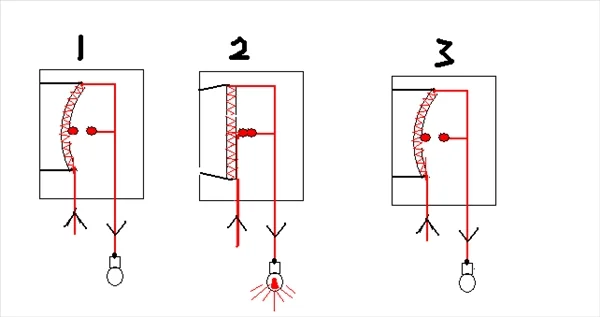
1- Current flows through the resistive wire (which is wraped around a spring steel that is bent like in the drawing) . This current will reach the bulb but it is not strong enough to lite it due to the resistance.
2- The spring steel gets heated and expands and become straight so the contacts are pushed together . Now the current will flow to the bulb through the less resistive path and the bulb lites up.
3- The very low current flowing through the resistive wire can't keep the spring steel from cooling down. As the spring steel cools down , it bends back to original shape and the cntacts get seperated. Which means low current at the bulb , therefore no lite. Now step 1 is reapeted again and the cycle begins.
From the drawing below.
1- Current flows through the resistive wire (which is wraped around a spring steel that is bent like in the drawing) . This current will reach the bulb but it is not strong enough to lite it due to the resistance.
2- The spring steel gets heated and expands and become straight so the contacts are pushed together . Now the current will flow to the bulb through the less resistive path and the bulb lites up.
3- The very low current flowing through the resistive wire can't keep the spring steel from cooling down. As the spring steel cools down , it bends back to original shape and the cntacts get seperated. Which means low current at the bulb , therefore no lite. Now step 1 is reapeted again and the cycle begins.


