

Starter Solenoid location?

This site may earn a commission from merchant affiliate
links, including eBay, Amazon, Skimlinks, and others.

Joined
Feb 1, 2007
Threads
61
Messages
600
Location
Bellevue, WA
I'm an electronics moron - now that we have THAT out of the way - "Where the hell's the record's room?".... Oh, sorry, wrong movie...

Where is starter solenoid location on a 2003? Anyone have a pic, or is it easy to see (it's probably right in front of my flippin' face...)

Doing some prep work for the hellroaring Dual bat install and need to find this little bugger:grinpimp:

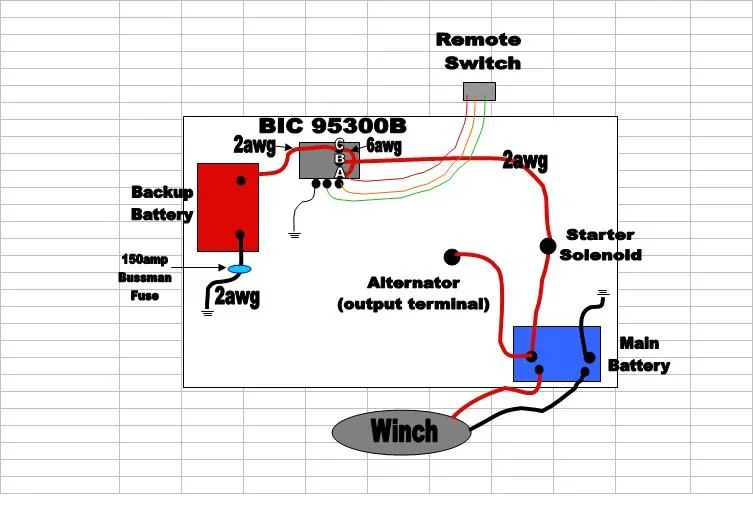
Thanks - I'll take pics of the install... here is the inital drawing (not sure about accuracy yet, but I think it's close)

Fish
Wiring.webp
 
That was my initial reaction as well Loud. But in talking to Mike at HR (and looking at his recommendation Hellroaring Battery Isolator/Combiner notes for 4 Wheel Drive dual battery applications it kinda make sense off the main.

Basically my concern was that if you "combine" the batteries for winching (especially if you have a long pull or have the engine off) what if you drain them BOTH? He says it's REALLY VERY unlikely. He said if you know you have a light winch job (or a few) just use your main (that's why it needs to be a deep cycle). If it starts to drain or get sluggish combine them and/or run the engine and charge it up a bit. Combining them gives your 3-4x the power (not just 2x). IF (very rare!!) they BOTH start to drain just stop the job for a few, start the engine and charge for a bit. He did't say exactly, and I'm no expert, but I'd imagine in order to drain BOTH batteries it would take a :censor: load of full length pulls.

Anyway, there are a few guys on the 80 forum that did it this way with the HR and I haven't seen any issues posted. So I think I'll give it a try this way and I'll let you know.
 
It's attached to the starter motor which is in a tough place to access. Why not winch off an ACCESSORY battery isolated only to be used with ACCESSORY loads? This notion of having a "back-up" battery is terrific, but in the way you're talking about hooking up the isolator, the "back-up" never has loads attached to it. Batteries that don't get used don't stay healthy long. I can't help but wonder if this method of installation serves the users, or serves the isolator manufacturer by guaranteeing very limited current actually passing through the isolator to maintain charge on a battery that's rarely used? To each their own, but if I'm buying a $200 second battery, I'm buying it to use, not to leave in the "backup"position to be used once every five years. I've got a rechargable flashlight I leave in the truck, always attached to the 12v accessory socket in the center console. The concept was that when I need a flashlight, it will always be there fully charged. Good idea, but it hasn't worked out the way I'd hoped. I use it so rarely that when I needed to use it, it provided light for about five seconds before it went dead. I called the manufacturer and they graciously sent me a new battery pack....it's $120 nice flashlight so I was bit miffed. Guess what? Haven't needed it for some time and now the brand new third battery pack is now dead. So I've had this flashlight for like five years, always charged, never used, and it takes a s*** every time I REALLY need it. Automotive batteries are no different....they need to be used.
 
Last edited:
'00 FSM (vol. 2, page ST-4) shows the "Magnetic Switch Assembly" as integral to the Starter, which is mounted in the easy-to-access (he-he) spot on top of the intake mnfld

do you *need* to tap into the harness there?
 
Thanks for the thoughts gents. Being a electronics rookie in spades I really don't know the answer. Your point seems pretty right on though about the battery being used. I'll ask Mike at HR when I call him and see what his thoughts are on it.

The other option is to bypass the starter solenoid and run it right to the main POS terminal - that sounds WAY more feasible now...
 
It's attached to the starter motor which is in a tough place to access. Why not winch off an ACCESSORY battery isolated only to be used with ACCESSORY loads? This notion of having a "back-up" battery is terrific, but in the way you're talking about hooking up the isolator, the "back-up" never has loads attached to it. Batteries that don't get used don't stay healthy long. I can't help but wonder if this method of installation serves the users, or serves the isolator manufacturer by guaranteeing very limited current actually passing through the isolator to maintain charge on a battery that's rarely used? To each their own, but if I'm buying a $200 second battery, I'm buying it to use, not to leave in the "backup"position to be used once every five years. I've got a rechargable flashlight I leave in the truck, always attached to the 12v accessory socket in the center console. The concept was that when I need a flashlight, it will always be there fully charged. Good idea, but it hasn't worked out the way I'd hoped. I use it so rarely that when I needed to use it, it provided light for about five seconds before it went dead. I called the manufacturer and they graciously sent me a new battery pack....it's $120 nice flashlight so I was bit miffed. Guess what? Haven't needed it for some time and now the brand new third battery pack is now dead. So I've had this flashlight for like five years, always charged, never used, and it takes a s*** every time I REALLY need it. Automotive batteries are no different....they need to be used.

I agree with this 100%!!!
 
I was reading through the 80's series forums regarding these, and the general gist I got out of those running the HR setup was this: Huge primary deep cycle battery, every accessory tied to it, and the second is there as a backup only if the primary can't start. The 2nd battery being a smaller, more economical battery used primarily to start the truck if the primary is completely dead.
 
hmmm

Thanks Slim - I read the same thing but I'd add the backup is also there to "combine" with the main for bigger/longer winch jobs if it's ever needed. Also, in regard to that 2nd battery being unused... In the "standard" mode the HR almost acts like a "trickle" charger to keep the second fully charged - or at least that what I can gather from the HR site... Anyway - if using the main for everything doesn't work all I need to do is wire the winch to the secondary... that is a very easy switch.

Thanks all.
Fish
 
BINGO as in that is a good thing Mobi? Right (I hope, please??)

I did talk to Mike again today and he confimed my initial thought on the "tirckle charging" of the second battery, the HR does it. He also confirmed that going RIGHT to the positive on the main battery is totally ok instead of the starter solenoid (REALLY GOOD - considering it's location).

Also, he says with this product you definitely do NOT want to hook a winch or other accessories up to the back-up if the HR is in the mix. It's specifically designed to all run off the main. Different way to skin a cat I guess - but I'm going to run with it given the "trickle charging" effect on the backup.

Thanks Mobi-Arc- I REALLY appreciate your thoughts and feedback. As I state, I am NOT an electronics expert, and you KNOW your stuff. Thus the beauty of this site, shared expertise can be a really good thing.

Most isolators are designed to actually pass current THROUGH the device, and their rating should reflect how much current the device can actually handle. I believe the HR device is "rated" at 150 amps for a second or two, but the method by which Mike suggests the product get installed essentially guarantees that it typically handles a fraction of that current rating. As long as you install it per Mike's instructions, I think the HR device will serve you well.
 
Back
Top Bottom