Check out their web site it depends on the amperage of the system. Or better yet get their number and call they will talk you through your needs and recommend a unit. They cut my orginal amperage in half (I thought I would need a 400)when we talked, saved me some money.
But yes they are very very proud(read expensive, compared to others on the market) but it does seem to be doing everything I wanted even winching a 10,000lbs Warn from the aux battery without problem.
Rereading all this stuff about dual batt systems has me rethinking how I want to lay out my system when I do it up. Ideally I'd love to run my aftermarket (amp, lighting, CB, etc.) off the auxillary battery, main vehicle circuits off the main battery, and combine both for winching, jumpstarting, or starter assist (whether from uber cold weather or if my main battery is drained for whatever reason). I thought I had it pretty much settled that I'd get an IBS system when the time comes, but now I'd love to be able to keep it as simple and maintenence-free as I could whether with switches or solenoids. My only question is how I would make sure that both batteries are kept fully charged with a system like this. That was what had led me to the NL and IBS systems, though if I can easily accomplish this with a simpler system, that'd be awesome.
I also liked how the NL and IBS systems were able to monitor both batteries, though there's nothing saying I couldn't put a voltmeter on the second battery to monitor it.
A single voltmeter with an On(momentary)-Off-On(Momentary) switch to select which battery will work for checking battery voltages. That is my plan. Momentary in both directions so that I can't forget and leave it on (thinking like Manuchao does too).
Its a little more hassle to open the hood and switch the battery switch, but for those rare times that it would be necessary to do so I don't see it being a big deal. If it would be then place the switch where it can be reached w/o opening the hood. I'm not likely to be in a huge hurry any time that needs to happen. And I prefer the robustness of parts designed for a use where if they fail lives are at stake. None of the "Overland" type products inspire that level of confidence in me. The downside to a manual switch is that I could forget to switch it back. I can live with that small deficiency.
Use lighter gauge wires. what i used was ridiculous overkill. Get tehm made up at a local battery shop. the place I used was WAY TOO EXPENSIVE.
Use a simple voltmeter with a switch like ntsqd suggests. my national luna monitor beeps at me all the time because it thinks my alternator is overcharging. Apparantly GM has a 14.9v charge voltage and the NL alarms at line 14.8. It is a huge pain in my ass to listen to that thing every time I start the truck and have to cancel it.
edit:
also, I have been runnign it since I installed it essentially without having to touch it. I have winched very heavily with it and run batteries down. no issues
A single voltmeter with an On(momentary)-Off-On(Momentary) switch to select which battery will work for checking battery voltages. That is my plan. Momentary in both directions so that I can't forget and leave it on (thinking like Manuchao does too).
Its a little more hassle to open the hood and switch the battery switch, but for those rare times that it would be necessary to do so I don't see it being a big deal. If it would be then place the switch where it can be reached w/o opening the hood. I'm not likely to be in a huge hurry any time that needs to happen. And I prefer the robustness of parts designed for a use where if they fail lives are at stake. None of the "Overland" type products inspire that level of confidence in me. The downside to a manual switch is that I could forget to switch it back. I can live with that small deficiency.
I'm thinking since there's already a factory voltmeter in the dash, I would just wire in a small (2 1/16") one for the aux battery on my A-pillar that's switched on by a relay triggered by the ignition circuit. That way it's on with the rest of the gauges and not sucking power when the truck is off. Simple automation there that won't cause problems.
Another option I've been considering for actually wiring in the batteries is going the VSR route that rover67 mentioned. I'm sure that if I do the install right, I wouldn't have a problem with any method I choose. Simple and robust as a JUST IN CASE would be good though.
I'm thinking since there's already a factory voltmeter in the dash, I would just wire in a small (2 1/16") one for the aux battery on my A-pillar that's switched on by a relay triggered by the ignition circuit. That way it's on with the rest of the gauges and not sucking power when the truck is off. Simple automation there that won't cause problems.
Another option I've been considering for actually wiring in the batteries is going the VSR route that rover67 mentioned. I'm sure that if I do the install right, I wouldn't have a problem with any method I choose. Simple and robust as a JUST IN CASE would be good though.
The factory ignition circuit would just be used to close a relay that would act as a switch for the aux voltmeter. The aux voltmeter's leads would be connected to the aux battery though, so it would read only that one.
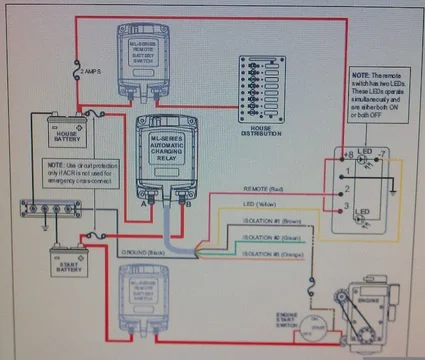
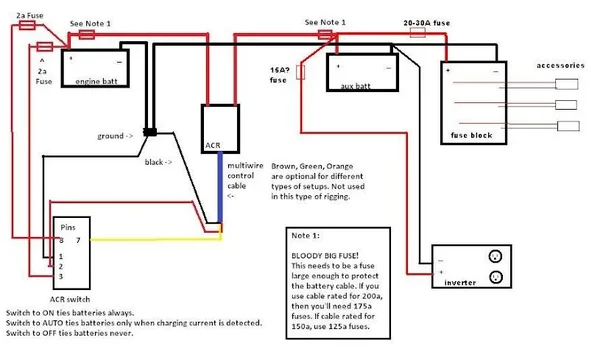
When wiring this up.. Im going with a Blue Sea Auto Relay.. do I need to have an inline fuse for each battery ? If so how big/small of a fuse ? the relay im getting has a blue print but its for boats.....(that's what I understand from looking at the PDF). anybody has a simpler diagram to wire this this up...?
I can't get the pdf to load properly, so I've no idea what its diagram looks like. Even tried @ work w/ no luck. Can you post it here? I *think* Mud allows pdf attachments.
If you're going to install fuse(s) in the charge wiring they need to be rated for at least the alternator's maximum output, what ever that is. Wouldn't hurt if they were up to 5 amps more than rated output.
I used a Blue Seas breaker instead of a fuse. Footprint is slightly smaller and no need to carry a spare.
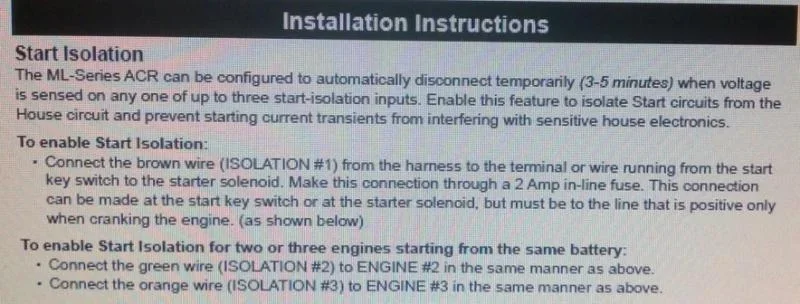
My BEP Marine VSR only needed a cable from each battery and a small wire for it's ground reference. The Blue Seas units have additional small wires for external referencing and manual, forced operation, but I don't think that connecting them to something is a requirement.
Here is the PDF file....
BTW... I was going to use fuses rated at 200amps.. my alternator is rated at 160 amps....... but sounds like the breaker is a better option..
Thanks for all your input
Unless you want to I don't think that you need to bother with the control wires, can ignore them for a simpler install. Which would be my suggestion. Use a marine battery switch to combine the batteries if you think that you might need to. Or carry some jumper cables.
I used 1 AGW wire from the ACR to the batteries and fuse them with a blue sea 200 amp fuse.
I also ended up using that little remote switch and its pretty cool I must say.. I installed the actual ACR inside the cab next to the passenger lower corner on the right...
The way the remote works is Combined mode, Auto Mode and Off mode.
On combined mode Im using both batteries if needed be for ( X ) reason.
On Auto mode when I start the truck the system turns on after 90 seconds and the red LED's turn on on the switch... when I turned the truck off the system isolates the banks until it senses a different voltage from either bank... Its pretty cool to see it go on and off whenever it needs to....
On Off mode the house battery does not get charged