


- Thread starter
- #21
I'll get some pics up soon. Thank you for the warm
Follow along with the video below to see how to install our site as a web app on your home screen.
Note: This feature may not be available in some browsers.
This site may earn a commission from merchant affiliate
links, including eBay, Amazon, Skimlinks, and others.


I still do the old fashioned 3000 mile interval. I drive two trucks and I try to get 3 oil changes per year in on both of them, but I don't always get there. Someone said almost no oil can go past 200 hours of use and still be good enough to do its job and it breaks down pretty quickly after 6 months. I just buy regular 10w30 dino or synth-blend in gallon jugs from places like Fleet Farm or WalMart. It takes two gallons to do an 80 and I use the new, small Toyota filter. I note much less start up screech/rattle/knock and the oil level stays at the full mark through the whole interval and looks golden until about 2500 miles and then it becomes darker, but not black.What mile interval are you guys using????

I use 5k in the Cruiser and infinity in my LX. The LX eats a quart of oil every 1k miles, so I feel like it always has partially fresh oil in it and is simultaneously lubricating everything from the valve cover down and the underside of the truck

What mile interval are you guys using????
This is exactly what my rear main has been doing for a good 6 months. I'd rather add a few bucks in oil every once in a while vs. tackling that job.

What I read was that the detergents in at will clean out gunk in the engine. Oil pressure needle sits at 1st mark on gauge-approx. 1/3 up the gauge.


I got my 91 fj80 Jan 1 290k. ...
If that's at idle, then you have great oil pressure. If that's at, say, freeway speeds, then you may have a problem.
Modern oil pressure gauges often lie. People tend to freak out when their oil pressure drops at idle, so manufacturers started fudging the details. If you're used to newer vehicles, it might shock you to see an accurate gauge.
As for engine cleaning, I've personally been using Sea-Foam in the crankcase before oil changes since I bought my rig, because I saw substantial sludge. I do the 15 minute idle, then drain. It comes out really, really black, so I suspect it's working. I'm not going to pull the valve cover to check, though, I just wanted to reduce the sludge before switching to Mobil 0W-40.
Dumping in a quart of diesel or kerosene is the old-school way to remove sludge. To be honest, I think you could put in a pretty wide variety of petroleum products without damaging anything, provided that you're only idling it.
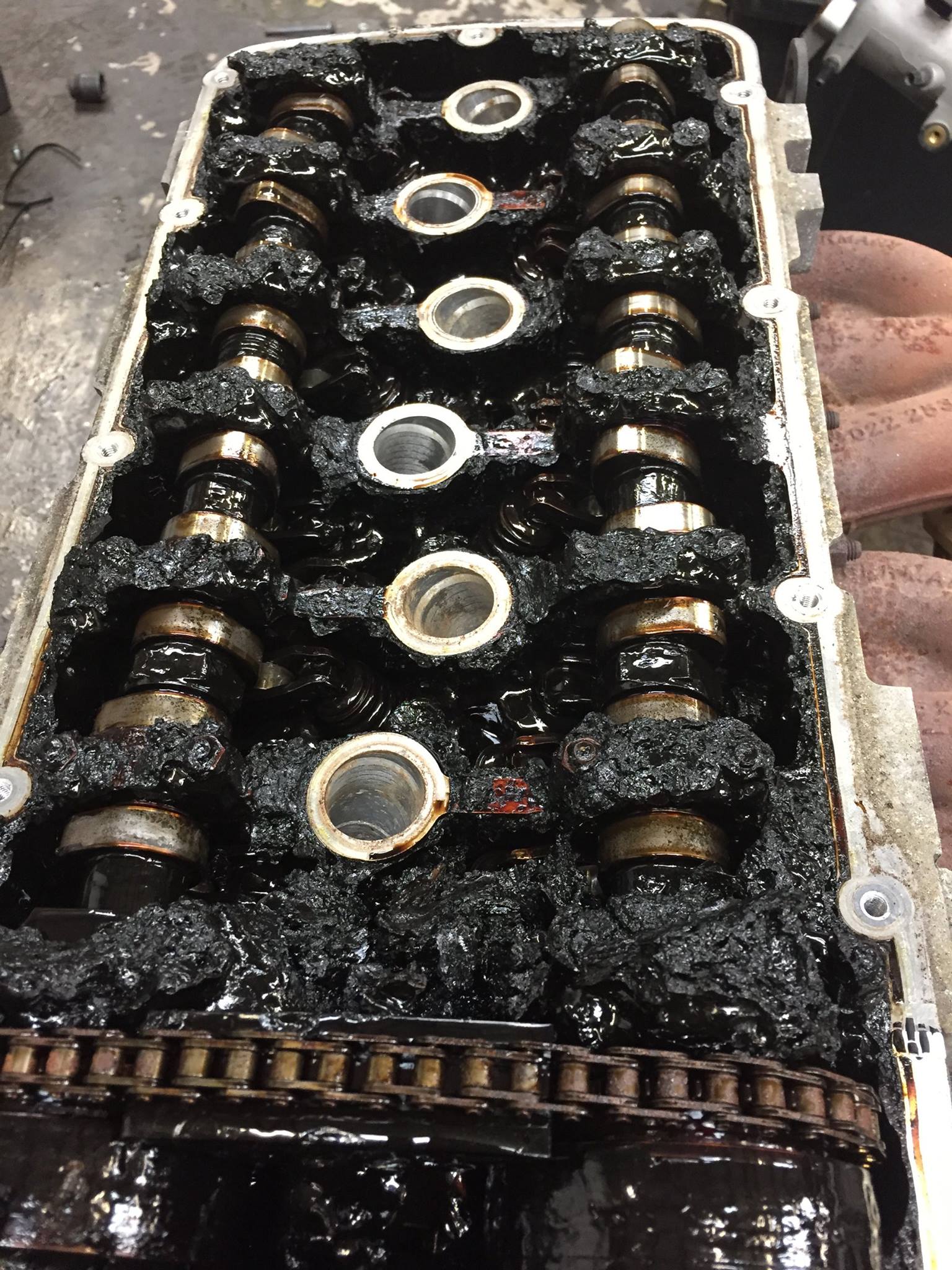
We're all just being precious about it, though. Here's some real sludge!
How much Seafoam are you adding???? I've ran it in my fuel but never added to the oil.
Oil pressure doesn't seem to change at freeway speeds.

I'm in San Diego and my 80 does well on 10W-30 dino. I need to change one of the rigs soon as the interval has passed 7K mi. Blackstone Labs can tell me how the oil is doing and advise on future interval.Not sure what's in there just got it. Assuming 10 w-40 or 10 w-30. I'm in southern Az should I go to a heavier oil? I think manual recommends 10 w-30

We're all just being precious about it, though. Here's some real sludge!
Dang...........that looks more like 'pumice'.

That's a random pic of an Audi with 84k miles without an oil change. Sort of puts things in perspective.

Any thoughts on additives-marvel mystery oil et al?
Because they have higher levels of detergents in them. The downside is that running diesel oil will do damage to your cats and in my experience, it's too thick at the 15w40 that is most commonly available in my ass cold environment.
My personal suspicion is that the detergents in the diesel oil loosen a ton of sludge and other gunk and then that gets blown all over the cats and they get clogged. If I were planning on a new exhaust system, I would run like three batches of Rotella through my rig and then do the exhaust job and then I would just switch to normal 10w30.


