Normal Oil Pressure on Gauge for 1HD-T?

This site may earn a commission from merchant affiliate
links, including eBay, Amazon, Skimlinks, and others.

I dont know about the B oil sender. Ive only looked at 1HZ 1HD T 2H 3F and some of the Toyota cars like Corrola and Camry 4cyl and they have the same.

I would hire a mechanical gauge and find the exact pressure in PSI;)

OK if you prefer numbers, I prefer to find out where I am within the acceptable range, that's why I prefer the OEMs. A guage that doesn't move much is not very useful to say the least, and an aftermarket one usually doesn't look good.

Does anyone know the resistance value of the OEM sender per PSI? Any figures in the service manual? I'm pretty sure the problem is probably related to deformation of the diaphragm, i doubt it would be electrical.

Chris
 
I dont know about the B oil sender. Ive only looked at 1HZ 1HD T 2H 3F and some of the Toyota cars like Corrola and Camry 4cyl and they have the same.

I would hire a mechanical gauge and find the exact pressure in PSI;)

X202
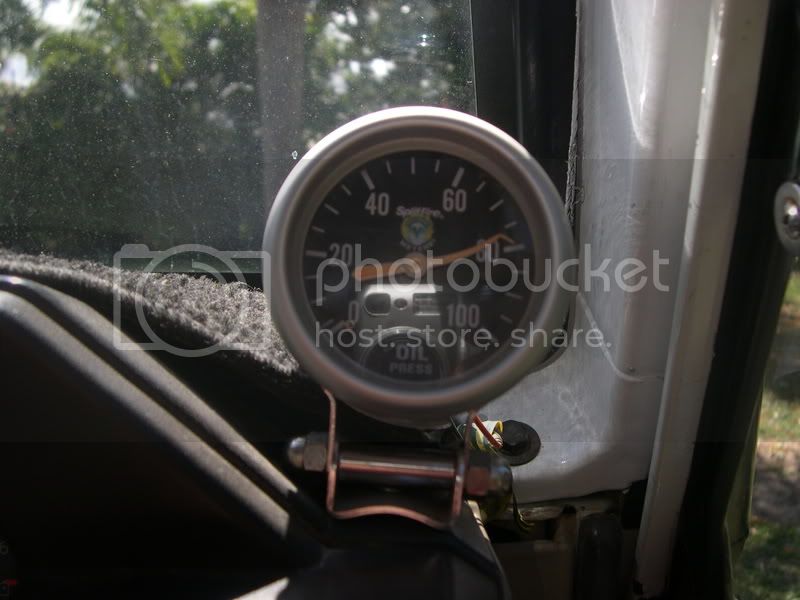
My oil pressure split and bent my oil filter also bending the pointer on the gauge shown because of a crook oil pressure relief valve. However the original toyota gauge never showed more than 3/4 the way up and very briefly. The original gauge is a decoration as is the temperature gauge. Though I am not saying a 1HZ or 1HDT will make this pressure. From the spacing something in the order of 100 to 120 lbs at least.
rainforrest067.jpg
 
X202
My oil pressure split and bent my oil filter also bending the pointer on the gauge shown because of a crook oil pressure relief valve
rainforrest067.jpg

Whoa!!!!

I suppose low oil pressure could also be caused by a valve opening too soon as well... Bum spring, possibly...

Other than you gauge having suffered that bizarre fate, any other sequels to this?
 
OK if you prefer numbers, I prefer to find out where I am within the acceptable range, that's why I prefer the OEMs. A guage that doesn't move much is not very useful to say the least, and an aftermarket one usually doesn't look good.

Does anyone know the resistance value of the OEM sender per PSI? Any figures in the service manual? I'm pretty sure the problem is probably related to deformation of the diaphragm, i doubt it would be electrical.

Chris

When you plug a mechanical gauge in you remove the sender so you are getting the actual pressure measured in psi.
It removes the electrical side of things from the equation.
Once you know that you have good pressure then you can investigate the electrical side of things.
The gauge and sender readings can be affected by other things such as resistance in the connections elsewhere or an alternator thats thinking about taking a dive.
This is the protocol the FSM advises.

I pull my sender out and plug a gauge in when doing service. I plan on keeping this up so I can detect(hopefully) any deteriation.
 
Both.

I don't really see a difference at idle cold or hot.

I won't drive it hard under load until it's warmed up.

I suppose the big end bearings were replaced?
 
Interesting discussion. I just finished doing the beb and my wife took the unit on a couple hour drive and I had told her to watch the oil pressure. I was concerned when she indicated that it was running at 1/3 on the gauge when traveling at 100km/hr. So based on suggestions here I decided to put a gauge on to test the oil pressure.

Some relevant info
1991 HDJVXLTD 1-hdt engine with 106,000kms
running 15W40 full synthetic Amsoil, just changed, new toyota Oil filter
Cold start oil pressure takes a couple of seconds to register then hovers around 1/2 on the gauge
At operating temperature at idle gauge hovers half way between low and 1/3
At operating temperature at 2500rpm gauge hovers just above 1/3
When I went to put on the pressure gauge I quickly realized that I needed a metric thread to adapt to the normal pipe thread on the pressure gauge (FYI).
At operating temperature and idle the pressure read 35psi
At operating temperature and 2500rpm the pressure read 72-75psi and seemed to max at that point.

Just thought I would share my readings because I was quite concerned about the low gauge readings when the unit was warm and idling. But given the min pressures somebody posted above, no worrys here.
 
Interesting discussion. I just finished doing the beb and my wife took the unit on a couple hour drive and I had told her to watch the oil pressure. I was concerned when she indicated that it was running at 1/3 on the gauge when traveling at 100km/hr. So based on suggestions here I decided to put a gauge on to test the oil pressure.

Some relevant info
1991 HDJVXLTD 1-hdt engine with 106,000kms
running 15W40 full synthetic Amsoil, just changed, new toyota Oil filter
Cold start oil pressure takes a couple of seconds to register then hovers around 1/2 on the gauge
At operating temperature at idle gauge hovers half way between low and 1/3
At operating temperature at 2500rpm gauge hovers just above 1/3
When I went to put on the pressure gauge I quickly realized that I needed a metric thread to adapt to the normal pipe thread on the pressure gauge (FYI).
At operating temperature and idle the pressure read 35psi
At operating temperature and 2500rpm the pressure read 72-75psi and seemed to max at that point.

Just thought I would share my readings because I was quite concerned about the low gauge readings when the unit was warm and idling. But given the min pressures somebody posted above, no worrys here.

This is indeed very, very interesting. That is exactly the information I was looking for, and your gauge seesm to behave exactlky like mine. I just have to get those darn bearings, the only thing slowing me down at this point is the fact I have to open up the crankcase and only then can I order the bearings. Impossible for me, it would take way too long with a truck out of commission :(

When I'm back home I will take the oil sender out of the 60 and see whether I can install it on the 80. Still have to get a cheap oil guage, thought I had one but I don't.

Thanks for your input y'all, it is much appreciated!

Christophe
 
your gauge seesm to behave exactlky like mine.
Christophe

As roscoFJ73 said right at the beginning...the stock gauges are notoriously inaccurate.

I can't count on my hands the differences I have seen in gauge readings, then when processing a truck find out the oil pressure has no bearing between readings on different trucks.

1st time I drove an HJ61 from the docks back home I almost had a heart attack when the engine was up to operating temps, and I stopped at a light. The gauge when down to the bottom line...as if no pressure. Later, when on the gauge it was 35psi at hot idle. Another truck shortly after would read 1/3 at hot idle and had 30psi hot idle.

As you have summised, the ONLY way to be sure of "your" oil pressure (and to get a datum on how to gauge your oil pressure needle) is to put a PSI gauge on it, and run it up.

And get those connecting rod bearings done...

hth's

gb
 
I suppose the big end bearings were replaced?

Your not confusing big end bearings with main bearings are you? Its the main bearings that affect the oil pressure,but I am aware the big ends need checking/replaced
Its better to hire a quality gauge than buy a cheapy
Also,did you try an oil change?
 
Your not confusing big end bearings with main bearings are you? Its the main bearings that affect the oil pressure,but I am aware the big ends need checking/replaced
Its better to hire a quality gauge than buy a cheapy
Also,did you try an oil change?

Pardon me Rosco but it seems to me that any worn bearing would cause a drop in oil pressure, big end or main. Seeing how badly pitted some of these big end bearings turned out to be, comparing to how nice and clean the mains often are, it would seem to me that poor oil pressure could indeed be caused by bad BEBs.

I finally got my oil filters: 90915-30002 in Saco, Maine, for US$9.53 each. That's just above $160 including Maine Sales Tax for 16 of them, or less than 12 cannuck loonies apiece. (BTW they come in boxes of 10) Compare that to CDN$33-36 each in Quebec with 1 to 5 weeks waiting time and about $28 each in BC, before federal and provincial taxes (between 7 and 15% depending on the provinces). That comes down to less than a third of whet they want for in the 'Great White North'...

OTOH they wanted $136 for the 16"x6"steel rims, which can ge gotten for $85 in Canada (about half price)...

Of course I had to show the mechanics at Prime Toyota in Saco the beautiful turbo diesel engine :)

Told ya my trips south of the border always pay for themselves :)

I've located some Amsoil 15W40 Diesel and Marine oil in a NAPA store nearby, but ouch! US$83 for 12 quarts (about 11.34litres)... If any of you know of a better price in Maine, please let me know, I think I'll go for some Rotella synthetic for now (about $4 a quart) until I get a chance to change my big end bearings.

Now that I've got my oil filters, I'll be doing my first oil change as soon as I get home, promised!

Christophe

 
I've located some Amsoil 15W40 Diesel and Marine oil in a NAPA store nearby, but ouch! US$83 for 12 quarts (about 11.34litres)... If any of you know of a better price in Maine, please let me know, I think I'll go for some Rotella synthetic for now (about $4 a quart) until I get a chance to change my big end bearings.Christophe

What's Esso XD 0/40 (synth) in your neck of the woods? Around here it is $24.00 a jug, and with it's additive pack/base qualities is one of the better deals in synth out there imo. Do some oil testing at different kms, spin on a new filter at 5000kms, and see what the results say...

hth's

gb
 
Pardon me Rosco but it seems to me that any worn bearing would cause a drop in oil pressure, big end or main. Seeing how badly pitted some of these big end bearings turned out to be, comparing to how nice and clean the mains often are, it would seem to me that poor oil pressure could indeed be caused by bad BEBs.

Well if you were serious about low oil pressure you would have taken the advice from myself and 3 other forum members about doing a proper test rather than fawk around with 2nd hand oil pressure senders
:rolleyes:
Also you would have changed the oil and not moaned about the cost as that also greatly affects the oil pressure and the longevity of the bearings more than anything.

As for the beb causing low oil pressure ,not until its too late any way.
The beb usually spin in the shell when the engines young and still has good pressure.
The manual zeroes in on the main bearings as the culprits of low pressure.
 
1Hz turbo external oil leak?

Hi , I have a oil leak on my newly rebuilt turbo 1hz. While driving at 110kms/hr for about 180kms today my low oil sensor came on. On inspection there was oil on the exhaust side of block and also back on the gearbox as well 2ltrs to top it up. There apears to be oil covered on the actuator valve and I think this may be the area. There isnt much on this side to leak. Another thing also. The last 2 days I noticed oil pressure on gauge was very high and didnt drop much blow the high mark. Today it started out high but settled back to the normal half way. Over the next week I will remove the air cleaner box and the hose air intake to the turbo for a better look. Turbo is gen ct-26
 
Back
Top Bottom