

Help decipher fuel system spaghetti monster

This site may earn a commission from merchant affiliate
links, including eBay, Amazon, Skimlinks, and others.

RWBeringer4x4

Mechanically Challenged
SILVER Star
Joined
Jul 11, 2012
Threads
140
Messages
5,545
Location
The People's Republik of Maryland
Hey everyone,

I've been under the truck quite a bit while the engine is out, and this is one more mustery I'd like to solve before it goes back together.

This truck came to me from the PO with a half-installed auxiliary tank bolted to the rear bed. It looks like it had been almost completely plumbed but never finished. I pulled the auxiliary tank years ago as its a pretty poor design, but the rest of the fuel system is still under the truck. I'd like to clean it up.

Toward the back of the truck, behind the stock fuel tank, are two "things" that seem to have controlled the transfer of gas from one tank to the other at one point.
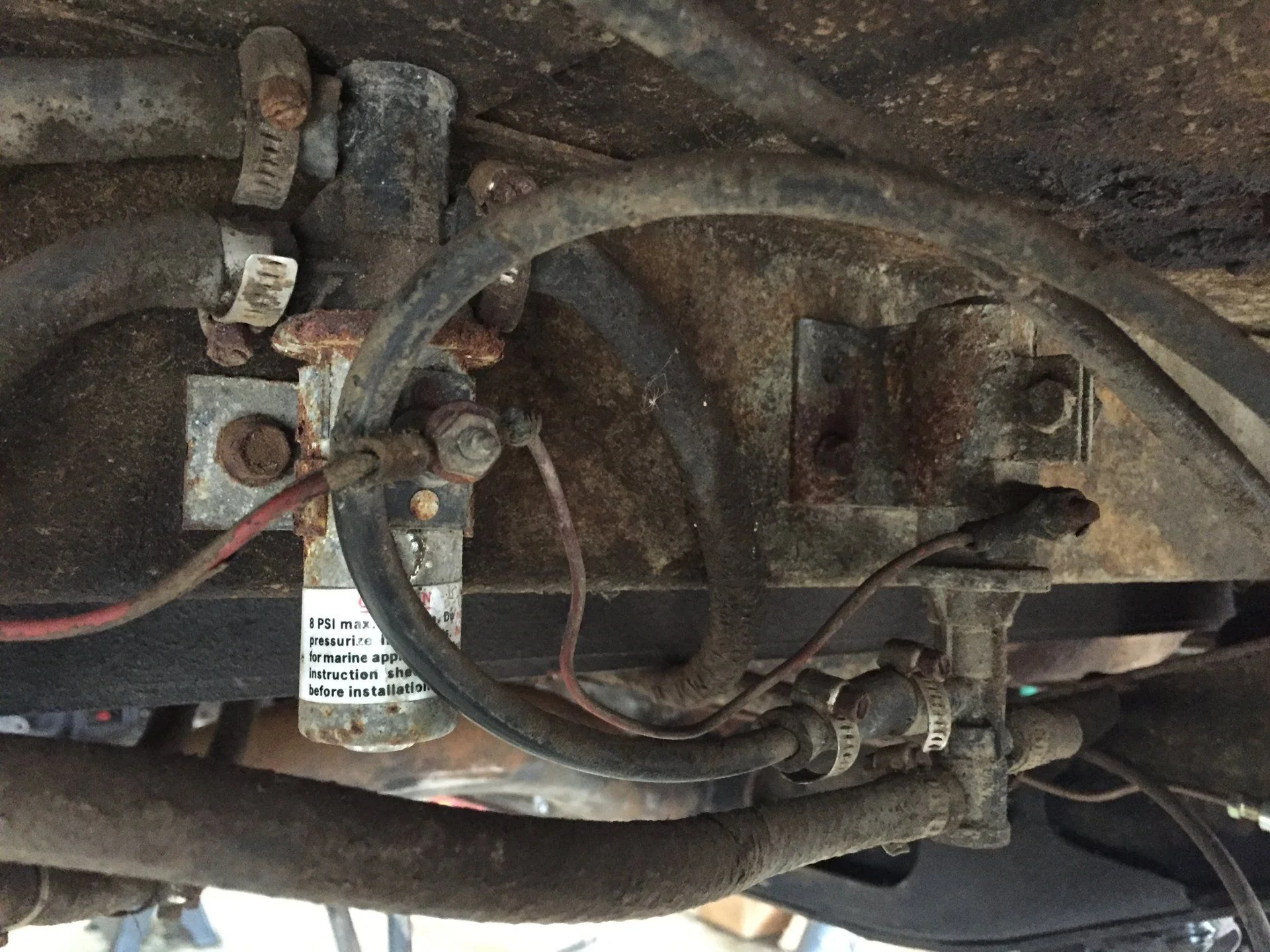
image.webp


In the foreground I believe is a pump - it mentions "8psi max" on the label, and the red wire heads to a switch on the dash labeled "AUX."

I'm not sure what the other junction that hangs lower is.

I think I can just remove this whole setup, correct?

Up front, all the original lines and the charcoal canister appear to be there. It appears all the return lines had been cut and plugged, the canister is there for show, as far as I can tell. The line with an open "T" fitting is still connected to the fuel separator in the cab.
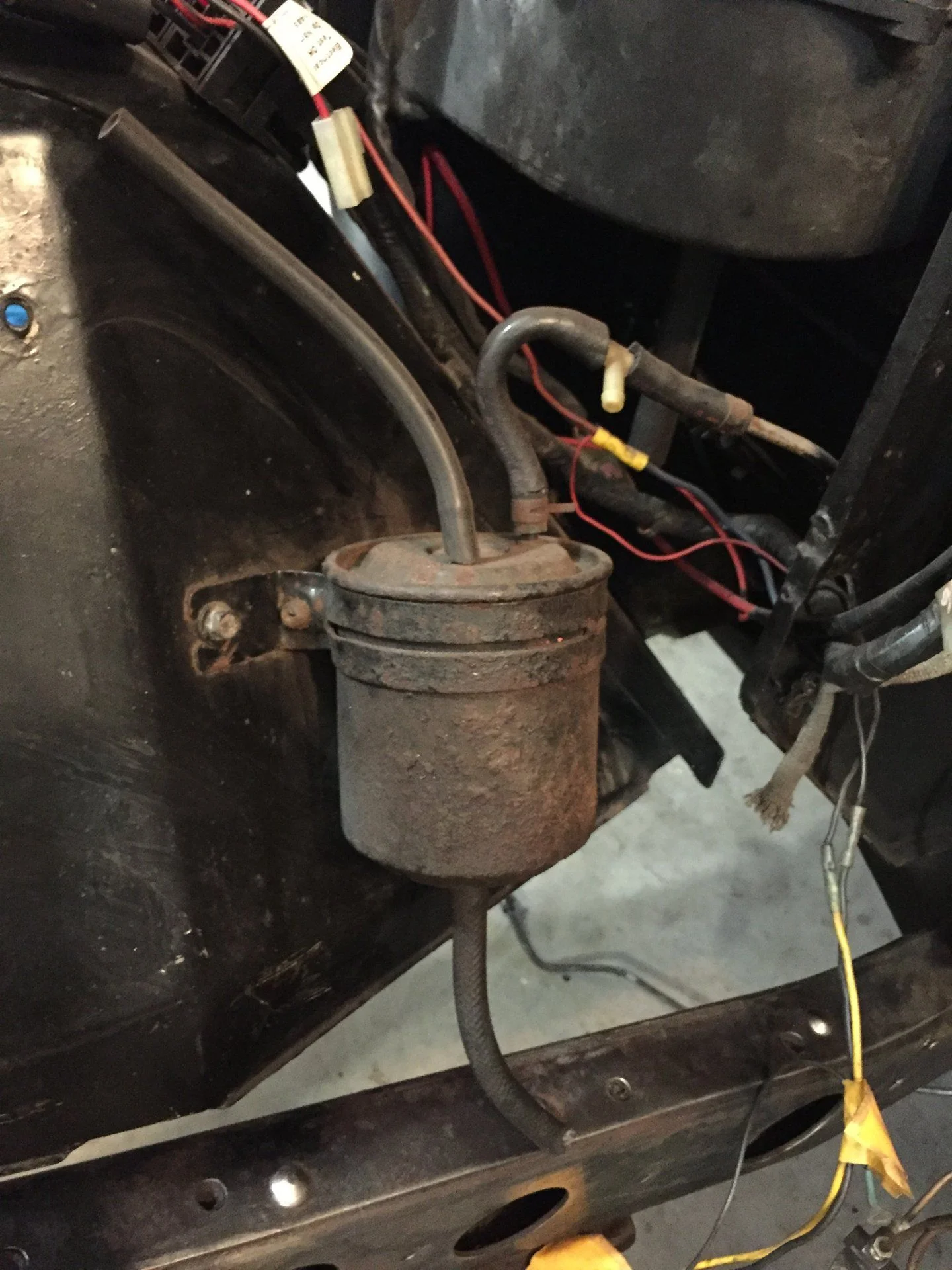
image.webp


This truck will run a 350 with a quadrajet. It doesn't have emissions controls to speak of. What does a proper fuel system for this setup look like? Would a return line from the carb connect at that T fitting above?

I assume the fuel line connection on the bottom of the gas tank runs to the carb (so the fuel flows through it via gravity). I assume I would route this line to the hard line on the frame rail, to the fuel pump, then a filter, and into the carb.

My next question is - is there supposed to be a return line? Vent lines? Etc. on a quadrajet? I don't think I was running one previously...If so, how does that get routed back from the quadrajet to the tank?

Is there any reason to try and reconnect the charcoal filter or the fuel separator in the cab? They're all still there just in various states of disconnected.
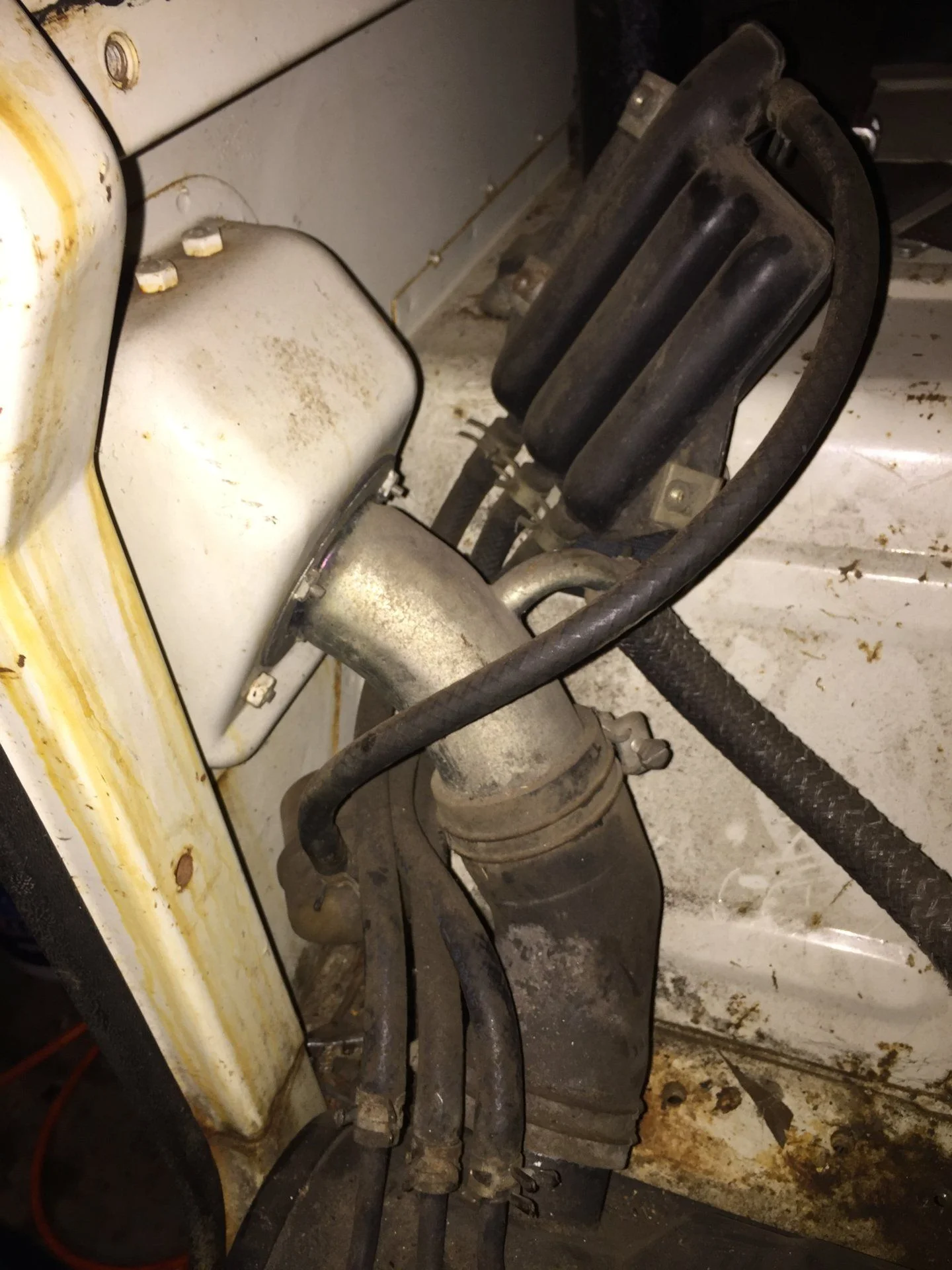
image.webp
 
Those "two things" both look like electric fuel pumps to me... Are they really wired in series?

How is all the hose routed?

If your main tank is serviced by a mechanical pump... Or, a separate electric pump, you should able to remove all of this... It's hard to know for sure without know how it's all plumbed...

If I were to guess, I would say, it looks like a PO attempted to set up a method for transferring fuel both ways... Main to aux and aux to main... No idea why you would want to transfer both ways... That's just more complex than needed.

I don't now quadrajet... Can't help... But, I would place the filter between the tank and the fuel pump, to keep any crap out of the fuel pump.

Assuming you have an OEM main tank, you have two ports on the driver's side of the tank... Down low is the fuel feed or pickup... Midway down the side is the return port... so,e trucks route the return, from the carb, back to the tank return port... Others have a 3-port mechanical pump... I THINK those pumps handle the return origination at the fuel pump... E.g. No return port on the carb... But, I could be wrong... Again...

Again, I don't know quadrajet... But, the whole point of the fuel separator and the charcoal cannister is to keep fumes out of the cab and out of the atmosphere... If you aren't aren't smogged... we don't have a real EPA anymore... you could probably get by without it all... But, let the quadrajet gurus answer.
 
Hey Danny,

Thanks for the info - yes the whole thing seems just as clugey as the rest of the mods on this truck... Here's where all the hoses come and go to...

Fuel system.webp

I had been running a manual fuel pump, and to my knowledge, these two pumps don't work...

It seems like the pump on the left draws fuel from the pickup and pushes it up to the carburetor. I don't know why it would have that additional pickup on top to the auxillary tank. The second pump seems like it might pull fuel from the aux tank and push it to the main tank via the main tank's vent line (the DS line higher up on the side of the tank). However, I have no idea why they had the line sticking out on the right run all the way up to the charcoal canister, connected to one of the original fuel lines, and plugged with a bolt in the engine bay.

To make things even more confusing, there was ANOTHER fuel line inside my frame rail, similar the the plastic lines for the Aux tank seen here, but it wasn't connected to ANYTHING on either side - just hanging loose in the frame rail, zip tied to the rest of the lines...

It sounds to me like I could do away with this whole setup, and I likely will. From there it's just a matter of figuring out how best to plumb the Q-jet. I always heard not to run a filter before the fuel pump as it can cause cavitation.

Obviously I'd like the minimize gas fumes for both me and the environment if I can, but I also like simplicity - so I don't really want to plumb in a whole chevy emissions system either.
 
Those two pumps may not work because they aren't grounded... If they were grounded to the frame or chassis, that ground I'd probably so corroded, it's no longer sufficient.

Based on your pic, notes and narrative... And the fact that those two pumps appear to be wired in series... I think the intent was to transfer fuel to the main tank, to replace fuel pulled from the main tank, in realtime... But, if that's the case, why wire to a switch on the dash?

It's all moot anyway, if you won't be running an aux tank... Just rip it out... If you decide to install an aux tank, you could set up a simple transfer, to refill the main tank, from the aux... Or, make it more complex (like mine) and then try to remember how you did it... :eek:

The extra lines in the frame rail are probably what the PO replaced with this setup... he probably couldn't get to to work, got frustrated and quit trying to figure it out. Why clean it up, when you're in his future...

I haven't had any cavitation issues... But, the OEM Aisan carb only requires about 3-5psi... it aounds like yours is at least double that... And my Carter electric pumps are propellor driven anyway...
 
Nah - quadrajets actually operate at about 3-5 as well. 8PSI is about the max they will handle.

I may run an aux tank someday - but the one I have is a pretty bad setup - long all-thread shafts that run through sleeves in the tank and bolt through the sheet metal bed.

It is also square, not angled at the rear, which would probably make for some pretty big departure angle issues.

It's definitely a battle for another day. At this point the objective is to clean up and simplify things. I would rather start from a solid baseline and re-complicate it myself!
 
Mine is actually not angled and it hasn't been an issue... but I'm not a rockcrawler kinda guy... but, I wouldn't want that bolts-thru-the-bed setup either.

Sometimes, I wish a PO had done it, instead of me...
 
I might have missed it.. but those two three way things are fuel valves for selecting between two tanks. It's what I have in my rig. I can try to help more after work this evening.

edit: c'aint spell
 
Last edited:
I might have missed it.. but those two three way things are fuel valves for selecting between two tanks. It's what I have in my rig. I can try too help more after work this evening.

Yes, I think you're right. What confuses me is, it seems like the fuel system was designed so that the tanks transfer both from one tank to the other, and so that you could run off one tank or the other, and bypass the second tank. Seems over-complicated to me - doesn't it make more sense to just have the auxillary tank pump fuel to the main tank, then have the main tank feed the carburetor? The only real advantage I see here is that you could potentially bypass one system if a pump failed or a fuel line clogged...
 
On SBC's, and most of GM engines with mechanical fuel pumps, the return line is at the fuel pump. IT's really your choice if you want to run a return line or not. For years I ran a 2 port fuel pump 1 in and 1 out. A couple of years ago, I decided to go with a fuel pump that had a return line.
 
Ill answer what I can...mostly cause Ive been researching quite a bit on aux tanks and how to plumb them (since Im adding one).

Quadrajets dont (need) have to have a return line. If you google youll see pretty much 50/50 on it. Mine didnt have one and it seemed to run just fine (for the little bit i used it).

As for your plumbing...rip it out. It looks like instead of a 6 port switch, the PO used two three port valves and wired them to switch with one switch. The one going to the carb would have switch which tank was feeding the carb. The second one im not totally sure what he was going for with. But either way it was wired so when feeding from the aux tank, the aux vent line was going to the charcoal canister. Then when feeding off the main tank, the aux tank vent line was blocked off.

The Downey instructions I got show basically what your PO did but without the switching valve for the vent lines. Instead just doing a "T" from each tank to the canister.


As for the switching between tanks for the feed instead of pumping into the main tank...Ive seen both ways. The pickup truck my dad had growing up had it where you switched the "feed" tank. Never had an issue switching but didnt do it often (and dad eventually got rid of the reserve tank) as it was just an around town truck. But feeding the main tank from a larger aux tank you could overfill the main tank and end up with issues that way. So you would need to watch things to make sure you stopped the transfer when the main tank was "full" again. Also to transfer to the other tank you would need an extra pump. Your mechanical pump on the 350 would be pulling from the main tank. You would need a second electric transfer pump to move the fuel from the aux tank to the main tank.

Hope that makes sense lol.
 
On SBC's, and most of GM engines with mechanical fuel pumps, the return line is at the fuel pump. IT's really your choice if you want to run a return line or not. For years I ran a 2 port fuel pump 1 in and 1 out. A couple of years ago, I decided to go with a fuel pump that had a return line.

I believe the pump I'm currently running is 1 in, 1 out - so I may just stick with a single line for now.

Seems like the consensus is to just bypass what's left of the EVAP system (charcoal canister, fuel separator, etc.) - is there anything creative I can do there to make the truck less fumy, or am I asking for trouble?
 
Ill answer what I can...mostly cause Ive been researching quite a bit on aux tanks and how to plumb them (since Im adding one).

Quadrajets dont (need) have to have a return line. If you google youll see pretty much 50/50 on it. Mine didnt have one and it seemed to run just fine (for the little bit i used it).

As for your plumbing...rip it out. It looks like instead of a 6 port switch, the PO used two three port valves and wired them to switch with one switch. The one going to the carb would have switch which tank was feeding the carb. The second one im not totally sure what he was going for with. But either way it was wired so when feeding from the aux tank, the aux vent line was going to the charcoal canister. Then when feeding off the main tank, the aux tank vent line was blocked off.

The Downey instructions I got show basically what your PO did but without the switching valve for the vent lines. Instead just doing a "T" from each tank to the canister.


As for the switching between tanks for the feed instead of pumping into the main tank...Ive seen both ways. The pickup truck my dad had growing up had it where you switched the "feed" tank. Never had an issue switching but didnt do it often (and dad eventually got rid of the reserve tank) as it was just an around town truck. But feeding the main tank from a larger aux tank you could overfill the main tank and end up with issues that way. So you would need to watch things to make sure you stopped the transfer when the main tank was "full" again. Also to transfer to the other tank you would need an extra pump. Your mechanical pump on the 350 would be pulling from the main tank. You would need a second electric transfer pump to move the fuel from the aux tank to the main tank.

Hope that makes sense lol.

Makes perfect sense! I assumed I'd need one electric fuel pump to transfer from one tank to the other. The confusion lay in the fact that my truck seemed to be running THREE pumps - the two electric pumps at the rear and the mechanical pump off the engine. Pretty confident only the mechanical pump was live though.
 
Im sure its not correct, but all my tank lines on the trail rig are capped, except supply and return. Im gonna eventually try to do a more stk set up on my street cruzer. Right now they're all capped too.
 
Makes perfect sense! I assumed I'd need one electric fuel pump to transfer from one tank to the other. The confusion lay in the fact that my truck seemed to be running THREE pumps - the two electric pumps at the rear and the mechanical pump off the engine. Pretty confident only the mechanical pump was live though.

So if you are running one tank and a mechanical pump, all you need to do is run a single line from the fuel tank pickup to the pump, and pump to carb, obviously..

And then for the tank vent. On mine I had a vented gas cap which would leak. I got tired of that so I installed a sealed cap (I think stock ones are) and ran a tank vent line up out of the tanks about a foot high, then straight down out the bottom of the 40, and a fuel filter on the end to keep dust out.

With the vent line going high it keeps any fuel from splashing out the line, and then having it go out the bottom ensures fuel wont flow from the tank if you end up shiny-side-down. edit: I think you can buy a roll over check valve too

I personally had to deal with a 6 port valve because of my two tanks and an EFI fuel return line, but yours should be a slam-dunk with one tank and no return.

Hope this helps. Cheers

another edit!: don't seal up the tank completely and have no vent. In addition to possibly having fuel starvation problems while you're driving, on a hot day with the rig sitting, the tank can become pressurized and possibly force fuel through the carb and into the engine and oil. This is bad!
 
Last edited:
Cool - Simple solutions are almost always the best ones!

As for caps - is there a specific cap that works elegantly? My go-to has always been a hose-clamped bolt, but since the vent line will no longer be used and capped in the cab, it is probably best to use the "right" type of cap.

I'm guessing you just find the appropriate size on summit?

I don't know about the cap. I've just used the rubber vacuum hose cap you get in a bubble pack from the auto parts store. These are probably the wrong thing and they do eventually crack and need to be replaced. Let us know if you find something better! Thx, B.
 
Makes perfect sense! I assumed I'd need one electric fuel pump to transfer from one tank to the other. The confusion lay in the fact that my truck seemed to be running THREE pumps - the two electric pumps at the rear and the mechanical pump off the engine. Pretty confident only the mechanical pump was live though.

Definitely no reason for addition pumps outside of the mechanical run by the 350. Unless you were doing a transfer pump to move from the aux to the main tank. But in your case Id just rip all that stuff out, since its old and crusty anyways I wouldnt reuse it anyways. Then just go back to stock on the fuel supply of stuff.
 
You've had a lot of people chime in about what to do, so I'll not add to that. But, back in the late 60's and early 70's when I was learning all about this "mechaniken" thing everything that i worked on was simple. Just the tank, filter (sometimes before, sometimes after the fuel pump), mechanical pump, and the carburetor. No return lines (the needle/seat in the carb stopped the incoming fuel when needed), and the tank was vented through the fill cap, although the cap usually was way above the actual tank and thus kept the full tank from sloshing out the vented cap.

A simple system is all you really need, however an added vent system would help keep the fuel in the tank and not evaporating on the ground after being sloshed out. My 40 (a 1971) has a simple system, and I don't like wasted fuel being out on the ground. I eventually went to a more "complicated" system when I got a late 60's pickup. I added a second tank that was switched through a hand operated valve, but still vented the simple way.

Don

(yes, I know I a bit slow to post, just now catching up (again))
 
Funny, just bought a used 40 out of AZ and has exactly the same set up!
 
Funny, just bought a used 40 out of AZ and has exactly the same set up!
Was it finished and functioning? Mine was never completed and I never did quite figure out what it was supposed to do!
 
Back
Top Bottom