DIY 20 gallon auxiliary fuel tank

This site may earn a commission from merchant affiliate
links, including eBay, Amazon, Skimlinks, and others.

One of my favorite additions to my 80 is the extra fuel tank--I really enjoy not carrying fuel cans. :) I constantly missed having that functionality on my 100, even just for around-town driving. So, I duplicated the setup I did under my other truck.

It's a fuel tank for an '87-'95 (ish) S-10 Blazer. The pump/sender assembly changed a bit over the years, so I picked one from a 1990 because it has simple barb fittings instead of weird threaded things.

I used the mounting brackets for the same truck, GM part number 15684333, and the rubbery isolators 88983035.

A fuel gauge/switch unit from Apexus, and some fittings from Filler Neck Supply are the bulk of the rest. A 2" to 1.5" stainless reducer, a chunk of 1 3/8" hose to connect the Toyota filler neck back together, a 5/8" to 1/2" reducer, and a 45 degree angled 2" filler hose. (this was replaced by a 90 degree one later, the 45 wasn't going to work nearly as well) There are also a couple strips of galvanized 16ga steel, which I used to make tank straps. (18ga would be great also, the 16 is a little bit hard to bend by hand) Not pictured: a length of 5/8" fuel hose, (maybe a foot?) three feet of 1/2" fuel line, and a couple feet of 3/8" fuel line.

All pictured:


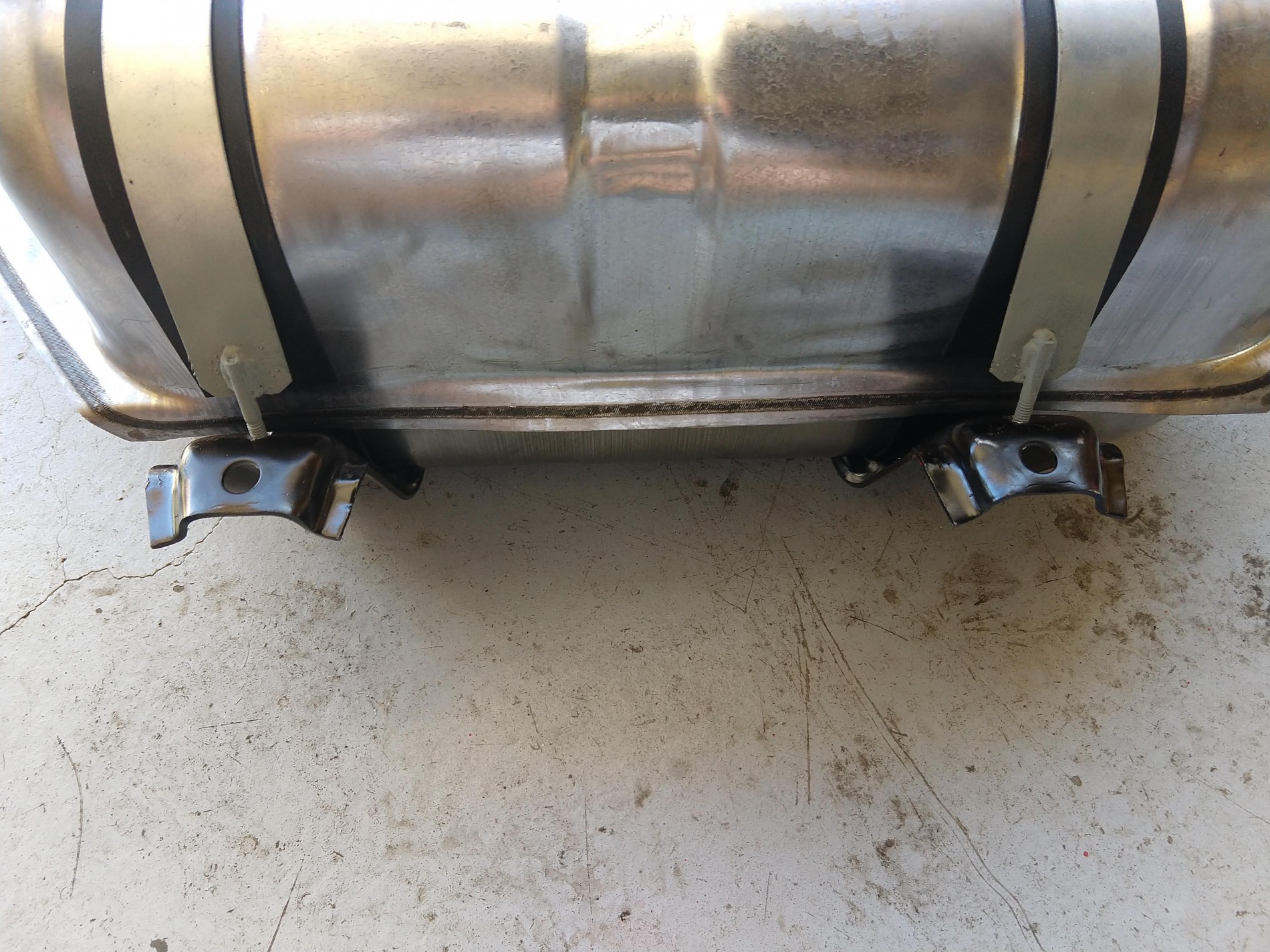
Here's how I did the straps--just welded a 1/4" bolt onto the end of the 16ga strip, drilled holes in the ends of the GM brackets, and bolted down with the rubber strips between all the metal-to-metal areas. I also dented the corner of the tank slightly, to leave more room for the Toyota filler tube. That may or may not be necessary, but it made me feel better. :)


4jAU.jpg


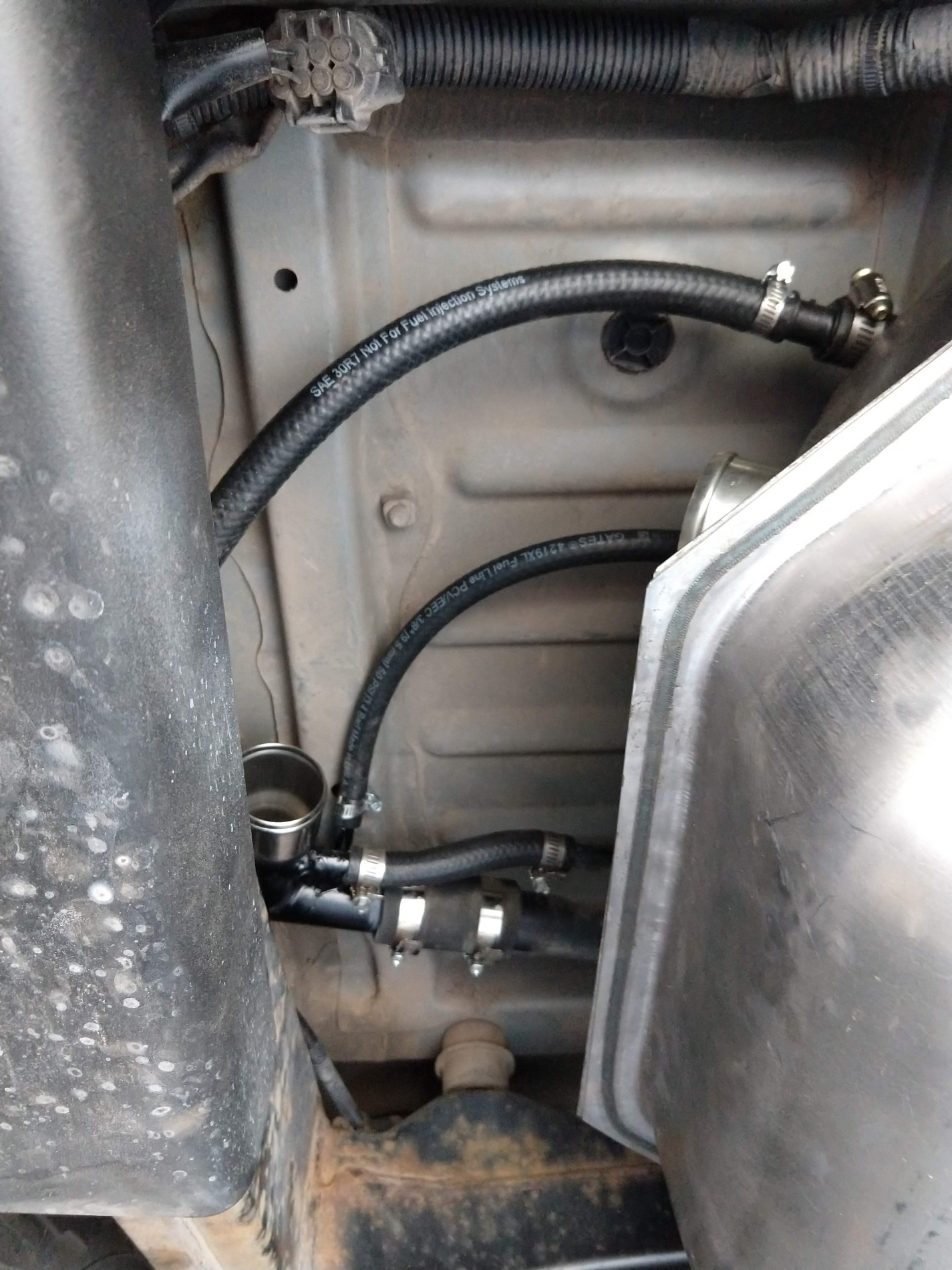
I won't be using the return line, nor the evap line--so I just looped them together as shown here. The large filler vent tube is 5/8", and that's what the 5/8-1/2" adapter is for. (the Toyota vent line is 1/2")

408C.jpg


4nJg.jpg


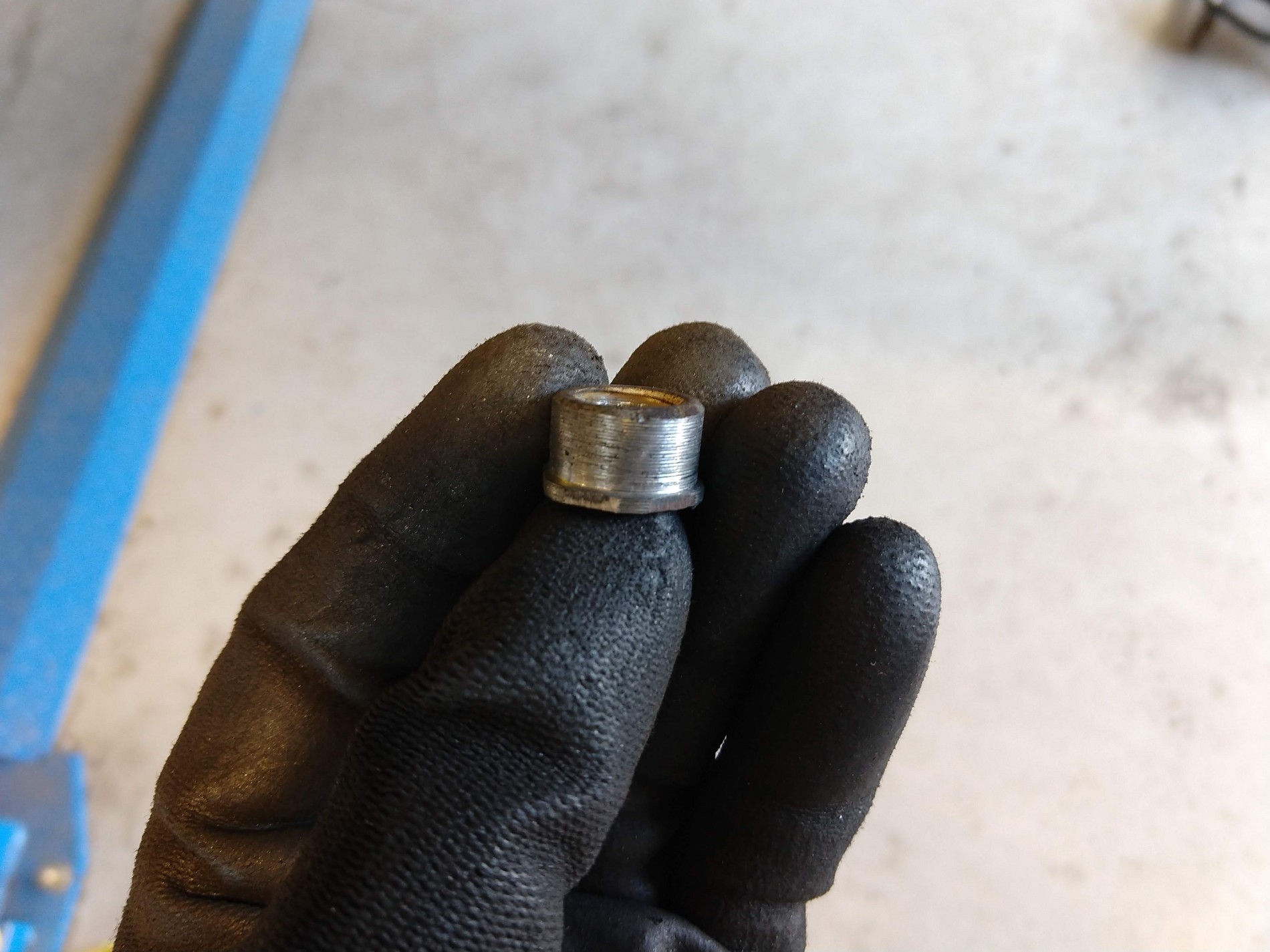
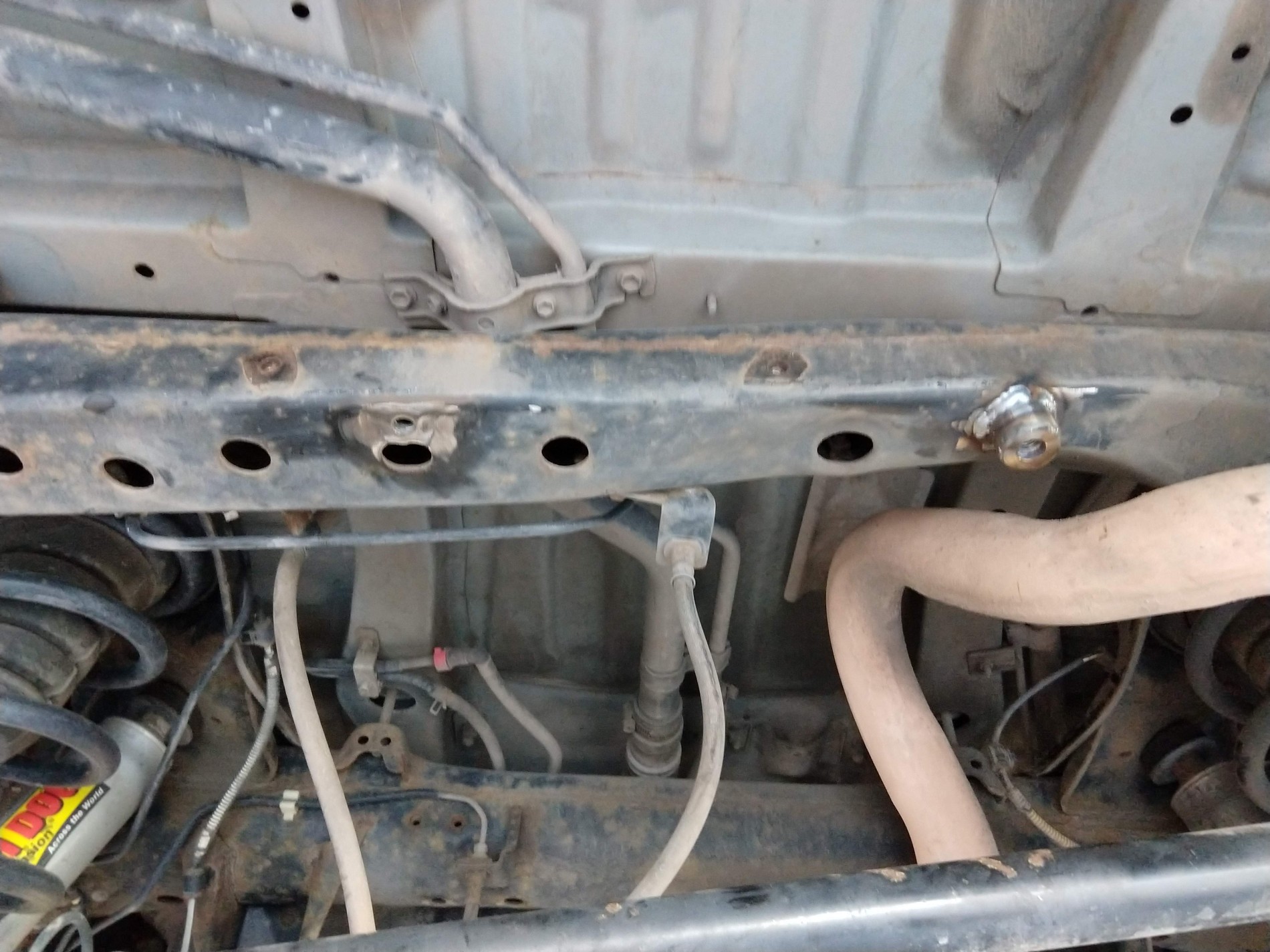
For mounting, I bolted the front end of the GM brackets right to the crossmember over the rear axle. I machined a nut to fit into a hole, like this:

zUHc.jpg


That was on the driver's side. On the passenger side, since the crossmember doesn't sit level I had to extend the bolt point .9". A piece of tubing, a washer, and a nut welded to the washer make this:


Welded in position.


For the rear of the tank, I just welded a chunk of angle between the framerails, with holes for bolts/nuts.


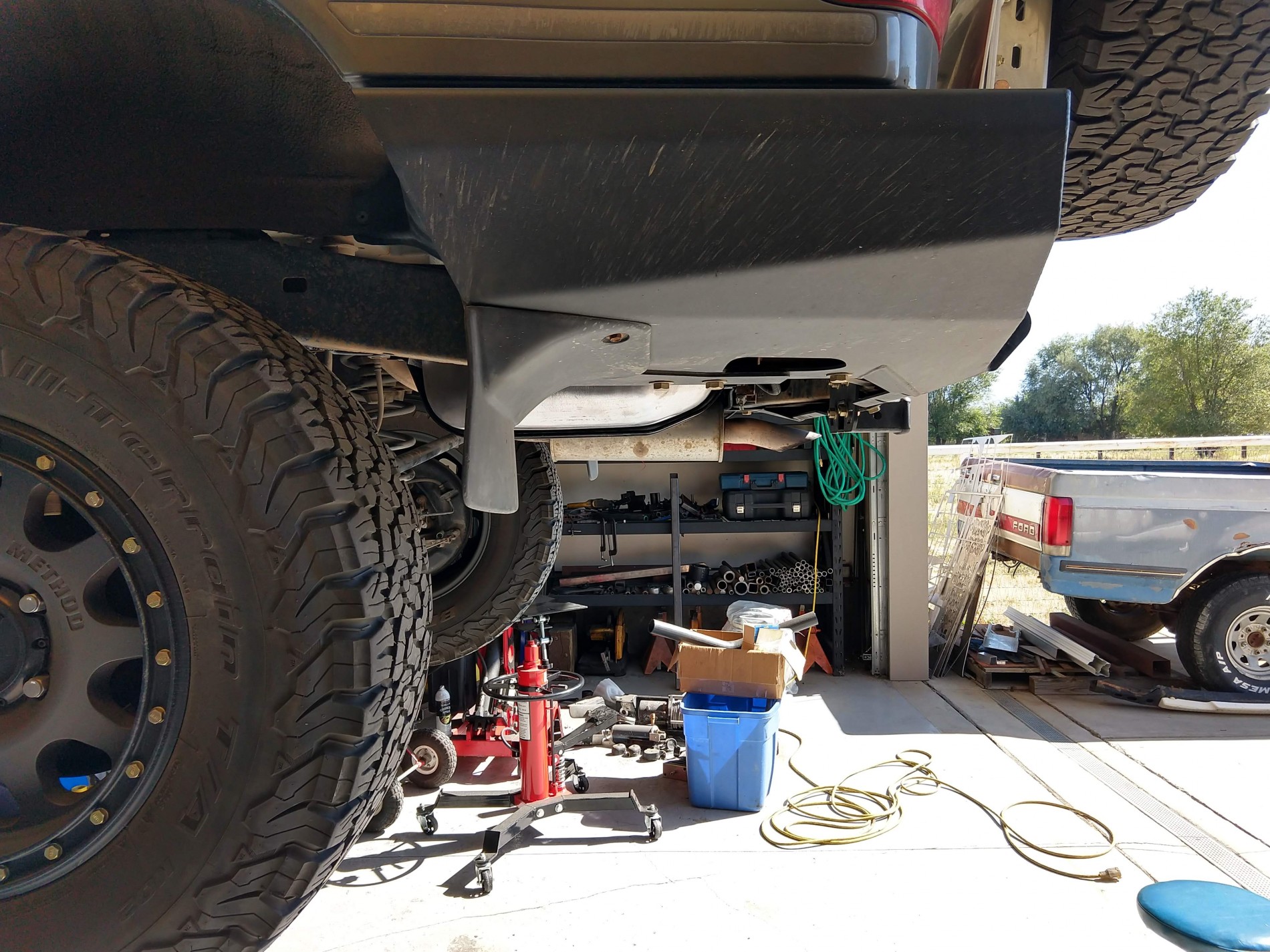
Painted and installed.


It does hang down below the framerails, but not anywhere near as far as the factory exhaust resonator. I centered the tank, and it has about 1/2" between the resonator and tank, maybe even a bit less. I'm sorta planning on replacing the resonator with a piece of tube, which I'll definitely do if I think it gets too hot or anything.


I didn't take too many pictures of how I built the filler tube--but it comes out easily enough after cutting it. :D There is just one bracket bolted to the body, behind the plastic inner fender piece.

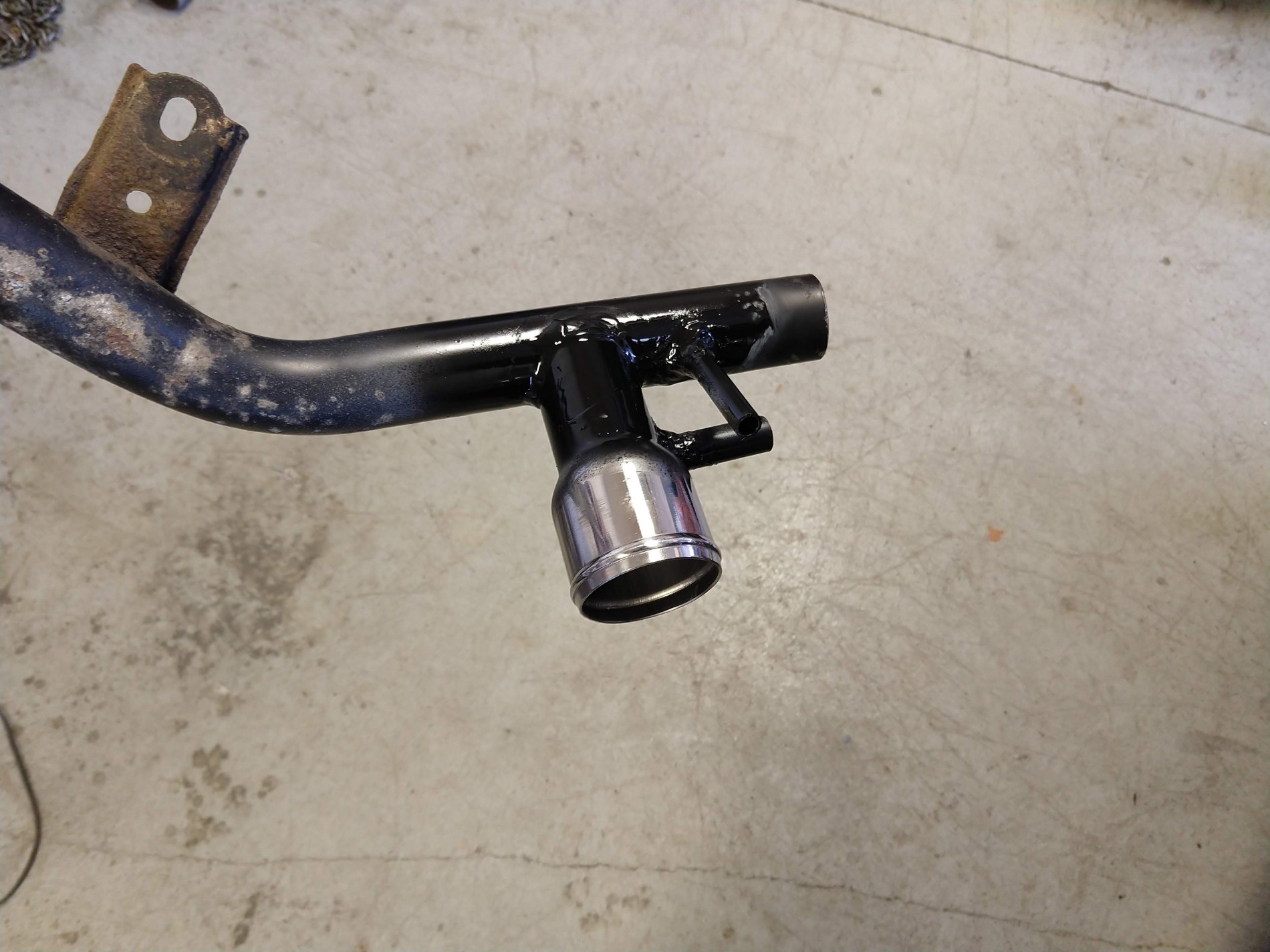
I marked where I wanted the "Tee" to go, and drilled holes in the filler tube. I left some material on the bottom side of the hole--the idea there is to bias fuel flow toward the stock tank when filling, and thus prevent fuel recirculating back to the aux tank when I'm pumping out of it. I also notched the stainless piece to fit the Toy filler tube.
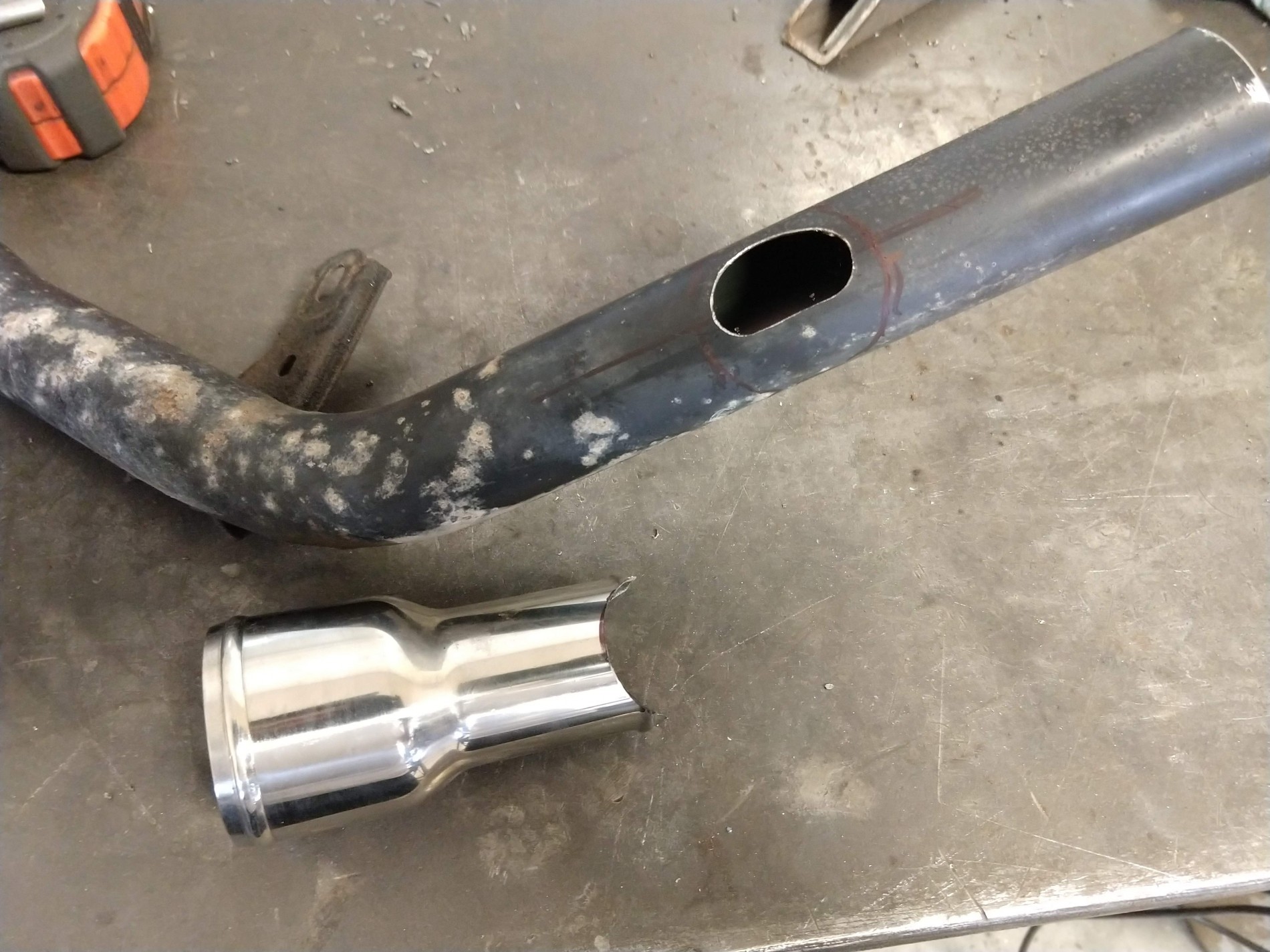


I used a piece of 3/8" brake line, and a piece of the 1/2" filler tube I cut away, to make the rest of the connections. The main filler tube sealed up perfectly, but uou can see I had some problems getting the smaller ones to seal after welding...I ended up chasing pinholes, and each time I welded one up I created two more. But I eventually prevailed, and coated the inside with fuel tank repair epoxy to kill any miniscule remaining leaks. ;)


All installed, minus the 2", 90 degree rubber filler hose. The spot I cut the tube is now hidden under the rubber coupler. The factory fuel vent is now connected to the "fill" of the aux tank, and the aux fuel vent is connected to the original vent going up to the filler neck itself. The 3/8" fuel line just runs from the pump outlet, into the filler tube heading to the factory tank.


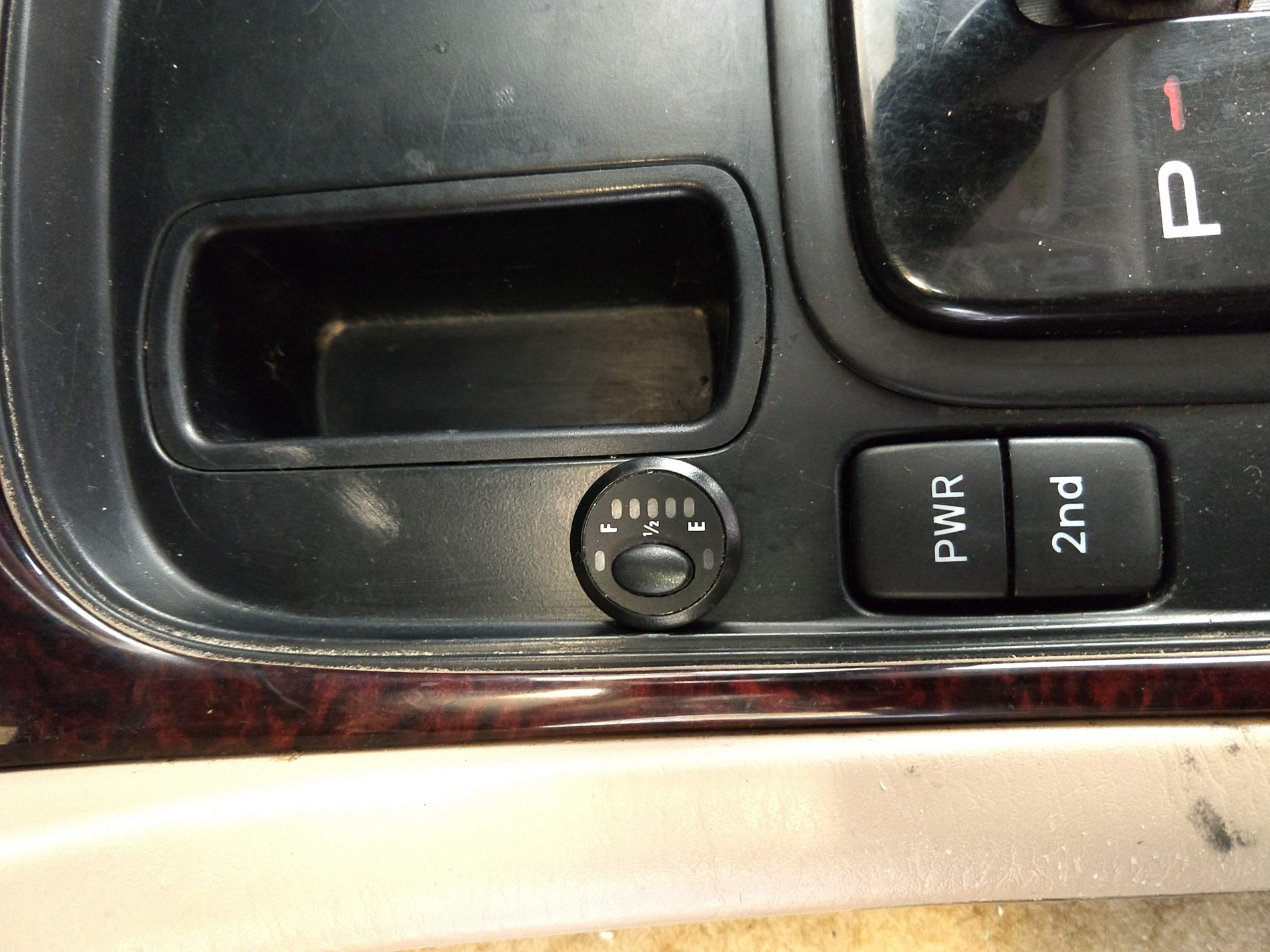
The fuel gauge/switch got mounted to the center console. LED lights show the fuel level, and the button turns on/off the fuel pump.


No pics, but there is a relay living in the jack compartment to energize the fuel pump.

First fill--I had somewhere between 1/2 and 1/4 tank to begin with.


And the comforting view of extra range. :D

So I am missing something, how does the Aux tank get filled ??
 
Nicely done. I'd love to do this too.
Any issues with the fuel backing up to the filler nozzle while filling - after the main tank is full?
 
You'd need some sort of circuit and relay to shut off the secondary pump when it got below 'X' amount, as read from the aux sender. You wouldn't want to run it too low and burn up the aux fuel pump. Looks like this way is simple - it is like carrying Jerry cans that you don't have to lug around and hold up in the air when you top off your tank - the aux pump does the work for you.

I have no automatic shut-off or anything. It would be kinda nice, but I kept it simple.
Old post but just for correction... I have the same Apexus Fuel Gauge/Switch. Once the gauge hits empty (blinking red status), it'll continue to transfer fuel for 2 minutes and then it'll automatically stop. If you hit the button again, it'll transfer again (granted there is still fuel in the tank) for 2 minutes and stop. If you find there is a lot of fuel left still, then you have to make an adjustment to the float or.... I believe there is a way to adjust the input on the switch itself but I've never needed to.

If the pump makes a loud tapping sound, then you are really out of fuel and you'd better shut it off. I sometimes transfer until it is completely empty. I've had my original fuel pump for 15 years now and it still works.
 
Old post but just for correction... I have the same Apexus Fuel Gauge/Switch. Once the gauge hits empty (blinking red status), it'll continue to transfer fuel for 2 minutes and then it'll automatically stop. If you hit the button again, it'll transfer again (granted there is still fuel in the tank) for 2 minutes and stop. If you find there is a lot of fuel left still, then you have to make an adjustment to the float or.... I believe there is a way to adjust the input on the switch itself but I've never needed to.

If the pump makes a loud tapping sound, then you are really out of fuel and you'd better shut it off. I sometimes transfer until it is completely empty. I've had my original fuel pump for 15 years now and it still works.
I'm guessing you got yours from LRA? I've done some research in the past months, and my switch does NOT do that. The one with the fuel pump cut-off is customized specifically for LRA by Apexus, and behaves differently. That's the difference between the PG200-b that I have, and the PG210-b-2a.

Apparently Apexus has ~18 different firmware options for different applications, using the same base switch.
 
Yes, I did get mine from LRA. I was trying to zoom in on your picture for the PN but it was too blurred. I see the PG210 sold outside of LRA and they also advertise the adjustable pump timer. I also attached PDF of programming mode.


Attachments

Yes, I did get mine from LRA. I was trying to zoom in on your picture for the PN but it was too blurred. I see the PG210 sold outside of LRA and they also advertise the adjustable pump timer. I also attached PDF of programming mode.

This is good info for anyone else who happens to get that switch. I tried unsuccessfully to get my switch to enter programming mode, before I figured out mine isn't capable of it. :rofl:
 
hi, awesome write up. how do you feel about aftermarket oem comparable fuel tanks? GM has discontinued but there is always aftermarket. or are you just buying a junkyard tank?
 
hi, awesome write up. how do you feel about aftermarket oem comparable fuel tanks? GM has discontinued but there is always aftermarket. or are you just buying a junkyard tank?
I used an aftermarket tank this time, after using a junkyard tank on my first setup.
 
I am researching this. I will do this first before my sold axle swap.

What did you do with the charcoal canister that was above the spare tire? Where did you move/mount it? I am going to weld a tank to fit, but need to know the best spot to relocate all the evap hoses and canister.
 
I am researching this. I will do this first before my sold axle swap.

What did you do with the charcoal canister that was above the spare tire? Where did you move/mount it? I am going to weld a tank to fit, but need to know the best spot to relocate all the evap hoses and canister.
My evap canister is under the hood, so I didn't modify any part of it.
 
Has anyone that has done this run into a siphoning issue?

Mine seems to pull from the aux tank for the first half a tank on both.

I’m 200 miles into a fill up and still show half a tank on the rig ( normally would have been close to empty) I have not transferred fuel manually on this tank.

A05A0C46-0789-4D7D-A6EE-4EC4747B98C6.webp
 
Has anyone that has done this run into a siphoning issue?

Mine seems to pull from the aux tank for the first half a tank on both.

I’m 200 miles into a fill up and still show half a tank on the rig ( normally would have been close to empty) I have not transferred fuel manually on this tank.

View attachment 2924772
Yes. I've noticed it more with city driving than highway, so I attribute it to fuel sloshing out of the aux tank and refilling the main, rather than actual siphoning. On the highway it's barely noticeable, but with spirited driving I can get to 1/2 tank in the aux, without pumping any fuel.
 
Yes. I've noticed it more with city driving than highway, so I attribute it to fuel sloshing out of the aux tank and refilling the main, rather than actual siphoning. On the highway it's barely noticeable, but with spirited driving I can get to 1/2 tank in the aux, without pumping any fuel.

That makes sense. A lot of my drive is twisty 50mph two lane and city driving. So it’s constantly getting sloshed.

I thought I was loosing my mind for a minute.
 
One of my favorite additions to my 80 is the extra fuel tank--I really enjoy not carrying fuel cans. :) I constantly missed having that functionality on my 100, even just for around-town driving. So, I duplicated the setup I did under my other truck.

It's a fuel tank for an '87-'95 (ish) S-10 Blazer. The pump/sender assembly changed a bit over the years, so I picked one from a 1990 because it has simple barb fittings instead of weird threaded things.

I used the mounting brackets for the same truck, GM part number 15684333, and the rubbery isolators 88983035.

A fuel gauge/switch unit from Apexus, and some fittings from Filler Neck Supply are the bulk of the rest. A 2" to 1.5" stainless reducer, a chunk of 1 3/8" hose to connect the Toyota filler neck back together, a 5/8" to 1/2" reducer, and a 45 degree angled 2" filler hose. (this was replaced by a 90 degree one later, the 45 wasn't going to work nearly as well) There are also a couple strips of galvanized 16ga steel, which I used to make tank straps. (18ga would be great also, the 16 is a little bit hard to bend by hand) Not pictured: a length of 5/8" fuel hose, (maybe a foot?) three feet of 1/2" fuel line, and a couple feet of 3/8" fuel line.

All pictured:


Here's how I did the straps--just welded a 1/4" bolt onto the end of the 16ga strip, drilled holes in the ends of the GM brackets, and bolted down with the rubber strips between all the metal-to-metal areas. I also dented the corner of the tank slightly, to leave more room for the Toyota filler tube. That may or may not be necessary, but it made me feel better. :)


4jAU.jpg


I won't be using the return line, nor the evap line--so I just looped them together as shown here. The large filler vent tube is 5/8", and that's what the 5/8-1/2" adapter is for. (the Toyota vent line is 1/2")

408C.jpg


4nJg.jpg


For mounting, I bolted the front end of the GM brackets right to the crossmember over the rear axle. I machined a nut to fit into a hole, like this:

zUHc.jpg


That was on the driver's side. On the passenger side, since the crossmember doesn't sit level I had to extend the bolt point .9". A piece of tubing, a washer, and a nut welded to the washer make this:


Welded in position.


For the rear of the tank, I just welded a chunk of angle between the framerails, with holes for bolts/nuts.


Painted and installed.


It does hang down below the framerails, but not anywhere near as far as the factory exhaust resonator. I centered the tank, and it has about 1/2" between the resonator and tank, maybe even a bit less. I'm sorta planning on replacing the resonator with a piece of tube, which I'll definitely do if I think it gets too hot or anything.


I didn't take too many pictures of how I built the filler tube--but it comes out easily enough after cutting it. :D There is just one bracket bolted to the body, behind the plastic inner fender piece.

I marked where I wanted the "Tee" to go, and drilled holes in the filler tube. I left some material on the bottom side of the hole--the idea there is to bias fuel flow toward the stock tank when filling, and thus prevent fuel recirculating back to the aux tank when I'm pumping out of it. I also notched the stainless piece to fit the Toy filler tube.


I used a piece of 3/8" brake line, and a piece of the 1/2" filler tube I cut away, to make the rest of the connections. The main filler tube sealed up perfectly, but uou can see I had some problems getting the smaller ones to seal after welding...I ended up chasing pinholes, and each time I welded one up I created two more. But I eventually prevailed, and coated the inside with fuel tank repair epoxy to kill any miniscule remaining leaks. ;)


All installed, minus the 2", 90 degree rubber filler hose. The spot I cut the tube is now hidden under the rubber coupler. The factory fuel vent is now connected to the "fill" of the aux tank, and the aux fuel vent is connected to the original vent going up to the filler neck itself. The 3/8" fuel line just runs from the pump outlet, into the filler tube heading to the factory tank.


The fuel gauge/switch got mounted to the center console. LED lights show the fuel level, and the button turns on/off the fuel pump.


No pics, but there is a relay living in the jack compartment to energize the fuel pump.

First fill--I had somewhere between 1/2 and 1/4 tank to begin with.
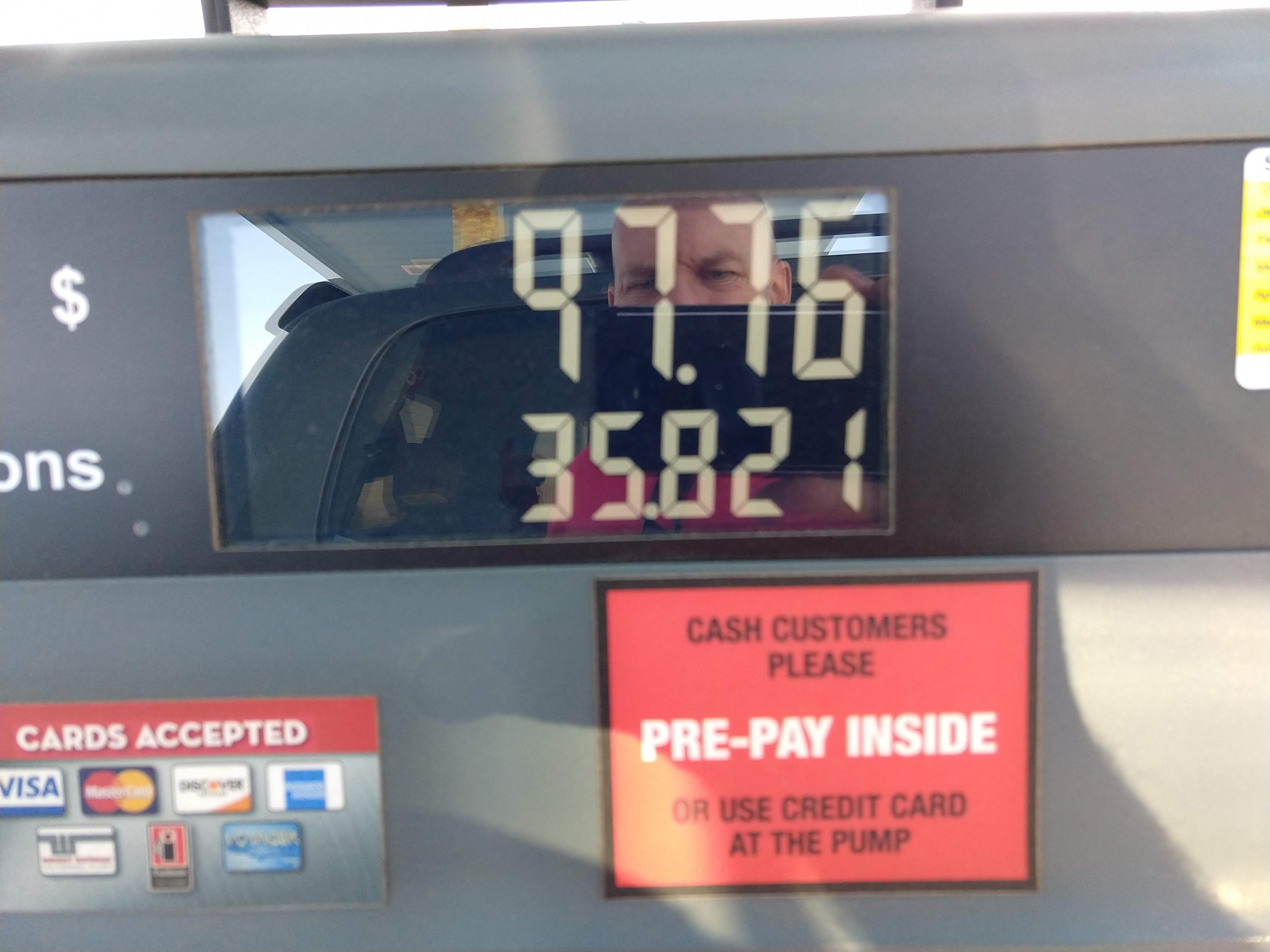


And the comforting view of extra range. :D

I have a few questions. First did you just use the factory fuel pump from the S-10 tank hooked up to the Apexus switch? Please provide me with more information on the relay switch. I am also slightly unsure how the auxiliary tank has information on how full it is at the Apexus switch. I have ordered the programmable switch and I have found a s10 tank with internals. I also have an additional fill line for a land cruiser as well as an additional entire land cruiser tank. Could I use those factory Toyota parts in the s10 tank?
 
Back
Top Bottom