



Hey gang,
So I'm a at very best. I know some of the basic things to look out for. Got a few solid mods that are providing me with a very stable rig.
Lately, I'd been noticing higher engine temperatures (UltraGauge digital readout was giving me idle between 205-210F). I was reading through posts, noticing others with well-maintained cooling systems or at least properly-functioning ones who would see 185-195, with absolute max load (towing 2-ton boat up 4 miles of 7 degree incline at 60+MPH, for example) reaching 205 tops, where I didn't even dare try towing a trailer for my recent move from PA to CO since it had been reaching 205, down to around 200 while cruising even with increased airflow.
Several months prior to this writing, I took a fan clutch from a '94 to swap into my '96 (didn't want to bother unless it was an Aisin) and relubricated the viscous coupling to a higher CST (viscosity) in order to improve radiator fan performance. My fan has since been blowing a cyclone right from start-up. Turns out, while the mod worked, it made little difference due to how badly gummed/silted my coolant lines/radiator were. My suspicion is that this engine was at first running Toyota red coolant, then wasn't properly flushed before green was added. The resulting sludge has been sloshing around in there ever since.
I was getting tired of seeing 205+ on the gauge, knowing the extra 15-20 degrees was just doing that much more damage than necessary. So, I caved and pretty much bought new parts for the whole system: water pump, thermostat/gasket, PHH, new clamps for all hoses. I didn't buy any hoses, as mine were actually in really good shape. The only hose I wound up having to mess with was the small hose running from above thermostat housing up to the cross pipe in front of the head. All I did was slice off the last 1/2" where the crack was and put it back on with new clamps. It's a tad taught, but no leaks so far.
I started by taking the hose off the lower passenger side (LHD) of the radiator and drained the coolant that way. Didn't bother to look for a drain bolt or something because it just takes too long to drain and you can't properly flush it. The coolant that poured out once I had separated the hose from the bit of pipe leading back to the second lower hose section was green-brown with red-ish silt that settled into a paste at the bottom of the bucket. After removing every piece of hose from the system (yes, including the PHH in the rear of the block, more later), I ran a garden hose into the radiator and flushed until the black carbon-y silt-y crap stopped flowing out. I put the hose in the inlet on the side of the radiator opposite the cap: yep, more black crud. I hate to think of how much of this stuff gets left behind, even with a thorough flush.
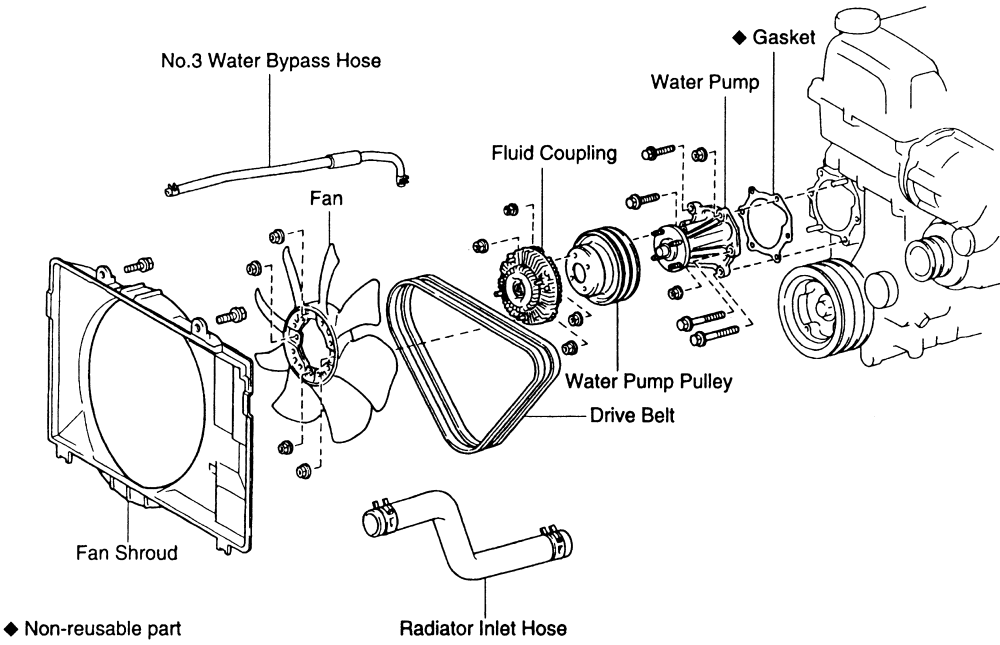
I then proceeded to loosen the fan clutch from the water pump pulley. This is best done BEFORE you loosen the tensioner on the belts (mathematics, dummy, look it up ). By removing the top 2 bolts on the fan shroud and pulling it back toward the block, you can squeeze the fan+coupling right out the gap created. Then, loosen the tensioner, remove the belts, and remove the pully, exposing the pump. Go around the pump loosening the bolts/nuts. The top and bottom are nuts on studs that make mounting of the water pump easier. The PS bolts are shorter, the DS bolts are longer. More coolant will rush out when you crack the (probably tightly-caked) seal between the pump and gasket. Remove the gasket by either prying underneath an edge with a fingernail or carefully with a pick being careful not to scratch the mating surface underneath.
The new pump I got (<a href="http://http://www.lowrangeoffroad.c...xus-lx450-4-5l-1fz-fe-water-pump-wpt-023.html">Aisin Water Pump</a> is the one I got from Low Range Offroad, $70 with shipping) needed to be conditioned face down in water (<a href="http://aisinaftermarket.com/uploads/ih0gsn5d_1254516150_en.pdf">Handling Instructions</a>). I was sure NOT to clock the pump fins before installation. To install the new pump, I just lined the gasket up to match the mating surface shape, slid it on the pegs, slid the bolts in, and tightened each in succession bit by bit till they were all tight. I just hand-tightened with a small socket wrench till they wouldn't turn anymore. You do not need to use a sealant or gasket maker substance for this. The metal gasket works fine. No leaks so far! It helps to attach the supplied studs into the fan-side of the pump before installation. Reattach your pulley/belts (helps to get the belts on the pulley, reattach the fan, then tighten the tensioner.) Reattach the fan shroud bolts.

Next, I moved on to the thermostat (<a href"http://shop.cruiserparts.net/index.php?main_page=product_info&cPath=6_30_233&products_id=34273">Cruiserparts.net Thermostat</a>. I was expecting this one to be in the pain in the a$$ - small nightmare category, but it was surprisingly easy. The three nuts shown above came right off, the tube housing/inlet came apart with a touch, and the old thermostat fell right out. After applying the gasket to the new thermostat, it slid right into the housing. I reattached the inlet pipe and tightened the nuts back onto the studs. 10 minutes, tops.


Finally, after steeling myself with a cold beer and a quick cry
  I got down to the PHH (<a href"http://www.phhkit.com/">PHH Kit</a>). There are dozens of write-ups about the PHH, replacement methods, best practices, bla bla bla. The two images above show the location and view of the pipe and block nipple from the front, DS wheel well. I did mine without even having to loosen the upper pipe bracket. I removed the PS front wheel and set the axle on a stand and then removed the rear and middle mud skirts to the right of the shock strut. I scooted my butt (legs under the truck) into the wheel well and found a way that I could reach either hand (not both at the same time) up and into the beast's cave. I have meaty bear-arms and ham-hands and I managed, after an hour of cursing, sweating and existential uncertainty, to reach in with a pair of needle-nose vice grips (seriously, couldn't have done this without them) and pry the clamps off the old, cracked, lime-scaled, crusty PHH. The outer one was flimsier and I just ripped it off with enough twists. I slid the other one up onto the metal pipe above the bit of hose. I yanked on the metal pipe till the hose cam off the block nipple a tad, then just started cutting the sucker till it came off easily. I then removed the old clamp. At this point, the pipe had been slightly bent outward by my yanking on it, so it did not quite line up with the nipple. This turned out to be a blessing. I greased up the new PHH (I really hope it lasts a million miles...) and slid it onto the pipe all the way till the back end of the hose was close to flush with the pipe end. After putting the new clamps on and tucking them up out of the way, I slid a framing hammer up in there and sort of lined up the pipe so it rested right in the nail grabber and just tapped at the other end with a BFH till it bent that little bit of the way back into alignment. Then, I slid the hose off the pipe and onto the nipple and secured the new clamps on either end. I didn't take any pictures, but like I said, for greater detail and more photos, www.sleeoffroad.com has a bunch of compiled write-ups as well as more images/angles, and there are dozens of them here on mud.
After cleaning all the hoses with dish soap and water as much as I could (some were pretty scaly inside, but no cracks visible), I replaced them all with new clamps from Autozone (<a href"http://www.autozone.com/autozone/ac...-257r?itemIdentifier=268425&_requestid=782755">Hose Clamps</a>). I refilled the radiator, and started the engine. Once it was up to operating temperature, it got pretty good and hot while pressure built and air was released from the system. Once the air had bled off and the system was pulling water, the temperature at idle dropped to 190, down from 205 degrees at idle. I flushed this water after driving approximately 100 miles over a day or so with the rear heater and AC/heat running in an attempt to flush every part of the system out fully. This yielded yet more black sludge and red coppery paste.
So now I'm wondering: how many more times should I flush this bad boy out? It seems like I still get a lot of coolant-color liquid coming out. Exactly how much of the total volume of the system are you even able to access with just radiator/pipe flushing? Am I missing something? Since I will have filled this thing up so thoroughly with tap water after these flushes, what should I do about getting coolant up to the proper proportions (close to 50/50)? Not to mention, how do I fully remove mineral-y tap water from the system once I'm done filling and flushing to run pure, distilled water/coolant?
Next step: JDM 14" aux fan mod. It's a process...
P.S. I tried to create text links in here, but the preview didn't display them properly. They're still in there if they don't post properly.
P.P.S. I also tried to attach pictures right from my desktop and show them in the body of the post, but they didn't preview properly either. Look at the attachments if they don't show up okay.
So I'm a
at very best. I know some of the basic things to look out for. Got a few solid mods that are providing me with a very stable rig.Lately, I'd been noticing higher engine temperatures (UltraGauge digital readout was giving me idle between 205-210F). I was reading through posts, noticing others with well-maintained cooling systems or at least properly-functioning ones who would see 185-195, with absolute max load (towing 2-ton boat up 4 miles of 7 degree incline at 60+MPH, for example) reaching 205 tops, where I didn't even dare try towing a trailer for my recent move from PA to CO since it had been reaching 205, down to around 200 while cruising even with increased airflow.
Several months prior to this writing, I took a fan clutch from a '94 to swap into my '96 (didn't want to bother unless it was an Aisin) and relubricated the viscous coupling to a higher CST (viscosity) in order to improve radiator fan performance. My fan has since been blowing a cyclone right from start-up. Turns out, while the mod worked, it made little difference due to how badly gummed/silted my coolant lines/radiator were. My suspicion is that this engine was at first running Toyota red coolant, then wasn't properly flushed before green was added. The resulting sludge has been sloshing around in there ever since.
I was getting tired of seeing 205+ on the gauge, knowing the extra 15-20 degrees was just doing that much more damage than necessary. So, I caved and pretty much bought new parts for the whole system: water pump, thermostat/gasket, PHH, new clamps for all hoses. I didn't buy any hoses, as mine were actually in really good shape. The only hose I wound up having to mess with was the small hose running from above thermostat housing up to the cross pipe in front of the head. All I did was slice off the last 1/2" where the crack was and put it back on with new clamps. It's a tad taught, but no leaks so far.
I started by taking the hose off the lower passenger side (LHD) of the radiator and drained the coolant that way. Didn't bother to look for a drain bolt or something because it just takes too long to drain and you can't properly flush it. The coolant that poured out once I had separated the hose from the bit of pipe leading back to the second lower hose section was green-brown with red-ish silt that settled into a paste at the bottom of the bucket. After removing every piece of hose from the system (yes, including the PHH in the rear of the block, more later), I ran a garden hose into the radiator and flushed until the black carbon-y silt-y crap stopped flowing out. I put the hose in the inlet on the side of the radiator opposite the cap: yep, more black crud. I hate to think of how much of this stuff gets left behind, even with a thorough flush.
I then proceeded to loosen the fan clutch from the water pump pulley. This is best done BEFORE you loosen the tensioner on the belts (mathematics, dummy, look it up
). By removing the top 2 bolts on the fan shroud and pulling it back toward the block, you can squeeze the fan+coupling right out the gap created. Then, loosen the tensioner, remove the belts, and remove the pully, exposing the pump. Go around the pump loosening the bolts/nuts. The top and bottom are nuts on studs that make mounting of the water pump easier. The PS bolts are shorter, the DS bolts are longer. More coolant will rush out when you crack the (probably tightly-caked) seal between the pump and gasket. Remove the gasket by either prying underneath an edge with a fingernail or carefully with a pick being careful not to scratch the mating surface underneath.The new pump I got (<a href="http://http://www.lowrangeoffroad.c...xus-lx450-4-5l-1fz-fe-water-pump-wpt-023.html">Aisin Water Pump</a> is the one I got from Low Range Offroad, $70 with shipping) needed to be conditioned face down in water (<a href="http://aisinaftermarket.com/uploads/ih0gsn5d_1254516150_en.pdf">Handling Instructions</a>). I was sure NOT to clock the pump fins before installation. To install the new pump, I just lined the gasket up to match the mating surface shape, slid it on the pegs, slid the bolts in, and tightened each in succession bit by bit till they were all tight. I just hand-tightened with a small socket wrench till they wouldn't turn anymore. You do not need to use a sealant or gasket maker substance for this. The metal gasket works fine. No leaks so far!
It helps to attach the supplied studs into the fan-side of the pump before installation. Reattach your pulley/belts (helps to get the belts on the pulley, reattach the fan, then tighten the tensioner.) Reattach the fan shroud bolts.Next, I moved on to the thermostat (<a href"http://shop.cruiserparts.net/index.php?main_page=product_info&cPath=6_30_233&products_id=34273">Cruiserparts.net Thermostat</a>. I was expecting this one to be in the pain in the a$$ - small nightmare category, but it was surprisingly easy. The three nuts shown above came right off, the tube housing/inlet came apart with a touch, and the old thermostat fell right out. After applying the gasket to the new thermostat, it slid right into the housing. I reattached the inlet pipe and tightened the nuts back onto the studs. 10 minutes, tops.
Finally, after steeling myself with a cold beer
and a quick cry I got down to the PHH (<a href"http://www.phhkit.com/">PHH Kit</a>). There are dozens of write-ups about the PHH, replacement methods, best practices, bla bla bla. The two images above show the location and view of the pipe and block nipple from the front, DS wheel well. I did mine without even having to loosen the upper pipe bracket. I removed the PS front wheel and set the axle on a stand and then removed the rear and middle mud skirts to the right of the shock strut. I scooted my butt (legs under the truck) into the wheel well and found a way that I could reach either hand (not both at the same time) up and into the beast's cave. I have meaty bear-arms and ham-hands and I managed, after an hour of cursing, sweating and existential uncertainty, to reach in with a pair of needle-nose vice grips (seriously, couldn't have done this without them) and pry the clamps off the old, cracked, lime-scaled, crusty PHH. The outer one was flimsier and I just ripped it off with enough twists. I slid the other one up onto the metal pipe above the bit of hose. I yanked on the metal pipe till the hose cam off the block nipple a tad, then just started cutting the sucker till it came off easily. I then removed the old clamp. At this point, the pipe had been slightly bent outward by my yanking on it, so it did not quite line up with the nipple. This turned out to be a blessing. I greased up the new PHH (I really hope it lasts a million miles...) and slid it onto the pipe all the way till the back end of the hose was close to flush with the pipe end. After putting the new clamps on and tucking them up out of the way, I slid a framing hammer up in there and sort of lined up the pipe so it rested right in the nail grabber and just tapped at the other end with a BFH till it bent that little bit of the way back into alignment. Then, I slid the hose off the pipe and onto the nipple and secured the new clamps on either end. I didn't take any pictures, but like I said, for greater detail and more photos, www.sleeoffroad.com has a bunch of compiled write-ups as well as more images/angles, and there are dozens of them here on mud.After cleaning all the hoses with dish soap and water as much as I could (some were pretty scaly inside, but no cracks visible), I replaced them all with new clamps from Autozone (<a href"http://www.autozone.com/autozone/ac...-257r?itemIdentifier=268425&_requestid=782755">Hose Clamps</a>). I refilled the radiator, and started the engine. Once it was up to operating temperature, it got pretty good and hot while pressure built and air was released from the system. Once the air had bled off and the system was pulling water, the temperature at idle dropped to 190, down from 205 degrees at idle. I flushed this water after driving approximately 100 miles over a day or so with the rear heater and AC/heat running in an attempt to flush every part of the system out fully. This yielded yet more black sludge and red coppery paste.
So now I'm wondering: how many more times should I flush this bad boy out? It seems like I still get a lot of coolant-color liquid coming out. Exactly how much of the total volume of the system are you even able to access with just radiator/pipe flushing? Am I missing something? Since I will have filled this thing up so thoroughly with tap water after these flushes, what should I do about getting coolant up to the proper proportions (close to 50/50)? Not to mention, how do I fully remove mineral-y tap water from the system once I'm done filling and flushing to run pure, distilled water/coolant?
Next step: JDM 14" aux fan mod. It's a process...
P.S. I tried to create text links in here, but the preview didn't display them properly. They're still in there if they don't post properly.
P.P.S. I also tried to attach pictures right from my desktop and show them in the body of the post, but they didn't preview properly either. Look at the attachments if they don't show up okay.

