

bad vibrations all of a sudden

This site may earn a commission from merchant affiliate
links, including eBay, Amazon, Skimlinks, and others.

Joined
Mar 27, 2003
Threads
385
Messages
21,383
Location
Groveland MA
Website
landtankproducts.com
Last week while travelling for work I suddenly started to get a low groan and some bad vibrations.

It came on all of a sudden and it took me a bit to figure it out. It seemed to be coming from the heater fan. I called Dan for a new one and it will arrive on Wednesday.

This morning I pulled the fan only to find it full of what looks like pink insulation. Pleasantly surprised that it was a simple fix I decided to remove the cage and wash out the 10 years of dirt on it before replacing the fan.

I removed the retainer clamp but the cage wouldn't budge. So I decided a little persuasion with a hammer was in order and tapped out the shaft. What I didn't realise is that there is a sort of locking tab on the cage that holds it in position on the shaft and the clamp is only a secondary measure to ensure the locking tab doesn't fail. Once the cage was off I realised that not only did I remove the cage but drove the amateur out the rear of the fan housing.

Easy diagnosis, unfortunately the patient died.

If you have diminished heating of cooling you might look into cleaning the cage as mine was fairly dirty. The fan cover comes off with 2 Philips screws and the fan itself is held in with 3 slotted torx screws. About 5 minutes to remove from the housing.


You win some, you loose some and then there are those times you're just a F'n idiot!
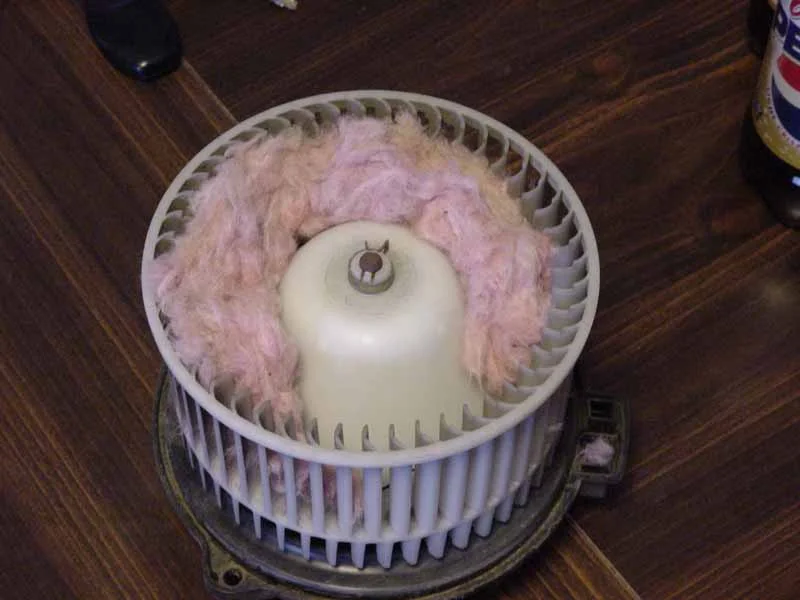
fan.webp
 
Mice.
 
put out some traps, *not* poison...

not fun to try and find a rotting mouse some place under the dash...
 
landtank said:
There was a batt of pink insulation in the garage for about a week and a half a while back. Not sure how that critter could get inside but must have.

No heat for me until Wednesday.


The little bastids can go anyplace they can get their head through.

I'm sorry we did not communicate better when you placed the order, otherwise you would have had it already..:frown:
 
Wow, that's quite the efficient airflow stopper! Guess the sounds were simply the dramatic change in air flow, or was it Mr. Mouse complaining about the "Tilt - a - Whirl"?

DougM
 
eh, that thing looks like the squirrel cage that powers the 91s and 92s!


:D
 
My wife noticed a nasty smell coming from under the bonnet of her car. I looked a couple of times and couldn't find anything. She finally got fed up and drug me out to the garage insisting there was something dead in her car. Somehow a mouse had built a nest between the engine and the transmission. You couldn't see him but you could see a piece of grass he used for the nest.

Got out the shop vac and dove in the engine bay, probing around with the vacuum hose. After a few minutes you could hear the unmistakeable "swhooop" as he was dislodged and sucked into the canister.

Upon inspection, he was about 12" long and veeeery skinny. Nasty smell. Traps got put into several spots in the garage and get inspected regularly now. Caught 2 so far. As for traps, the D-Con round cylinders are working for me. Kinda expensive but makes a neat package. Tried those sticky pads one time... sheesh, what a mess.

-B-
 
:eek: I looked around the web for ya thinking there would be minor warnings about inhaled fiberglass insulation .. most spoke of minr irritation to eyes, sinuses etc. But one site sounds pretty alarmist:
When these fibers are inhaled they can make small cuts in the sinuses or throat, causing respiratory tract irritation. Since all residential batt insulations are coated with a formaldehyde based resin, this resin is in contact with the cut, resulting in further irritation. If very many of these resin coated fibers get into the air and are inhaled, they can cause severe problems.

A case in point involves a Rhode Island family: Stan and Eunice Kozikowski and their two children. In 1986 they were having some work done on an air conditioning system in their attic. During the construction process, workmen disturbed the existing fiberglass insulation. When an attic mounted whole house fan was turned on, fiberglass particles were blown throughout the house through an open attic hatch. All four family members suffered eye, ear, skin and respiratory irritation almost immediately. While a thorough cleanup removed most of the particles of insulation, it was impossible to remove it all from such things as carpet, upholstery and clothing.

As time passed, a wide variety of symptoms appeared, including: conjunctivitis, dermatitis, intestinal and urilogical disorders, immunological imbalances, chronic chemical sensitization, heart irregularities with accompanying chest pain, acute nervous teeth causing temporal mandibular joint syndrome, acute sinus headaches, migrain headaches, tracheitis, tonsillitis, sinusitis, tachycardia, acute eczema and psoriasis, acute depression, anxiety, and tension.

Because of this family's acute exposure, they are now very sensitive to a wide variety of commonly encountered chemicals such as artificial fragrances. This has resulted in severe restrictions and means that their lives will never be the same again.

Fiberglass may also be capable of causing lung cancer in the same way that asbestos does. Workers first exposed over 30 years ago to man-made mineral fibers have a slightly higher incidence of lung cancer than the general population. The cancer causing ability seems related to very small particle sizes. The fiber sizes found in most batt insulations are too large to be inhaled deeply into the lungs, however, blow-in fiberglass products may contain particles of similar size to asbestos fibers. These can be inhaled deeply into the lungs where they can lodge, possibly resulting in malignancy.

Ken Roberts, an Environmental Services Manager for Manville Corporation, a Denver based fiberglass insulation manufacturer, points out that when asbestos gets into the lungs, it remains unchanged, thus, it can cause damage during the entire life of the victim. On the other hand, he says that fiberglass is eventually dissolved by body fluids, thus it should be of less concern than asbestos. Richard Munson, head of Victims of Fiberglass, an Auburn, California group formed to make the public aware of the dangers of this material, believes that this should cause more concern. Munson claims that when fiberglass dissolves in the lungs, the "decomposition produces silicic acid which is a cytotoxin." Cytotoxins kill living cells.


TY
 
That bed could have been made by a mouse - but a red squirrel will do the same thing in the fall of the year, so if the decon doesn't stop the "nest building" - either use a .22 to solve your problem or pull the cage every now and then for a quick peek. The 22 solved my heater problem a couple years ago but created a bigger hassle with the ole lady when I couldn't tell which of the 5 squirrels was the problem, so I clobbered all five and I'm still getting flack over it.
 
Back
Top Bottom