



I have had some folks express some interest in this dual battery alternative so I though I would do a brief write up. It was actually fairly simple and did not require any special order componets though I remember having to call around to find the red top 6vt Optimas.
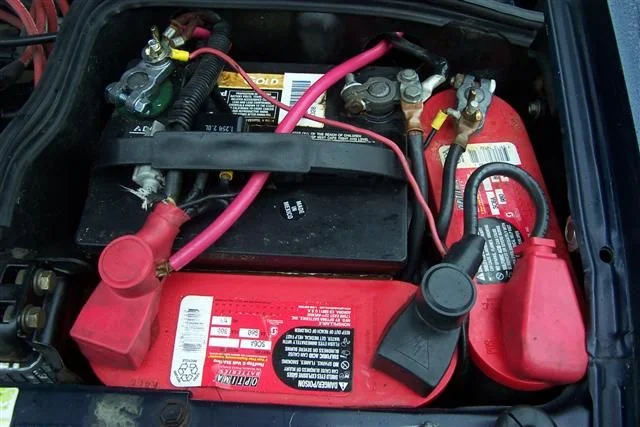
The first thing to do is to be sure on the dimensions with which you are working. My 12vt die-hard was 8" deep, 7" wide, and 9" long. It worked out that this allowed perfectly for the Optimas which were 3.5" inches wide and 9.5"long. The Optimas were only 7" deep which provided for their edges to fit under the grid support/fender lips.
I did do a small amount of custom fitting to the battery tray in one small spot with a razor knife(sorry I don't have pictures of this spot but it is fairly obvious as you are fitting). I also had to "adjust" one of the rubber insulated bolt heads that hold the radiator bracket (3 or 4 whacks with a hammer). After those two minor adjustments the batteries feel like they snap in with the edge of the Optimas fitting just ever so slightly under the metal grid support.
Dropping the 12vt in last prevents any movement of the Optimas or lateral movement of the 12vt. Connecting cables and snug fit will secure the 12vt from any vertical movement. You could rig up hold downs, but I chose not to since the set-up feels very tight and secure. Even if I did a Christo Slee rollover I believe that my batteries would not budge (I would have much bigger worries at that point anyhow).
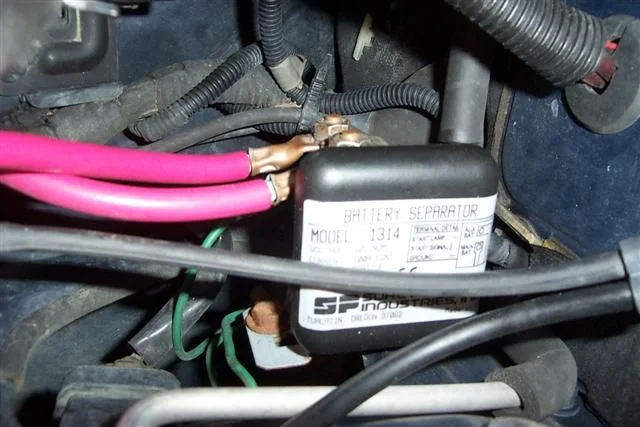
Wiring is pretty simple. Common ground between the 12vt and the Optimas as is apparent, but not obvious from the photo. Starting and stock charging functions are ran off of the postive of the Optimas. Also, a positive cable is ran from this terminal to the sure power battery seperator (model 1314) I bought from NAPA. Then another postive cable is ran from the other terminal on the battery seperator to the positive terminal on the auxillary 12vt battery.
The seperator contiually charges the Optimas (main battery), but as soon as they hit a certain voltage it closes (allows the batteries to connect) to also charge the auxillary battery until the two reach a certain voltage. If the main battery falls below a certain voltage level the seperator opens and the auxillary is no longer connected. The seperator continually goes between these these states until the ignition (charging) is turned off. When no current is present the system opens and the two batteries are disconnected.
There is a ground wire that must also be attached to the seperator, but the unit comes with thorough directions to explain how to hook it up. There are two terminals I have not used yet that I may employ at the time of my next upgrade. These other two terminals allow you to use a switch to manually connect the two batteries from the cab. You would do this if your starter battery failed or if you wanted extra power for starting in the cold or winching. Currently I have some compact jumper cables that suit this purpose .
So that is pretty much the long and the short of it. I will mention that at one point I lost solid connection between the two 6vts and had to tighten the link up even though it looked solid. Terminal covers are a very good idea with everything being so close. I eventually plan to move the seperator to beneath the battery tray and hook up the parallel switch when I upgrade the die-hard 12vt to an Odyssey dry cell(these operate as deep cycle or high cranking amps-there are other potential dual battery combinations through Odyssey that I have not yet explored). And finally, I puchased terminals and wiring from a marine shop though I am sure you could go elsewhere.

The first thing to do is to be sure on the dimensions with which you are working. My 12vt die-hard was 8" deep, 7" wide, and 9" long. It worked out that this allowed perfectly for the Optimas which were 3.5" inches wide and 9.5"long. The Optimas were only 7" deep which provided for their edges to fit under the grid support/fender lips.
I did do a small amount of custom fitting to the battery tray in one small spot with a razor knife(sorry I don't have pictures of this spot but it is fairly obvious as you are fitting). I also had to "adjust" one of the rubber insulated bolt heads that hold the radiator bracket (3 or 4 whacks with a hammer). After those two minor adjustments the batteries feel like they snap in with the edge of the Optimas fitting just ever so slightly under the metal grid support.
Dropping the 12vt in last prevents any movement of the Optimas or lateral movement of the 12vt. Connecting cables and snug fit will secure the 12vt from any vertical movement. You could rig up hold downs, but I chose not to since the set-up feels very tight and secure. Even if I did a Christo Slee rollover I believe that my batteries would not budge (I would have much bigger worries at that point anyhow).
Wiring is pretty simple. Common ground between the 12vt and the Optimas as is apparent, but not obvious from the photo. Starting and stock charging functions are ran off of the postive of the Optimas. Also, a positive cable is ran from this terminal to the sure power battery seperator (model 1314) I bought from NAPA. Then another postive cable is ran from the other terminal on the battery seperator to the positive terminal on the auxillary 12vt battery.
The seperator contiually charges the Optimas (main battery), but as soon as they hit a certain voltage it closes (allows the batteries to connect) to also charge the auxillary battery until the two reach a certain voltage. If the main battery falls below a certain voltage level the seperator opens and the auxillary is no longer connected. The seperator continually goes between these these states until the ignition (charging) is turned off. When no current is present the system opens and the two batteries are disconnected.
There is a ground wire that must also be attached to the seperator, but the unit comes with thorough directions to explain how to hook it up. There are two terminals I have not used yet that I may employ at the time of my next upgrade. These other two terminals allow you to use a switch to manually connect the two batteries from the cab. You would do this if your starter battery failed or if you wanted extra power for starting in the cold or winching. Currently I have some compact jumper cables that suit this purpose
.So that is pretty much the long and the short of it. I will mention that at one point I lost solid connection between the two 6vts and had to tighten the link up even though it looked solid. Terminal covers are a very good idea with everything being so close. I eventually plan to move the seperator to beneath the battery tray and hook up the parallel switch when I upgrade the die-hard 12vt to an Odyssey dry cell(these operate as deep cycle or high cranking amps-there are other potential dual battery combinations through Odyssey that I have not yet explored). And finally, I puchased terminals and wiring from a marine shop though I am sure you could go elsewhere.
Last edited:


