


- Joined
- May 8, 2008
- Threads
- 2,177
- Messages
- 2,177
If you've ever launched a boat at Flaming Gorge, cast a line into the Green River, or watched the sun set over those rust-red canyon walls, recent news should stop you cold.
The Interior Department has begun sending billions of gallons of water from Flaming Gorge Reservoir downstream to prop up Lake Powell's low water levels, and the scale of what's coming is staggering. DOI is proposing to draw down as much as one million acre-feet — a full third of the water in Flaming Gorge — to keep Powell stable, because the reservoir is getting so low that officials fear it could stop generating hydropower by August.
This isn't a distant policy debate. It's happening right now, at a place you know and love.
This isn't even the first time. The Interior Department released half a million acre-feet from Flaming Gorge in 2022, but this year's releases could reach double that amount. We keep coming back to the same emergency, draining the same reservoir, buying ourselves a little more time before the next crisis. But we could be out of time. If we have back to back weak winters with low snowpack, the emergency actions taken this year will lead to a system-wide failure next year. There won't be any more backup plans to bail us out.
The Consequences Are Already Here
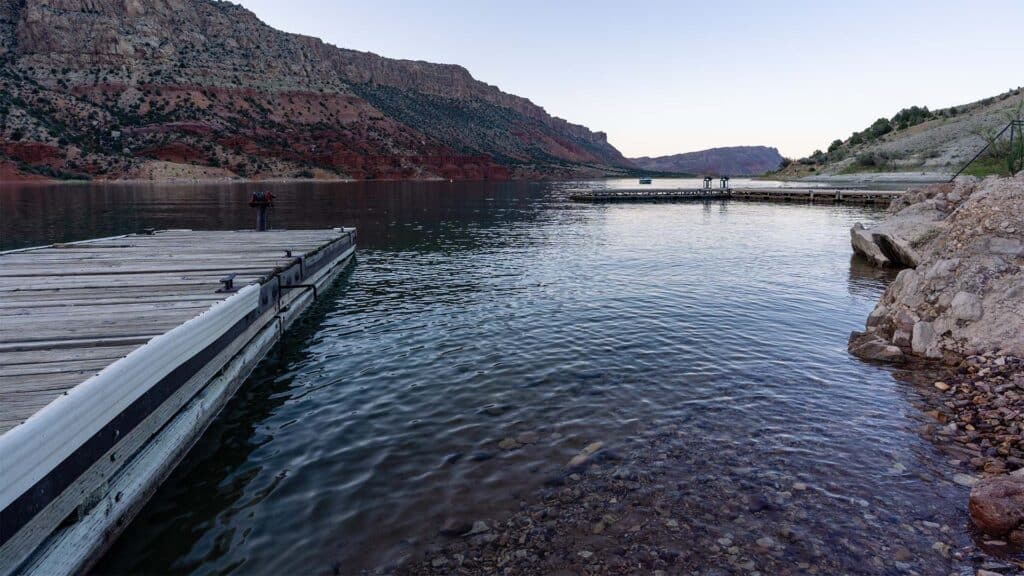
Wyoming water commissioner Brandon Gebhart stated that this year's draining will likely close three of five boat ramps at Flaming Gorge and hurt local fish as the water recedes. In his own words: "What we are approving…will have significant negative impacts on our water resources, local economies and recreation both this year and for years to come."
Think about what that means for the outfitters, guides, marina operators, and gateway businesses that depend on a full reservoir. Think about the families who planned their summer around Flaming Gorge. Think about the anglers who drive hours for a shot at the trophy trout that thrive in cold, deep water.
The Interior Department has acknowledged that at upstream reservoirs, boating access may be reduced earlier in the season than normal, Grand Canyon rafting conditions will be affected, and fishing will be more challenging. The recreation economy of the entire Colorado River Basin is taking the hit so a broken system can limp along a little longer. And even after these extraordinary measures, almost all boat launches at Lake Powell will be unavailable this year.
Rationing Scarcity Isn't Working
The four upper basin states — Colorado, Wyoming, Utah, and New Mexico — remain at an impasse with California, Nevada, and Arizona over how to share and conserve the dwindling waterway. The upper basin states are using the dire situation at Lake Powell to try to renew negotiations that have so far failed to produce a deal.
Colorado water commissioner Becky Mitchell put it plainly: "The upper basin is proud to be part of the solution, but we cannot be the entire solution."
She's right. And here's the hard truth: no amount of negotiating over how to divide a shrinking supply will fix a problem caused by insufficient supply. We've been managing decline for two decades. It isn't working.
There Is Another Way
The Colorado River Abundance Act proposes a fundamental shift in strategy. Released by the BlueRibbon Coalition in January 2026, the Act aims to stabilize the Western water system by delivering up to 7 million acre-feet of new supply through next-generation desalination, water recycling, and the infrastructure needed to move that water into key diversion points of the Colorado River system.
The Act establishes the Colorado River Abundance Fund, authorized at $40 billion over a decade, and enables long-term public-private partnerships to design, build, finance, and operate the necessary facilities. Instead of forcing states into zero-sum fights over shrinking shares, it aims to reduce pressure on the natural system and create room for everyone to win.
The legislation includes specific safeguards to prevent catastrophic drawdown at Lake Powell and Lake Mead, protect low-cost hydropower relied upon by millions across the West, and maintain functional recreation access that supports tourism economies and rural communities.
That last point matters enormously to anyone who uses Flaming Gorge, Lake Powell, or the rivers that connect them. Recreation access isn't an afterthought in this proposal — it's a stated goal.
What You Can Do
The post-2026 operating guidelines for the Colorado River are being finalized right now. Reclamation plans to finalize a post-2026 operational plan by October 1, 2026, and Congress is actively weighing what role it will play. The predictions for water stability are on a knife's edge, and bold action will be necessary. The window to shape this outcome is open, but it won't stay open long.
If you fish, boat, camp, or simply care about the future of the West's most important river system, your voice matters. Contact your senators and representatives and tell them you support the Colorado River Abundance Act. Tell them that draining Flaming Gorge every few years is not a plan. Tell them the West deserves better than managed decline.
The reservoir you love is sending its water downstream because we've run out of other options. The Colorado River Abundance Act is about making sure that we actually have the option of choosing abundance for our future instead of settling for water scarcity.
Fill out the form here to urge your representatives to back the Act before the October deadline!
The BlueRibbon Coalition has advocated for recreation access on public lands since 1987. For more information on the Colorado River Abundance Act, visit coloradoriverabundanceact.com.
Continue reading...
The Interior Department has begun sending billions of gallons of water from Flaming Gorge Reservoir downstream to prop up Lake Powell's low water levels, and the scale of what's coming is staggering. DOI is proposing to draw down as much as one million acre-feet — a full third of the water in Flaming Gorge — to keep Powell stable, because the reservoir is getting so low that officials fear it could stop generating hydropower by August.
This isn't a distant policy debate. It's happening right now, at a place you know and love.
This isn't even the first time. The Interior Department released half a million acre-feet from Flaming Gorge in 2022, but this year's releases could reach double that amount. We keep coming back to the same emergency, draining the same reservoir, buying ourselves a little more time before the next crisis. But we could be out of time. If we have back to back weak winters with low snowpack, the emergency actions taken this year will lead to a system-wide failure next year. There won't be any more backup plans to bail us out.
The Consequences Are Already Here
Wyoming water commissioner Brandon Gebhart stated that this year's draining will likely close three of five boat ramps at Flaming Gorge and hurt local fish as the water recedes. In his own words: "What we are approving…will have significant negative impacts on our water resources, local economies and recreation both this year and for years to come."
Think about what that means for the outfitters, guides, marina operators, and gateway businesses that depend on a full reservoir. Think about the families who planned their summer around Flaming Gorge. Think about the anglers who drive hours for a shot at the trophy trout that thrive in cold, deep water.
The Interior Department has acknowledged that at upstream reservoirs, boating access may be reduced earlier in the season than normal, Grand Canyon rafting conditions will be affected, and fishing will be more challenging. The recreation economy of the entire Colorado River Basin is taking the hit so a broken system can limp along a little longer. And even after these extraordinary measures, almost all boat launches at Lake Powell will be unavailable this year.
Rationing Scarcity Isn't Working
The four upper basin states — Colorado, Wyoming, Utah, and New Mexico — remain at an impasse with California, Nevada, and Arizona over how to share and conserve the dwindling waterway. The upper basin states are using the dire situation at Lake Powell to try to renew negotiations that have so far failed to produce a deal.
Colorado water commissioner Becky Mitchell put it plainly: "The upper basin is proud to be part of the solution, but we cannot be the entire solution."
She's right. And here's the hard truth: no amount of negotiating over how to divide a shrinking supply will fix a problem caused by insufficient supply. We've been managing decline for two decades. It isn't working.
There Is Another Way
The Colorado River Abundance Act proposes a fundamental shift in strategy. Released by the BlueRibbon Coalition in January 2026, the Act aims to stabilize the Western water system by delivering up to 7 million acre-feet of new supply through next-generation desalination, water recycling, and the infrastructure needed to move that water into key diversion points of the Colorado River system.
The Act establishes the Colorado River Abundance Fund, authorized at $40 billion over a decade, and enables long-term public-private partnerships to design, build, finance, and operate the necessary facilities. Instead of forcing states into zero-sum fights over shrinking shares, it aims to reduce pressure on the natural system and create room for everyone to win.
The legislation includes specific safeguards to prevent catastrophic drawdown at Lake Powell and Lake Mead, protect low-cost hydropower relied upon by millions across the West, and maintain functional recreation access that supports tourism economies and rural communities.
That last point matters enormously to anyone who uses Flaming Gorge, Lake Powell, or the rivers that connect them. Recreation access isn't an afterthought in this proposal — it's a stated goal.
What You Can Do
The post-2026 operating guidelines for the Colorado River are being finalized right now. Reclamation plans to finalize a post-2026 operational plan by October 1, 2026, and Congress is actively weighing what role it will play. The predictions for water stability are on a knife's edge, and bold action will be necessary. The window to shape this outcome is open, but it won't stay open long.
If you fish, boat, camp, or simply care about the future of the West's most important river system, your voice matters. Contact your senators and representatives and tell them you support the Colorado River Abundance Act. Tell them that draining Flaming Gorge every few years is not a plan. Tell them the West deserves better than managed decline.
The reservoir you love is sending its water downstream because we've run out of other options. The Colorado River Abundance Act is about making sure that we actually have the option of choosing abundance for our future instead of settling for water scarcity.
Fill out the form here to urge your representatives to back the Act before the October deadline!
The BlueRibbon Coalition has advocated for recreation access on public lands since 1987. For more information on the Colorado River Abundance Act, visit coloradoriverabundanceact.com.
Continue reading...