Help with fuel sender

This site may earn a commission from merchant affiliate
links, including eBay, Amazon, Skimlinks, and others.

Joined
Jun 2, 2009
Threads
77
Messages
919
Location
NC
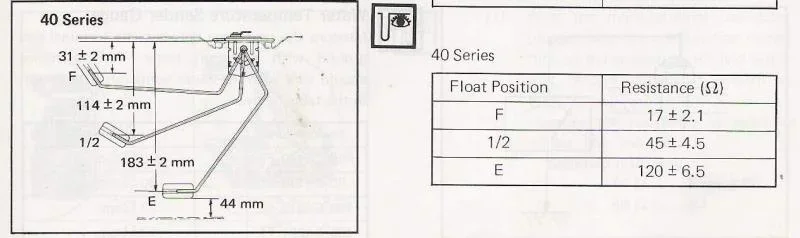
Does anyone have a fuel sender not installed, that works correctly, that they can do ohm checks for me? I know it's 17 full and 120 empty, but I need 33% and 66% to program the fuel gauge on my Dakota digital cluster. I tried to calculate it, but it's apparently not linear as my gauge was showing over 3/4 full and it was only half full. Help would be greatly appreciated!
 
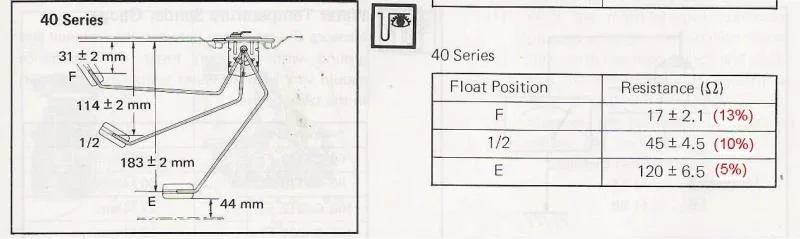
The half value is 45 ohm, which is almost half of (120-17)/2= 51.5 ohm.
But you're right. It's not linear.
The difference between Full and Half is 28 ohm and the difference between Half and Empty is 75 ohm.
Image-27crop.webp

Nice puzzle. Can't you take out your sender?
All the measurements are in the diagram.

Rudi
Image-27crop.webp
 
Trying to avoid ripping the seats, frames, and tank cover out if possible. I had fumes in the cab when I first got the 40 and got all that fixed, so I hate to risk ruining a good seal with the sender and tank. I may just have to buy one for a spare and measure that one, but I was hoping someone would have a sender and the time to do it. Thanks for the chart!
 
I have one out of my '77 that was replaced when I installed the new tank. The old one was working fine as far as I know. I might be able to set up a rig to measure resistance at all the marks you need - give me a day or so---
 
I have one out of my '77 that was replaced when I installed the new tank. The old one was working fine as far as I know. I might be able to set up a rig to measure resistance at all the marks you need - give me a day or so---

That would be great! Thanks!
 
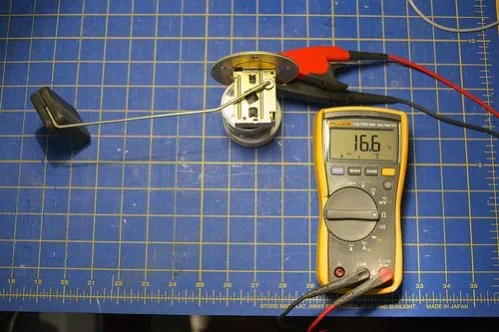
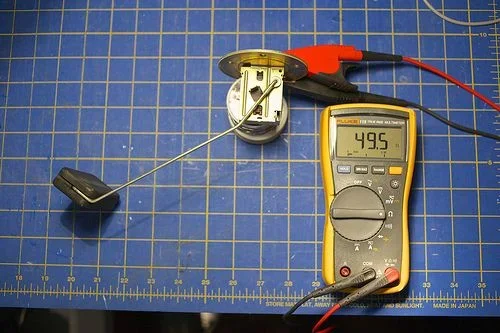
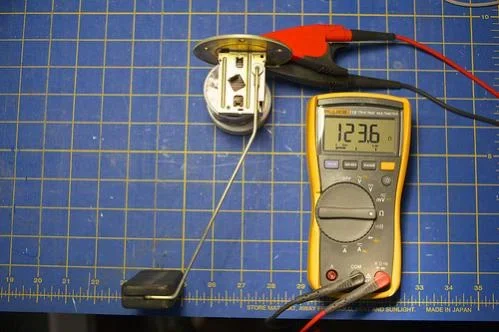
Here is how Mud member fj718 did his tests.
Maybe these pics are helpful.
mud_fj718_fuel_sender_full.webp

mud_fj718_fuel_sender_half.webp

mud_fj718_fuel_sender_empty.webp

Rudi
mud_fj718_fuel_sender_full.webp
mud_fj718_fuel_sender_half.webp
mud_fj718_fuel_sender_empty.webp
 
That's very helpful--the same setup I was going to try, just in smaller increments. ( the grid background makes it a lot easier}- That might help with the digital programming.(especially if it's not linear)
 
Last edited:
I did some math and came up with this:
F.......17
3/4....31
2/3....34
1/2....51.5 (not 45 as per the FSM)
1/3....69
1/4....86
E.......120

Interesting to see what your measurements come up with.

Rudi
 
Last edited:
Ok-here's the first chop at this--DO NOT USE just yet-these readings were taken with an analog VOM, so they are somewhat slushy. At least they may give an approximation of what you need. Tomorrow, I will have the sender set up in a more stable clamp structure and get some digi readings for the positions---interesting note here--if you turn this upsidedown, it looks almost exactly like the stone trajectory from a Trebuchet--
77 FJ40 tank vs sender resistance.webp
 
Last edited:
I did some math and came up with this: F.......17 3/4....31 2/3....34 1/2....51.5 (not 45 as per the FSM) 1/3....69 1/4....86 E.......120 Interesting to see what your measurements come up with. Rudi

Looking at Sggoat's chart, your numbers may not be far off!
 
Here's the results of today's testing-I mounted the sender on a wooden rail atop a plastic tub. Filled the tub until the sender just started registering changes in the resistance,(2 ozs. at a time when close) then took the 2 ozs back out--this was marked as the "Empty" level. Filled the container till the resistance stopped changing-marked as "full". Just divided the two levels into 1/16th increments-. Gradually filled container and took readings at each 1/16th inch; then siphoned the water back out to check and see if the readings were consistant(they were-within .6 ohms)
BTW the Green Food coloring is in deference to Rudi--
fuel sender test1.webp
fuel sender test2.webp
77 FJ40 tank vs sender resistance.webp
 
GREAT JOB Sggoat! :clap::clap::clap:

You really put a lot of time and energy in this.

I'm going to "steal" your graphic for future use if you don't mind.
I'm sure it will pop up one day in my "cluster" thread (with credits to you).

Rudi
 
am i crazy to think that the sender is just a potentiometer and there is a wiper and band inside? in the music world, there are linear and logorithmic pots. if the resistance doesnt change on a linear "curve", which i think has been proven, then i wonder if it follows the logorithmic curve of a guitar pot.

also sggoat, the float moves radially about the point of the wiper in the sender, but you are measuring the float linearly. does that mean the results would be the same? not doubting or debating, just curious...
 
A few years ago I opened one up because that sender had a bad contact inside. You could hear the slider making a rasping sound. BTW, it was an aftermarket sender.
It's just a stick wounded with resistor wire and a slider contact. Very, super, simple basic. And yes it should be linear. If it was logarithmic the graphic would go of the chart.
I blame it on the irregularity of the winding's and the size of the slider contact.
The slider contact is bigger than the distance between two winding's.

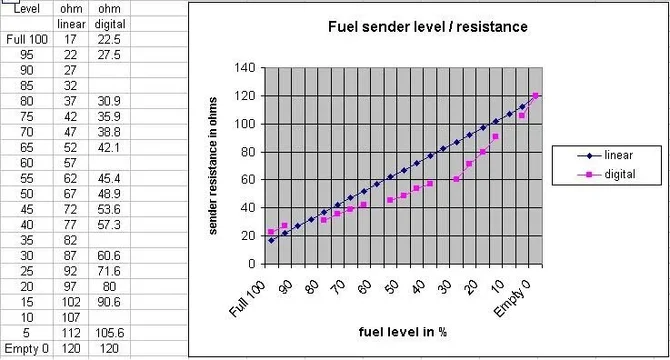
Here is a graphic for comparing the linear curve with the actual measurements from Sggoat. The gaps are due to the fact that the test was done in 1/16th increments and then converted in percentages which is difficult to comprehend for my metric brain. Just kidding.
The blue line is the "should be" characteristic. The purple line is the the actual resistance measured by Sggoat.
fuel sender resistance vs level.webp

Rudi
fuel sender resistance vs level.webp
 
I thought it would be a log plot, so I tried to duplicate what was in a fuel tank using the plastic container to eliminate the inherent error . The results show a little curve, I think. I think you are exactly right about the pot and wiper--I would have expected a more curved plot--sort of like a rope strung between two trees-half of the rope plot would approximate the curve of the sender--guess I was wrong a little on this.-the plot has a little curve to it, but not what I expected. The sender is OLD--ok, so maybe the thing is off. The fill numbers seemed to be very stable though; they didn't get too erratic til I started draining(seemed like a lot of side-to-side wiggle that affected the readings)--Even putting the siphon hose into the container seemed to affect the readings when I was doing the drain check.
Do you have any ideas about the linear vs logarithmic testing while I still have this rig set up? I can prob fab up what ever you like--might be some interesting data.
The sender seems to have some float side to-side irregularities--any idea how to eliminate? I can try to fix and test again----
 
i would be interested to see it measured in degrees rather than a linear measurement. say the arm of the float moves from 6 oclock (0deg) to 9oclock (90deg). you could draw angle increments on a piece of plexi with sharpie, or do this all in a 10gal fish tank and draw on the glass. i cant imagine the wiper in the sender is a linear device so i would think there is some error, perhaps tiny, in angles of the wiper vs your inches measurements.
 
I think that we going to far in this. The original idea was to get reference points for calibrating a new cluster.

A. The gauges in our clusters are (in my opinion) indicators. OIL high-low, FUEL empty-full and TEMP cold-hot. Not what you call "calibrated".

B. The senders are so simple and have such big tolerances that it is useless, in my opinion, to narrow it down.
Have a look at the tolerances from Mr.T. From 5% at Empty to 13% at Full.
Image-27crop%.webp

Rudi
Image-27crop%.webp
 
A friend of mine suggested this data could be imported into Microsoft Excel and converted to radians-he didn't know how(I've never done it either), it might give you the degree numbers you are looking for-I don't have a fish tank anyway). Sorry
Gary
 
Back
Top Bottom